Results by title
122 books match the query 'English poetry' and 4 start with w
What Became of Wystan?
Change and Continuity in Auden's PoetryAlan Jacobs
University of Arkansas Press, 1998
In this lucid and balanced treatise Alan Jacobs reveals the true parameters of Auden's change after the poet's move to America in 1939. By carefully examining poems that represent transitional moments in Auden's thinking, Jacobs identifies the points at which the tectonic plates of the poet's intellect clashed and the buckles and rifts these pressures caused in Auden's body of work.
[more]
What Is A Poet?
Hank Lazer
University of Alabama Press, 1987
This book discusses the extent of distrust and the extent of the misunderstandings that exist in the poetry world.
[more]

Wordsworth and the Green Romantics
Affect and Ecology in the Nineteenth CenturyLisa Ottum
University of New Hampshire Press, 2016
Situated at the intersection of ecocriticism, affect studies, and Romantic studies, this collection breaks new ground on the role of emotions in Western environmentalism. Recent scholarship highlights how traffic between Romantic-era literature and science helped to catalyze Green Romanticism. Closer to our own moment, the affective turn reflects similar cross-disciplinary collaboration, as many scholars now see the physiological phenomenon of affect as a force central to how we develop conscious attitudes and commitments. Together, these trends offer suggestive insights for the study of Green Romanticism.
[more]
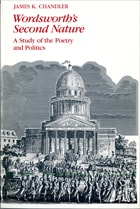
Wordsworth's Second Nature
A Study of the Poetry and PoliticsJames Chandler
University of Chicago Press, 1984
Wordsworth is England's greatest poet of the French Revolution: he witnessed some of its events first hand, participated in its intellectual and social ambitions, and eventually developed his celebrated poetic campaign in response to its enthusiasms. But how should that response be understood? Combining careful interpretive analysis with wide-ranging historical scholarship, Chandler presents a challenging new account of the political views implicit in Wordsworth's major works–in The Prelude, above all, but also in the central lyrics and shorter narrative poems.
Central to the discussion, which restores Wordsworth to both the French and English contexts in which he matured, is a consideration of his relation to Rousseau and Burke. Chandler maintains that by the time Wordsworth set forth his "program for poetry" in 1798, he had turned away from the Rousseauist idea of nature that had informed his early republican writings. He had already become a poet of what Burke called "second nature"–human nature cultivated by custom, habit, and tradition–and an opponent of the quest for first principles that his friend Coleridge could not forsake. In his analysis of the poetry, Chandler suggests that even Wordsworth's most apparently private moments, the lyrical "spots of time," ideologically embodied the uncalculated habits of an oral narrative discipline and a native English mind.
Central to the discussion, which restores Wordsworth to both the French and English contexts in which he matured, is a consideration of his relation to Rousseau and Burke. Chandler maintains that by the time Wordsworth set forth his "program for poetry" in 1798, he had turned away from the Rousseauist idea of nature that had informed his early republican writings. He had already become a poet of what Burke called "second nature"–human nature cultivated by custom, habit, and tradition–and an opponent of the quest for first principles that his friend Coleridge could not forsake. In his analysis of the poetry, Chandler suggests that even Wordsworth's most apparently private moments, the lyrical "spots of time," ideologically embodied the uncalculated habits of an oral narrative discipline and a native English mind.
[more]