Results by title
114 books match the query 'Enslaved persons' and 4 start with w
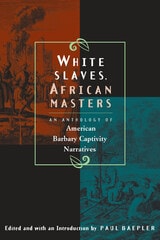
White Slaves, African Masters
An Anthology of American Barbary Captivity NarrativesEdited by Paul Baepler
University of Chicago Press, 1999
Though Barbary privateers began to seize North American colonists as early as 1625, Barbary captivity narratives did not begin to flourish until after the American Revolution. During these years, stories of Barbary captivity forced the U.S. government to pay humiliating tributes to African rulers, stimulated the drive to create the U.S. Navy, and brought on America's first post-revolutionary war. These tales also were used both to justify and to vilify slavery.
The accounts collected here range from the 1798 tale of John Foss, who was ransomed by Thomas Jefferson's administration for tribute totaling a sixth of the annual federal budget, to the story of Ion Perdicaris, whose (probably staged) abduction in Tangier in 1904 prompted Theodore Roosevelt to send warships to Morocco and inspired the 1975 film The Wind and the Lion. Also included is the unusual story of Robert Adams, a light-skinned African American who was abducted by Arabs and used by them to hunt negro slaves; captured by black villagers who presumed he was white; then was sold back to a group of Arabs, from whom he was ransomed by a British diplomat.
Long out of print and never before anthologized, these fascinating tales open an entirely new chapter of early American literary history, and shed new light on the more familiar genres of Indian captivity narrative and American slave narrative.
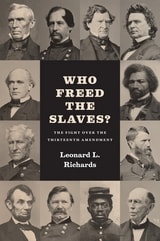
Who Freed the Slaves?
The Fight over the Thirteenth AmendmentLeonard L. Richards
University of Chicago Press, 2015
The real story, however, is much more complicated—and dramatic—than that. With Who Freed the Slaves?, distinguished historian Leonard L. Richards tells the little-known story of the battle over the Thirteenth Amendment, and of James Ashley, the unsung Ohio congressman who proposed the amendment and steered it to passage. Taking readers to the floor of Congress and the back rooms where deals were made, Richards brings to life the messy process of legislation—a process made all the more complicated by the bloody war and the deep-rooted fear of black emancipation. We watch as Ashley proposes, fine-tunes, and pushes the amendment even as Lincoln drags his feet, only coming aboard and providing crucial support at the last minute. Even as emancipation became the law of the land, Richards shows, its opponents were already regrouping, beginning what would become a decades-long—and largely successful—fight to limit the amendment’s impact.
Who Freed the Slaves? is a masterwork of American history, presenting a surprising, nuanced portrayal of a crucial moment for the nation, one whose effects are still being felt today.
Witnessing Slavery
The Development Of Ante-Bellum Slave NarrativesFrances Smith Foster
University of Wisconsin Press, 1994
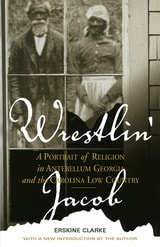
Wrestlin' Jacob
A Portrait of Religion in Antebellum Georgia and the Carolina Low CountryErskine Clarke
University of Alabama Press, 2000
Wrestling with God, scripture, and conscience in the nineteenth‑century South
First published in 1979, Wrestlin’ Jacob offers important insights into the intersection of black and white religious history in the South. Erskine Clarke provides two arenas—one urban and one rural—that show what happened when white ministers tried to bring black slaves into the fold of Christianity. Clarke illustrates how the good intentions—and vain illusions—of the white preachers, coupled with the degradation and cultural strength of the slaves, played a significant role in the development of black churches in the South.
From 1833 to 1847, Reverend Charles Colcock Jones served as an itinerant minister to slaves on the rice and cotton plantations in Liberty County, Georgia. The aim of Jones, and of the largely Puritan-descended slave owners, was to harvest not only good Christians but also obedient and hard-working slaves. At the same time, similar efforts were under way in cosmopolitan Charleston, South Carolina. Charleston permitted blacks to worship only under the supervision of whites, and partially as a result, whites and blacks worshiped together in ways that would be unheard of later in the segregated South.
Clarke examines not only the white ministers’ motivation in their missionary work but also the slaves’ reasons for becoming a part of the church. He addresses the important issue of the continuity of African traditions with the religious life of slaves and provides a significant introduction to the larger issues of slavery and religion in the South.