Results by title
177 books match the query 'Equality' and 8 start with w

Wanting Children
Family-Planning Policies and the Engineering of America’s PopulationLeonard M. Lopoo
University of Chicago Press, 2026
On the eugenic origins of US reproductive laws—and the surprising policy changes needed to remedy it.
The US government spends hundreds of millions of dollars every year to promote and facilitate contraception. Whereas other wealthy countries support broader fertility interventions under the banner of “family planning,” the United States remains committed only to helping Americans—and especially poorer Americans—plan not to have a family.
In an unflinching treatise on one of the century’s defining social issues, Leonard M. Lopoo shows how the US’s asymmetric reproductive approach is a vestige of the country’s earlier sins: America’s first reproductive policies were authored by some of the twentieth century’s most prominent eugenicists, a group whose primary goal was birth prevention among lower economic classes and racial minorities. These origins have consequently created a contradictory position for the country today, in which contraception for the lowest-income Americans is subsidized, while many upper-class Americans employ technologies to have children with preferable traits.
Lopoo recasts this personal and politicized topic in elegant, stark terms. If the United States is to legislate reproduction, the only defensible approach is equity: helping people who want children to have children. Wanting Children posits a new and elevating criterion for how we think about fertility in the twenty-first century.

Warriors for Social Justice and Equality
Maria Jimenez of Houston and Mexican American ActivismLinda J. Quintanilla
University of North Texas Press, 2025
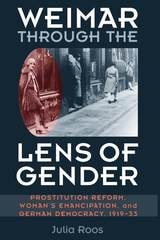
Weimar through the Lens of Gender
Prostitution Reform, Woman's Emancipation, and German Democracy, 1919-33Julia Roos
University of Michigan Press, 2010
"This book will make a valuable contribution to the field of German history, as well as the histories of gender and sexuality. The argument that Weimar feminism did bring about tangible gains for women needs to be made, and Roos has done so convincingly."
---Julia Sneeringer, Queens College
Until 1927, Germany had a system of state-regulated prostitution, under which only those prostitutes who submitted to regular health checks and numerous other restrictions on their personal freedom were tolerated by the police. Male clients of prostitutes were not subject to any controls. The decriminalization of prostitution in 1927 resulted from important postwar gains in women's rights; yet this change---while welcomed by feminists, Social Democrats, and liberals—also mobilized powerful conservative resistance. In the early 1930s, the right-wing backlash against liberal gender reforms like the 1927 prostitution law played a fateful role in the downfall of the Weimar Republic and the rise of Nazism.
Weimar through the Lens of Gender combines the political history of early twentieth-century Germany with analytical perspectives derived from the fields of gender studies and the history of sexuality. The book's argument will be of interest to a broad readership: specialists in the fields of gender studies and the history of sexuality, as well as historians and general readers interested in Weimar and Nazi Germany.
Julia Roos is Assistant Professor of History at Indiana University, Bloomington.
Jacket art: "Hamburg, vermutlich St. Pauli, 1920er–30er Jahre," photographer unknown, s/w-Fotografie. (Courtesy of the Museum für Hamburgische Geschichte.)

When Bad Things Happen to Privileged People
Race, Gender, and What Makes a Crisis in AmericaDara Z. Strolovitch
University of Chicago Press, 2023
A deep and thought-provoking examination of crisis politics and their implications for power and marginalization in the United States.
From the climate crisis to the opioid crisis to the Coronavirus crisis, the language of crisis is everywhere around us and ubiquitous in contemporary American politics and policymaking. But for every problem that political actors describe as a crisis, there are myriad other equally serious ones that are not described in this way. Why has the term crisis been associated with some problems but not others? What has crisis come to mean, and what work does it do?
In When Bad Things Happen to Privileged People, Dara Z. Strolovitch brings a critical eye to the taken-for-granted political vernacular of crisis. Using systematic analyses to trace the evolution of the use of the term crisis by both political elites and outsiders, Strolovitch unpacks the idea of “crisis” in contemporary politics and demonstrates that crisis is itself an operation of politics. She shows that racial justice activists innovated the language of crisis in an effort to transform racism from something understood as natural and intractable and to cast it instead as a policy problem that could be remedied. Dominant political actors later seized on the language of crisis to compel the use of state power, but often in ways that compounded rather than alleviated inequality and injustice. In this eye-opening and important book, Strolovitch demonstrates that understanding crisis politics is key to understanding the politics of racial, gender, and class inequalities in the early twenty-first century.

Where the Hood At?
Fifty Years of Change in Black NeighborhoodsMichael C. Lens
Russell Sage Foundation, 2024
Hip hop music was born out of Black neighborhoods in the 1970s and has evolved alongside them. In Where the Hood At? Lens uses rap’s growth and influence across the country to frame discussions about the development and conditions of Black neighborhoods. Lens finds that social and economic improvement in Black neighborhoods since the 1970s has been slow. However, how well Black neighborhoods are doing varies substantially by region. Overall, Black neighborhoods in the South are doing well and growing quickly. Washington D.C. and Atlanta, in particular, stand out as centers of Black affluence. Black neighborhoods in the Midwest and the Rust Belt, on the other hand, are particularly disadvantaged. The welfare of Black neighborhoods is related not only to factors within neighborhoods, such as the unemployment rate, but also to characteristics of the larger metropolitan area, such as overall income inequality. Lens finds that while gentrification is increasingly prevalent, it is growing slowly, and is not as pressing an issue as public discourse would make it seem. Instead, concentrated disadvantage is by far the most common and pressing problem in Black neighborhoods.
Lens argues that Black neighborhoods represent urban America’s greatest policy failures, and that recent housing policies have only had mild success. He provides several suggestions for policies with the goal of uplifting Black neighborhoods. One radical proposal is enacting policies and programs, such as tax breaks for entrepreneurs or other small business owners, that would encourage Black Americans to move back to the South. Black Americans migrating South would have a better chance at moving to an advantaged Black neighborhood as improving neighborhood location is higher when moving across regions. It would also help Black Americans expand their political and economic power. He also suggests a regional focus for economic development policies, particularly in the Midwest where Black neighborhoods are struggling the most. One way to boost economic development would be to move federal agencies to the area. He also calls for building more affordable housing in Black suburbs. Black poverty is lower in suburbs than in central cities, so increasing housing in Black suburbs would allow Black households to relocate to more advantaged neighborhoods, which research has shown leads to improved life outcomes.
Where the Hood At? is a remarkable and comprehensive account of Black neighborhoods that helps us to better understand the places and conditions that allow them flourish or impedes their advancement.
Wives Not Slaves
Patriarchy and Modernity in the Age of RevolutionsKirsten Sword
University of Chicago Press, 2021
Kirsten Sword’s richly researched history reconstructs the stories of wives who fled their husbands between the mid-seventeenth and early nineteenth centuries, comparing their plight with that of other runaway dependents. Wives not Slaves explores the links between local justice, the emerging press, and transatlantic political debates about marriage, slavery and imperial power. Sword traces the relationship between the distress of ordinary households, domestic unrest, and political unrest, shedding new light on the social changes imagined by eighteenth-century revolutionaries, and on the politics that determined which patriarchal forms and customs the new American nation would—and would not—abolish.
Work, Retire, Repeat
The Uncertainty of Retirement in the New EconomyTeresa Ghilarducci
University of Chicago Press, 2024
A damning portrait of the dire realities of retirement in the United States—and how we can fix it.
While the French went on strike in 2023 to protest the increase in the national retirement age, workers in the United States have all but given up on the notion of dignified retirement for all. Instead, Americans—whose elders face the highest risk of poverty compared to workers in peer nations—are fed feel-good stories about Walmart clerks who can finally retire because a customer raised the necessary funds through a GoFundMe campaign.
Many argue that the solution to the financial straits of American retirement is simple: people need to just work longer. Yet this call to work longer is misleading in a multitude of ways, including its endangering of the health of workers and its discrimination against people who work in lower-wage occupations. In Work, Retire, Repeat, Teresa Ghilarducci tells the stories of elders locked into jobs—not because they love to work but because they must.
But this doesn’t need to be the reality. Work, Retire, Repeat shows how relatively low-cost changes to how we finance and manage retirement will allow people to truly choose how they spend their golden years.

Workers of All Colors Unite
Race and the Origins of American SocialismLorenzo Costaguta
University of Illinois Press, 2023
Costaguta charts the socialist movement’s journey through the conflict and down a path that ultimately abandoned scientific racism in favor of an internationalist class-focused and racial-conscious American socialism. As he shows, the shift relied on a strong immigrant influence personified by the cosmopolitan Marxist thinker and future IWW cofounder Daniel De Leon. The class-focused movement that emerged became American socialism’s most common approach to race in the twentieth century and beyond.