425 books match the query 'Ethics' and 12 start with w

cover of Wages of Evil: Dostoevsky and Punishment

Wages of Evil

Dostoevsky and Punishment

Anna Schur

Northwestern University Press, 2012

Dostoevsky’s views on punishment are usually examined through the prism of his Christian commitments. For some, this means an orientation toward mercy; for others, an affirmation of suffering as a path to redemption. Anna Schur incorporates sources from philosophy, criminology, psychology, and history to argue that Dostoevsky’s thinking about punishment was shaped not only by his Christian ethics but also by the debates on penal theory and practice unfolding during his lifetime.
 
As Dostoevsky attempts to balance the various ethical and cultural imperatives, he displays ambivalence both about punishment and about mercy. This ambivalence, Schur argues, is further complicated by what Dostoevsky sees as the unfathomable quality of the self, which hinders every attempt to match crimes with punishments. The one certainty he holds is that a proper response to wrongdoing must include a concern for the wrongdoer’s moral improvement.
[more]
cover of Walk in the Good Way: Classical Natural Law and Civic Friendship

Walk in the Good Way

Classical Natural Law and Civic Friendship

Michael Pakaluk

Catholic University of America Press, 2027

What holds a free society together? Not law alone, and not self-interest — but something older and deeper that the classical tradition called civic friendship: the bonds of genuine goodwill and common purpose that bind citizens to one another and make a republic possible. This book recovers that idea, and argues that without it, neither natural law theory nor political life can be adequately understood. Michael Pakaluk brings together more than two decades of scholarship on Aristotle, Aquinas, and the American Founding to show that the classical conception of natural law is fundamentally different in kind from the modern theories that have displaced it. Where contemporary natural law and liberal political theory — in their best-known versions — begin from abstract principles of practical reason, the classical tradition begins from human nature itself: from our constitution as social beings, equipped by nature and Providence to live together, and oriented toward civic friendship as the proper realization of that nature. The argument moves across three great traditions. In Aristotle, civic friendship is the telos of political life — not an ornament added to justice, but its consummation, the common good understood as a shared form of life. In Aquinas, natural law is the rational creature's participation in divine providence, its precepts providing not a checklist of obligations but starting-points for the cultivation of virtue and the perfection of character. In the American Founders — above all in John Adams, whose Aristotelian convictions Pakaluk examines with care — the ideals of natural sociability were neither decorative nor derivative, but the animating principles of the republican experiment itself. The result is a vision at once ancient and urgently contemporary. At a moment of deepening civic fracture, Walk in the Good Way makes the case that the path to a stable and vigorous free society runs through the recovery of something we have nearly forgotten: that we are, by nature, made for life together — and that nature itself shows us how
[more]
cover of Walls: Enclosure and Ethics in the Modern Landscape

Walls

Enclosure and Ethics in the Modern Landscape

Thomas Oles

University of Chicago Press, 2014

Stone walls, concrete walls, chain-link walls, border walls: we live in a world of walls. Walls mark sacred space and embody earthly power. They maintain peace and cause war. They enforce separation and create unity. They express identity and build community. Yard to nation, city to self, walls define and dissect our lives. And, for Thomas Oles, it is time to broaden our ideas of what they can—and must—do.
 
In Walls, Oles shows how our minds and our politics are shaped by–and shape–our divisions in the landscape. He traces the rich array of practices and meanings connected to the making and marking of boundaries across history and prehistory, and he describes how these practices have declined in recent centuries. The consequence, he argues, is all around us in the contemporary landscape, riven by walls shoddy in material and mean in spirit. Yet even today, Oles demonstrates, every wall remains potentially an opening, a stage, that critical place in the landscape where people present themselves and define their obligations to one another. In an evocative epilogue, Oles brings to life a society of productive, intentional, and ethical enclosure—one that will leave readers more hopeful about the divided landscapes of the future.
[more]
cover of Was Hitler a Darwinian?: Disputed Questions in the History of Evolutionary Theory

Was Hitler a Darwinian?

Disputed Questions in the History of Evolutionary Theory

Robert J. Richards

University of Chicago Press, 2013
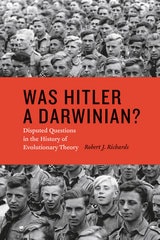
In tracing the history of Darwin’s accomplishment and the trajectory of evolutionary theory during the late nineteenth and early twentieth centuries, most scholars agree that Darwin introduced blind mechanism into biology, thus banishing moral values from the understanding of nature. According to the standard interpretation, the principle of survival of the fittest has rendered human behavior, including moral behavior, ultimately selfish. Few doubt that Darwinian theory, especially as construed by the master’s German disciple, Ernst Haeckel, inspired Hitler and led to Nazi atrocities.
           
In this collection of essays, Robert J. Richards argues that this orthodox view is wrongheaded. A close historical examination reveals that Darwin, in more traditional fashion, constructed nature with a moral spine and provided it with a goal: man as a moral creature. The book takes up many other topics—including the character of Darwin’s chief principles of natural selection and divergence, his dispute with Alfred Russel Wallace over man’s big brain, the role of language in human development, his relationship to Herbert Spencer, how much his views had in common with Haeckel’s, and the general problem of progress in evolution. Moreover, Richards takes a forceful stand on the timely issue of whether Darwin is to blame for Hitler’s atrocities. Was Hitler a Darwinian? is intellectual history at its boldest.
[more]
cover of Went to the Devil: A Yankee Whaler in the Slave Trade

Went to the Devil

A Yankee Whaler in the Slave Trade

Anthony J. Connors

University of Massachusetts Press, 2019

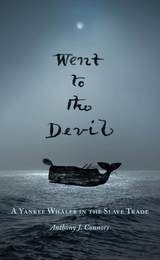
Edward Davoll was a respected New Bedford whaling captain in an industry at its peak in the 1850s. But mid-career, disillusioned with whaling, desperately lonely at sea, and experiencing financial problems, he turned to the slave trade, with disastrous results. Why would a man of good reputation, in a city known for its racial tolerance and Quaker-inspired abolitionism, risk engagement with this morally repugnant industry?

In this riveting biography, Anthony J. Connors explores this question by detailing not only the troubled, adventurous life of this man but also the turbulent times in which he lived. Set in an era of social and political fragmentation and impending civil war, when changes in maritime law and the economics of whaling emboldened slaving agents to target captains and their vessels for the illicit trade, Davoll's story reveals the deadly combination of greed and racial antipathy that encouraged otherwise principled Americans to participate in the African slave trade.
[more]
cover of What Comes after Entanglement?: Activism, Anthropocentrism, and an Ethics of Exclusion

What Comes after Entanglement?

Activism, Anthropocentrism, and an Ethics of Exclusion

Eva Haifa Giraud

Duke University Press, 2019

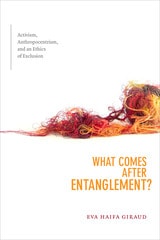
By foregrounding the ways that human existence is bound together with the lives of other entities, contemporary cultural theorists have sought to move beyond an anthropocentric worldview. Yet as Eva Haifa Giraud contends in What Comes after Entanglement?, for all their conceptual power in implicating humans in ecologically damaging practices, these theories can undermine scope for political action. Drawing inspiration from activist projects between the 1980s and the present that range from anticapitalist media experiments and vegan food activism to social media campaigns against animal research, Giraud explores possibilities for action while fleshing out the tensions between theory and practice. Rather than an activist ethics based solely on relationality and entanglement, Giraud calls for what she describes as an ethics of exclusion, which would attend to the entities, practices, and ways of being that are foreclosed when other entangled realities are realized. Such an ethics of exclusion emphasizes foreclosures in the context of human entanglement in order to foster the conditions for people to create meaningful political change.
[more]
cover of What Would You Do?: Juggling Bioethics and Ethnography

What Would You Do?

Juggling Bioethics and Ethnography

Charles L. Bosk

University of Chicago Press, 2008

In hospital rooms across the country, doctors, nurses, patients, and their families grapple with questions of life and death. Recently, they have been joined at the bedside by a new group of professional experts, bioethicists, whose presence raises a host of urgent questions. How has bioethics evolved into a legitimate specialty? When is such expertise necessary? How do bioethicists make their decisions? And whose interests do they serve?

Renowned sociologist Charles L. Bosk has been observing medical care for thirty-five years. In What Would You Do? he brings his extensive experience to bear on these questions while reflecting on the ethical dilemmas that his own ethnographic research among surgeons and genetic counselors has provoked. Bosk considers whether the consent given to ethnographers by their subjects can ever be fully voluntary and informed. He questions whether promises of confidentiality and anonymity can or should be made. And he wonders if social scientists overestimate the benefits of their work while downplaying the risks.

Vital for practitioners of both the newly prominent field of bioethics and the long-established craft of ethnography, What Would You Do? will also engross anyone concerned with how our society addresses difficult health care issues.
[more]
cover of When Conscience Calls: Moral Courage in Times of Confusion and Despair

When Conscience Calls

Moral Courage in Times of Confusion and Despair

Kristen Renwick Monroe

University of Chicago Press, 2023

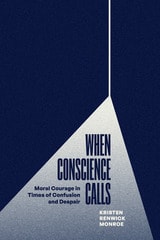
What is moral courage? Why is it important and what drives it? An argument for why we should care about moral courage and how it shapes the world around us.

War, totalitarianism, pandemics, and political repression are among the many challenges and crises that force us to consider what humane people can do when the world falls apart. When tolerance disappears, truth becomes rare, and civilized discourse is a distant ideal, why do certain individuals find the courage to speak out when most do not?

When Conscience Calls offers powerful portraits of ordinary people performing extraordinary acts—be it confronting presidents and racist mobs or simply caring for and protecting the vulnerable. Uniting these portraits is the idea that moral courage stems not from choice but from one’s identity. Ultimately, Kristen Renwick Monroe argues bravery derives from who we are, our core values, and our capacity to believe we must change the world. When Conscience Calls is a rich examination of why some citizens embrace anger, bitterness, and fearmongering while others seek common ground, fight against dogma, and stand up to hate.
[more]
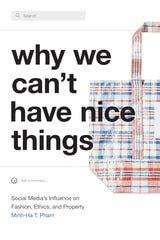
cover of Why We Can't Have Nice Things: Social Media’s Influence on Fashion, Ethics, and Property

Why We Can't Have Nice Things

Social Media’s Influence on Fashion, Ethics, and Property

Minh-Ha T. Pham

Duke University Press, 2022

In 2016, social media users in Thailand called out the Paris-based luxury fashion house Balenciaga for copying the popular Thai “rainbow bag,” using Balenciaga’s hashtags to circulate memes revealing the source of the bags’ design. In Why We Can’t Have Nice Things Minh-Ha T. Pham examines the way social media users monitor the fashion market for the appearance of knockoff fashion, design theft, and plagiarism. Tracing the history of fashion antipiracy efforts back to the 1930s, she foregrounds the work of policing that has been tacitly outsourced to social media. Despite the social media concern for ethical fashion and consumption and the good intentions behind design policing, Pham shows that it has ironically deepened forms of social and market inequality, as it relies on and reinforces racist and colonial norms and ideas about what constitutes copying and what counts as creativity. These struggles over ethical fashion and intellectual property, Pham demonstrates, constitute deeper struggles over the colonial legacies of cultural property in digital and global economies.
[more]
cover of Willing and Unable: Doctors' Constraints in Abortion Care

Willing and Unable

Doctors' Constraints in Abortion Care

Lori R. Freedman

Vanderbilt University Press, 2010

Willing and Unable explores the social world where abortion politics and mainstream medicine collide. The author interviewed physicians of obstetrics and gynecology around the United States to find out why physicians rarely integrate abortion into their medical practice. While abortion stigma, violence, and political contention provide some explanation, her findings demonstrate that willing physicians are further encumbered by a variety of barriers within their practice environments.
Structural barriers to the mainstream practice of abortion effectively institutionalize the buck-passing of abortion patients to abortion clinics. As the author notes, "Public-health-minded HMOs and physician practices could significantly change the world of abortion care if they stopped outsourcing it."
Drawing from forty in-depth interviews, the book presents a challenge to a commonly held assumption that physicians decide whether or not to provide abortion based on personal ideology. Physician narratives demonstrate how their choices around learning, doing, and even having abortions themselves disrupt the pro-choice/pro-life moral and political binary.

[more]
cover of Words, Works, and Ways of Knowing: The Breakdown of Moral Philosophy in New England before the Civil War

Words, Works, and Ways of Knowing

The Breakdown of Moral Philosophy in New England before the Civil War

Sara Paretsky

University of Chicago Press, 2016

Crime writer Sara Paretsky is known the world over for her acclaimed series of mysteries starring Chicago private investigator V. I. Warshawski, now in its seventeenth installment. Paretsky’s work has long been inflected with history—for her characters the past looms large in the present—and in her decades-long career, she has been recognized for transforming the role of women in contemporary crime fiction.
What’s less well-known is that before Paretsky began her writing career, she earned a PhD in history from the University of Chicago with a dissertation on moral philosophy and religion in New England in the early and mid-nineteenth century. Now, for the first time, fans of Paretsky can read that earliest work, Words, Works, and Ways of Knowing.

Paretsky here analyzes attempts by theologians at Andover Seminary, near Boston, to square and secure Calvinist religious beliefs with emerging knowledge from history and the sciences. She carefully shows how the open-minded scholasticism of these theologians paradoxically led to the weakening of their intellectual credibility as conventional religious belief structures became discredited, and how this failure then incited reactionary forces within Calvinism. That conflict between science and religion in the American past is of interest on its face, but it also sheds light on contemporary intellectual battles.

Rounding out the book, leading religious scholar Amanda Porterfield provides an afterword discussing where Paretsky’s work fits into the contemporary study of religion. And in a sobering—sometimes shocking—preface, Paretsky paints a picture of what it was like to be a female graduate student at the University of Chicago in the 1970s. A treat for Paretsky’s many fans, this book offers a glimpse of the development of the mind behind the mysteries.
[more]
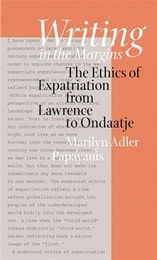
cover of Writing in the Margins: The Ethics of Expatriation from Lawrence to Ondaatje

Writing in the Margins

The Ethics of Expatriation from Lawrence to Ondaatje

Marilyn Adler Papayanis

Vanderbilt University Press, 2005

Looking closely at a group of writers who rejected the industrial West in favor of the expatriate life and made that quest the subject of their work, Marilynn Papayanis reveals their concerns to be ethical as well as aesthetic. Her book brims with fresh insights into such works as Paul Bowles's The Sheltering Sky, Lawrence Durrell's The Alexandria Quartet, and Michael Ondaatjes The English Patient.
[more]