Results by title
421 books match the query 'Evolution' and 5 start with w

Was Hitler a Darwinian?
Disputed Questions in the History of Evolutionary TheoryRobert J. Richards
University of Chicago Press, 2013
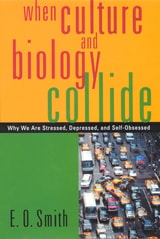
When Culture and Biology Collide
Why We are Stressed, Depressed, and Self-ObsessedE. O. Smith
Rutgers University Press, 2002
Why do we do things that we know are bad for us? Why do we line up to buy greasy fast food that is terrible for our bodies? Why do we take the potentially lethal risk of cosmetic surgery to have a smaller nose, bigger lips, or a less wrinkled face? Why do we risk life and limb in a fit of road rage to seek revenge against someone who merely cut us off in traffic? If these life choices are simply responses to cultural norms and pressures, then why did these particularly self-destructive patterns evolve in place of more sensible ones?
In When Culture and Biology Collide, E. O. Smith explores various aspects of behavior that are endemic to contemporary Western society, and proposes new ways of understanding and addressing these problems. Our physiology and behavior are the products of thousands of generations of evolutionary history. Every day we play out behaviors that have been part of the human experience for a very long time, yet these behaviors are played out in an arena that is far different from that in which they evolved. Smith argues that this discordance between behavior and environment sets up conditions in which there can be real conflict between our evolved psychological predispositions and the dictates of culture.
Topics such as drug abuse, depression, beauty and self-image, obesity and dieting, stress and violence, ethnic diversity, and welfare are all used as sample case studies. As with all of his case studies, Smith emphasizes the importance of not using an evolutionary explanation as an excuse for a particular pattern of behavior. Instead, he seeks to offer a perspective that will help us see ourselves more clearly and that may be useful in developing intelligent solutions to seemingly intractable problems. Smith provides ways of developing strategies for minimizing our self-destructive tendencies.
Why Evolution Works (and Creationism Fails)
Matt Young and Paul K. Strode
Rutgers University Press, 2009
Focusing on what other books omit, how science works and how pseudoscience works, Matt Young and Paul K. Strode demonstrate the futility of “scientific” creationism. They debunk the notion of intelligent design and other arguments that show evolution could not have produced life in its present form.
Concluding with a frank discussion of science and religion, Why Evolution Works (and Creationism Fails) argues that science by no means excludes religion, though it ought tocast doubt on certain religious claims that are contrary to known scientific fact.

Why Intelligent Design Fails
A Scientific Critique of the New CreationismEdited by Matt Young and Taner Edis
Rutgers University Press, 2004
Is Darwinian evolution established fact, or a dogma ready to be overtaken by "intelligent design"? This is the debate raging in courtrooms and classrooms across the country.
Why Intelligent Design Fails assembles a team of physicists, biologists, computer scientists, mathematicians, and archaeologists to examine intelligent design from a scientific perspective. They consistently find grandiose claims without merit.
Contributors take intelligent design's two most famous claims--irreducible complexity and information-based arguments--and show that neither challenges Darwinian evolution. They also discuss thermodynamics and self-organization; the ways human design is actually identified in fields such as forensic archaeology; how research in machine intelligence indicates that intelligence itself is the product of chance and necessity; and cosmological fine-tuning arguments.
Intelligent design turns out to be a scientific mistake, but a mistake whose details highlight the amazing power of Darwinian thinking and the wonders of a complex world without design.
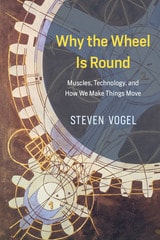
Why the Wheel Is Round
Muscles, Technology, and How We Make Things MoveSteven Vogel
University of Chicago Press, 2016
Steven Vogel combines his engineering expertise with his remarkable curiosity about how things work to explore how wheels and other mechanisms were, until very recently, powered by the push and pull of the muscles and skeletal systems of humans and other animals. Why the Wheel Is Round explores all manner of treadwheels, hand-spikes, gears, and more, as well as how these technologies diversified into such things as hand-held drills and hurdy-gurdies. Surprisingly, a number of these devices can be built out of everyday components and materials, and Vogel’s accessible and expansive book includes instructions and models so that inspired readers can even attempt to make their own muscle-powered technologies, like trebuchets and ballista.
Appealing to anyone fascinated by the history of mechanics and technology as well as to hobbyists with home workshops, Why the Wheel Is Round offers a captivating exploration of our common technological heritage based on the simple concept of rotation. From our leg muscles powering the gears of a bicycle to our hands manipulating a mouse on a roller ball, it will be impossible to overlook the amazing feats of innovation behind our daily devices.