Results by title
67 books match the query 'Exile' and 2 start with w
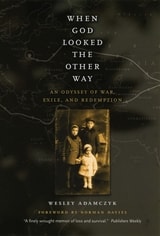
When God Looked the Other Way
An Odyssey of War, Exile, and RedemptionWesley Adamczyk
University of Chicago Press, 2004
Often overlooked in accounts of World War II is the Soviet Union's quiet yet brutal campaign against Polish citizens, a campaign that included, we now know, war crimes for which the Soviet and Russian governments only recently admitted culpability. Standing in the shadow of the Holocaust, this episode of European history is often overlooked. Wesley Adamczyk's gripping memoir, When God Looked the Other Way, now gives voice to the hundreds of thousands of victims of Soviet barbarism.
Adamczyk was a young Polish boy when he was deported with his mother and siblings from their comfortable home in Luck to Soviet Siberia in May of 1940. His father, a Polish Army officer, was taken prisoner by the Red Army and eventually became one of the victims of the Katyn massacre, in which tens of thousands of Polish officers were slain at the hands of the Soviet secret police. The family's separation and deportation in 1940 marked the beginning of a ten-year odyssey in which the family endured fierce living conditions, meager food rations, chronic displacement, and rampant disease, first in the Soviet Union and then in Iran, where Adamczyk's mother succumbed to exhaustion after mounting a harrowing escape from the Soviets. Wandering from country to country and living in refugee camps and the homes of strangers, Adamczyk struggled to survive and maintain his dignity amid the horrors of war.
When God Looked the Other Way is a memoir of a boyhood lived in unspeakable circumstances, a book that not only illuminates one of the darkest periods of European history but also traces the loss of innocence and the fight against despair that took root in one young boy. It is also a book that offers a stark picture of the unforgiving nature of Communism and its champions. Unflinching and poignant, When God Looked the Other Way will stand as a testament to the trials of a family during wartime and an intimate chronicle of episodes yet to receive their historical due.
“Adamczyk recounts the story of his own wartime childhood with exemplary precision and immense emotional sensitivity, presenting the ordeal of one family with the clarity and insight of a skilled novelist. . . . I have read many descriptions of the Siberian odyssey and of other forgotten wartime episodes. But none of them is more informative, more moving, or more beautifully written than When God Looked the Other Way.”—From the Foreword by Norman Davies, author of Europe: A History and Rising ’44: The Battle for Warsaw
“A finely wrought memoir of loss and survival.”—Publishers Weekly
“Adamczyk’s unpretentious prose is well-suited to capture that truly awful reality.” —Andrew Wachtel, Chicago Tribune Books
“Mr. Adamczyk writes heartfelt, straightforward prose. . . . This book sheds light on more than one forgotten episode of history.”—Gordon Haber, New York Sun
“One of the most remarkable World War II sagas I have ever read. It is history with a human face.”—Andrew Beichman, Washington Times
[more]

Where Is Ana Mendieta?
Identity, Performativity, and ExileJane Blocker
Duke University Press, 1999
Ana Mendieta, a Cuban-born artist who lived in exile in the United States, was one of the most provocative and complex personalities of the 1970s’ artworld. In Where Is Ana Mendieta? art historian Jane Blocker provides an in-depth critical analysis of Mendieta’s diverse body of work. Although her untimely death in 1985 remains shrouded in controversy, her life and artistic legacy provide a unique vantage point from which to consider the history of performance art, installation, and earth works, as well as feminism, multiculturalism, and postmodernism.
Taken from banners carried in a 1992 protest outside the Guggenheim Museum in New York, the title phrase “Where is Ana Mendieta?” evokes not only the suspicious and tragic circumstances surrounding her death but also the conspicuous absence of women artists from high-profile exhibitions. Drawing on the work of such theorists as Judith Butler, Joseph Roach, Edward Said, and Homi Bhabha, Blocker discusses the power of Mendieta’s earth-and-body art to alter, unsettle, and broaden the terms of identity itself. She shows how Mendieta used exile as a discursive position from which to disrupt dominant categories, analyzing as well Mendieta’s use of mythology and anthropology, the ephemeral nature of her media, and the debates over her ethnic, gender, and national identities.
As the first major critical examination of this enigmatic artist’s work, Where Is Ana Mendieta? will interest a broad audience, particularly those involved with the production, criticism, theory, and history of contemporary art.
[more]