Results by title
98 books match the query 'Existentialism' and 2 start with w
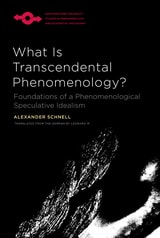
What Is Transcendental Phenomenology?
Foundations of a Phenomenological Speculative IdealismAlexander Schnell; Leonard Ip
Northwestern University Press, 2027
Offering a systematic introduction to a vital discipline
Phenomenology is a now century-old school of philosophy, to which Alexander Schnell offers here a threefold introduction that explores its diversity of approaches. In What Is Transcendental Phenomenology?, Schnell provides an in-depth overview of the Husserlian phenomenological method and its fundamental concepts (epoché and reduction, eidetic variation, phenomenological description, and phenomenological construction). He then examines that method’s limits, stressing the necessity of overcoming them in order to achieve a constructive approach while staying true to its fundamental disciplinary frameworks. Finally, he outlines a theory of understanding that expands the phenomenological method and highlights its speculative grounding before turning to speculative realists’ criticisms of the field. Schnell’s work shows that phenomenology can face the challenge of speculative thinking from an idealist standpoint, making a vital contribution to current debates about new, or speculative, realism. This important volume not only answers its titular question but, in its mode of discussing its subject, is itself phenomenology.

Who Says Anything about Winning?
Eight Exercises in Philosophical ResignationTereza Matejcková
Karolinum Press, 2026
A contemporary philosophical argument that boldly proposes resignation as the path to a fully realized self.
Traditional cultures have exercises that teach people discipline. Even modern philosophers, Hegel, Nietzsche, and Kierkegaard, paid special attention to striving for spirituality, although outside religious frameworks. However, if we are to grow, a more relaxed relationship to the self may be beneficial; hence the notion of resignation. A resigned will is not weak; it can resist itself and others. Such resignation is a man’s defense against becoming a mere element in a sequence of events. Art, philosophy, and mainly freedom all rely on the ability to create distance. In Who Says Anything about Winning?, Tereza Matejcková offers more than a history of a notion or a thematic reading of the legacy of respected thinkers; she offers a fresh view of self-acceptance and growth.