Results by title
50 books match the query 'Experiments' and 2 start with w

Wetwares
Experiments In Postvital LivingRichard Doyle
University of Minnesota Press, 2003
A dizzying tour of the ways technologies, both real and imagined, can transform humanity
The mind of the machine, the body suspended in time, organs exchanged, thought computed, genes manipulated, DNA samples abducted by aliens: the terrain between science and speculation, fraught with the possibility of technological and perhaps even evolutionary transformations, is the territory Richard Doyle explores in Wetwares. In a manner at once sober and playful, Doyle maps potentials for human transformation by new ecologies of information in the early twenty-first century.
Wetwares ranges over recent research in artificial life, cloning, cryonics, computer science, organ transplantation, and alien abduction. Moving between actual technical practices, serious speculative technology, and science fiction, Doyle shows us emerging scientific paradigms where “life” becomes more a matter of information than of inner vitality—in short, becomes “wetwares” for DNA and computer networks. Viewing technologies of immortality—from cryonics to artificial life—as disciplines for welcoming a thoroughly other future, a future of neither capital, god, human, nor organism, the book offers tools for an evolutionary, transhuman mutation in the utterly unpredictable decades to come.[more]
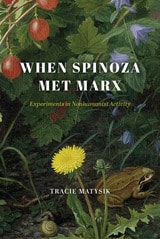
When Spinoza Met Marx
Experiments in Nonhumanist ActivityTracie Matysik
University of Chicago Press, 2022
Explores concepts that bring together the thinking of Spinoza and Marx.
Karl Marx was a fiery revolutionary theorist who heralded the imminent demise of capitalism, while Spinoza was a contemplative philosopher who preached rational understanding and voiced skepticism about open rebellion. Spinoza criticized all teleological ideas as anthropomorphic fantasies, while Marxism came to be associated expressly with teleological historical development. Why, then, were socialists of the German nineteenth century consistently drawn to Spinoza as their philosophical guide? Tracie Matysik shows how the metaphorical meeting of Spinoza and Marx arose out of an intellectual conundrum around the meaning of activity. How is it, exactly, that humans can be fully determined creatures but also able to change their world? To address this paradox, many revolutionary theorists came to think of activity in the sense of Spinoza—as relating. Matysik follows these Spinozist-socialist intellectual experiments as they unfolded across the nineteenth century, drawing lessons from them that will be meaningful for the contemporary world.
Karl Marx was a fiery revolutionary theorist who heralded the imminent demise of capitalism, while Spinoza was a contemplative philosopher who preached rational understanding and voiced skepticism about open rebellion. Spinoza criticized all teleological ideas as anthropomorphic fantasies, while Marxism came to be associated expressly with teleological historical development. Why, then, were socialists of the German nineteenth century consistently drawn to Spinoza as their philosophical guide? Tracie Matysik shows how the metaphorical meeting of Spinoza and Marx arose out of an intellectual conundrum around the meaning of activity. How is it, exactly, that humans can be fully determined creatures but also able to change their world? To address this paradox, many revolutionary theorists came to think of activity in the sense of Spinoza—as relating. Matysik follows these Spinozist-socialist intellectual experiments as they unfolded across the nineteenth century, drawing lessons from them that will be meaningful for the contemporary world.
[more]