Results by title
135 books match the query 'Faith' and 4 start with w
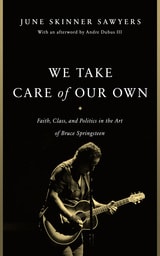
We Take Care of Our Own
Faith, Class, and Politics in the Art of Bruce SpringsteenJune Skinner Sawyers
Rutgers University Press, 2024
We Take Care of Our Own traces the evolution of Bruce Springsteen’s beliefs, beginning with his New Jersey childhood and ending with his most recent works from Springsteen on Broadway to Letter to You. The author follows the singer’s life, examining his albums and a variety of influences (both musical and nonmusical), especially his Catholic upbringing and his family life, to show how he became an outspoken icon for working-class America—indeed for working-class life throughout the world. In this way, the author emphasizes the universality of Springsteen’s canon and depicts how a working-class sensibility can apply to anyone anywhere who believes in fairness and respect. In addition, the author places Springsteen in the historical context not only of literature (especially John Steinbeck) but also of the art world (specifically the work of Thomas Hart Benton and Edward Hopper). Among the themes explored in the book include community, a sense of place, America as the Promised Land, the myth of the West, and, ultimately, mortality.
[more]
Why I Stay 2
The Challenges of Discipleship for Contemporary Latter-day SaintsRobert A. Rees
Signature Books, 2021
One’s religious affiliation may be determined, at least, initially, by family and culture, but the ultimate choice to stay is, in the end, personal. This second volume of Why I Stay touches on the weighty decisions and complex issues people ponder in a faith journey and which fork in the road to take once they face them.
Twenty-one women and men discuss what it is about Mormonism that keeps them part of the fold. Their deep, unique experiences make their individual travels even more compelling. Kimberly Applewhite Teitter, growing up in the South as a Black Latter-day Saint, often encountered well-meaning Latter-day Saints whose words messaged the idea that she was at some level an outsider or perhaps not as authentically Mormon as others in her congregation. Thus, she writes, “At the end of the day I’m still Black—still have felt the weight of proving that I represent the church I’ve fought so hard for my entire life.” Yet the very episodes that could have driven her from the church became lessons on the meaning of discipleship.
For Carol Lynn Pearson, staying boiled down to two reasons: “I find a great deal of love in this church,” and “where I do not find love, I have an opportunity to help create love.” The stories she shares illuminate that mantra. Mitch Mayne, an openly gay man, has faced many challenges by his decision to stay. “Most days, it seems I can’t be Mormon enough for my LDS community, and I can’t be gay enough for my LGBT fellows.” In his essay, he answers the question many have asked: “Why don’t you just leave the church?”
[more]

Witness and Existence
Essays in Honor of Schubert M. OgdenEdited by Philip E. Devenish and George L. Goodwin
University of Chicago Press, 1989
For over thirty years Schubert Ogden has championed and exemplified a particular understanding of the task and content of Christian theology. The task of theology is to examine the meaning and truth of Christian faith in terms of human experience. All theological claims, therefore, are assessable by two criteria: their appropriateness to the normative Christian witness and their credibility in terms of human existence. The content of Christian theology may be accurately and succinctly stated in two words: radical monotheism. The point of all theological doctrines, from christology to ethics, is to reflect on the gift and demand of God's love. It may be said, then, that Ogden's entire theological project consists in the attempt to show that radical monotheism, which is the essential point of the Christian witness, is also the inclusive end of human existence.
Witness and Existence pays tribute to Ogden by bringing together essays by eminent scholars in New Testament studies and philosophical theology, two fields which directly reflect his methodological concerns and his substantive contributions. The book honors Ogden precisely by engaging the fundamental issues which Ogden himself has taken so seriously.
The first group of essays presents careful analyses of issues basic to the early Christian witness; the second group examines the credibility of the Christian claim about God in terms of human experience. The editors' introductory essay provides the first comprehensive analysis yet to appear of Ogden's theology. A complete bibliography of his published writings is included as an appendix.
[more]
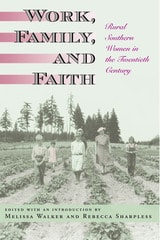
Work, Family, and Faith
Rural Southern Women in the Twentieth CenturyEdited & Intro by Melissa Walker & Rebecca Sharpless
University of Missouri Press, 2006
At the beginning of the twentieth century, the majority of rural southerners were dependent on agriculture and eked out a living as tenants on land owned by someone else. Women took on multiple duties, from child rearing to labor in the fields, to help meet their own goals of independence, well-being, and family persistence on the land. Over the course of the century, however, women found their lives and their work transformed. Government intervention, the Great Depression, and industrial job opportunities created by the two world wars and the development of Sun Belt industries lured or pushed tens of thousands of black and white rural southerners off the land.
As the American South changed around them, becoming more urban and industrialized, some women struggled to help their families survive in the increasingly large-scale and commercial agricultural economy, while other women eagerly seized opportunities to engage in rural reform, get better educations, and work at off-farm jobs. Whether they moved to the cities or stayed on the farms, most of these women continued to struggle against poverty and relied on tradition and inner strength to get by.
This well-researched, sharply focused, and keenly insightful collection of essays takes readers across the twentieth-century South, from rural roadside stands to tobacco fields to Sloss-Sheffield Steel’s “Sloss Quarters” in Birmingham. Covering the full scope of southern rural women’s varied lives, this book will be of particular value to anyone interested in sociology, women’s studies, or southern history.
[more]