Results by title
64 books match the query 'Farmers' and 3 start with w
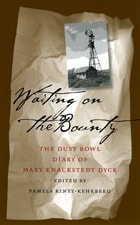
Waiting On The Bounty
Dust Bowl Diary Mary DyckPamela Riney-Kehrberg
University of Iowa Press, 1999
The daughter of German immigrants, Mary Knackstedt married Henry Dyck, a Mennonite farmer, and in 1905 moved west to a settlement near Lamont Township in Hamilton County, Kansas. For the next thirty years they enjoyed growth and prosperity. Then the drought and dust storms that had driven many farmers from the region in the early years of the century returned. The Dycks remained on their farm and witnessed the mass exodus of farmers and townspeople—including close friends and family—who fled the Kansas wheat country to find work.
Though she had only a fifth-grade education, Mary Knackstedt Dyck faithfully kept a diary. Written with pencil on lined notebook paper, her daily notations tell the story of farm life on the far western border of Kansas during the grim Dust Bowl years. Manuscript diaries from this era and region are extremely rare, and those written by farm women are even more so. From the point of view of a wife, mother, and partner in the farming enterprise, Dyck recorded the everyday events as well as the frustrations of living with drought and dust storms and the sadness of watching one's children leave the farm.
Though she had only a fifth-grade education, Mary Knackstedt Dyck faithfully kept a diary. Written with pencil on lined notebook paper, her daily notations tell the story of farm life on the far western border of Kansas during the grim Dust Bowl years. Manuscript diaries from this era and region are extremely rare, and those written by farm women are even more so. From the point of view of a wife, mother, and partner in the farming enterprise, Dyck recorded the everyday events as well as the frustrations of living with drought and dust storms and the sadness of watching one's children leave the farm.
A remarkable historical document, the diary describes a period in this century before the telephone and indoor plumbing were commonplace in rural homes—a time when farm families in the Plains states were isolated from world events, and radio provided an enormously important link between farmsteads and the world at large. Waiting on the Bounty brings us unusual insights into the agricultural and rural history of the United States, detailing the tremendous changes affecting farming families and small towns during the Great Depression.
Pamela Riney-Kehrberg has provided an edited version of the diary entries from 1936 to 1941. Her informative introduction tells the story of the Dycks' settlement in western Kansas and places the diary in its historical context.
[more]
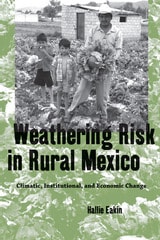
Weathering Risk in Rural Mexico
Climatic, Institutional, and Economic ChangeHallie Eakin
University of Arizona Press, 2006
From floods and droughts to tsunamis and hurricanes, recent years have seen a distressing and often devastating increase in extreme climatic events. While it is possible to study these disasters from a purely scientific perspective, a growing preponderance of evidence suggests that changes in the environment are related to both a shift in global economic relations and these weather-related disasters.
In Weathering Risk in Rural Mexico, Hallie Eakin draws on ethnographic data collected in three agricultural communities in rural Mexico to show how economic and climatic change are not only linked in cause and effect at the planetary scale but also interact in unpredictable and complex ways in the context of regional political and trade relationships, national economic and social programs, and the decision making of institutions, enterprises, and individuals.She shows how the parallel processes of globalization and climatic change result in populations that are “doubly exposed” and thus particularly vulnerable.
Chapters trace the effects of El Niño in central Mexico in the late 1990s alongside some of the principal changes in the country’s agricultural policy. Eakin argues that in order to develop policies that effectively address rural poverty and agricultural development, we need an improved understanding of how households cope simultaneously with various sources of uncertainty and adjust their livelihoods to accommodate newly evolving environmental, political, and economic realities.
[more]
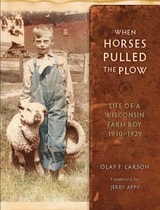
When Horses Pulled the Plow
Life of a Wisconsin Farm Boy, 1910–1929Olaf F. Larson
University of Wisconsin Press, 2011
In 1910, when Olaf F. Larson was born to tenant livestock and tobacco farmers in Rock County, Wisconsin, the original barn still stood on the property. It was filled with artifacts of an earlier time—an ox yoke, a grain cradle, a scythe used to cut hay by hand. But Larson came of age in a brave new world of modern inventions—tractors, trucks, combines, airplanes—that would change farming and rural life forever.
When Horses Pulled the Plow is Larson’s account of that rural life in the early twentieth century. He weaves invaluable historical details—including descriptions of farm equipment, crops, and livestock—with wry tales about his family, neighbors, and the one-room schoolhouse he attended, revealing the texture of everyday life in the rural Midwest almost a century ago. This memoir, written by Larson in his ninth decade, provides a wealth of details recalled from an earlier era and an illuminating read for anyone with their own memories of growing up on a farm.
[more]