Results by title
102 books match the query 'Florida' and 3 start with w
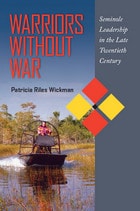
Warriors Without War
Seminole Leadership in the Late Twentieth CenturyPatricia Riles Wickman
University of Alabama Press, 2012
Warriors Without War takes readers beneath the placid waters of the Seminole’s public image and into the fascinating depths of Seminole society and politics.
For the entire last quarter of the twentieth century, the Seminole Tribe of Florida, a federally recognized American Indian Tribe, struggled as it transitioned from a tiny group of warriors into one of the best-known tribes on the world’s economic stage through their gaming enterprises.
Caught between a desperate desire for continued cultural survival and the mounting pressures of the non-Indian world—especially, the increasing requirements of the United States government— the Seminoles took a warriorlike approach to financial risk management. Their leader was the sometimes charming, sometimes crass and explosive, always warriorlike James Billie, who twice led the tribe in fights with the State of Florida that led all the way to the US Supreme Court.
Patricia Riles Wickman, who lived and worked for fifteen years with the Seminole people, chronicles the near-meteoric rise of the tribe and its leader to the pinnacle of international fame, and Billie’s ultimate fall after twenty-four years in power. Based partly on her own personal experiences working with the Seminole Tribe of Florida, Wickman has produced an in-depth study of the rise of one of the largest Indian gaming operations in the United States that reads almost like a Capote nonfiction novel.
[more]
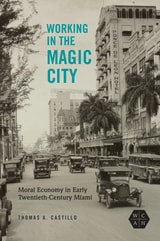
Working in the Magic City
Moral Economy in Early Twentieth-Century MiamiThomas A. Castillo
University of Illinois Press, 2022
In the early twentieth century, Miami cultivated an image of itself as a destination for leisure and sunshine free from labor strife. Thomas A. Castillo unpacks this idea of class harmony and the language that articulated its presence by delving into the conflicts, repression, and progressive grassroots politics of the time. Castillo pays particular attention to how class and race relations reflected and reinforced the nature of power in Miami. Class harmony argued against the existence of labor conflict, but in reality obscured how workers struggled within the city's service-oriented seasonal economy. Castillo shows how and why such an ideal thrived in Miami’s atmosphere of growth and boosterism and amidst the political economy of tourism. His analysis also presents class harmony as a theoretical framework that broadens our definitions of class conflict and class consciousness.
[more]
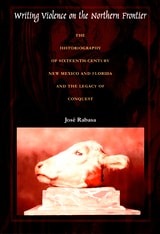
Writing Violence on the Northern Frontier
The Historiography of Sixteenth-Century New Mexico and Florida and the Legacy of ConquestJosé Rabasa
Duke University Press, 2000
In Writing Violence on the Northern Frontier José Rabasa examines the conjunction between writing and violence that defined the sixteenth-century Spanish conquest of the Americas (particularly North America) and in doing so, he reveals why this conjunction remains relevent and influential today. Rabasa elaborates a critique of Spanish legislation that prescribed forms of converting Indians to Christianity and subjecting them to Spanish rule, which was referred to by some as “peaceful conquest.” He argues that the oxymoronic nature of this term demands an oppositional mode of inquiry based on an understanding of violence that expands beyond acts of war to include symbolism, interpretation, legislation, and other speech acts that he refers to as the “force of law.”
To advance his argument Rabasa analyzes visual and verbal representations, colonialist programs, and the theories of colonization that informed the historiography of sixteenth-century New Mexico and Florida, which includes the territory from the Pacific coast to Kansas, and from present-day Florida to Tennessee and Arkansas. Using little-known materials from the northern borderlands of Spanish imperial expansion, Rabasa works to complicate notions of violence and their relationship to writing. Understood in juxtaposition with modern texts on postcolonial theory, his description of the dual function of these colonial texts—to represent material acts of violence and to act as violence itself—also emphasizes the lingering effects of this phenomenon in contemporary intellectual work and everyday life. In this way Writing Violence on the Northern Frontier serves not only as an explanation of what colonialist texts do but also instigates new ways of thinking about colonial discourse.
This book will interest scholars of colonial studies and early North American history, as well as a broader audience interested in interdisciplinary perspectives on the topic of racial, ethnic, and literary violences.
[more]