Results by title
484 books match the query 'Foreign relations' and 10 start with w
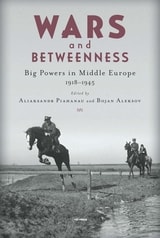
Wars and Betweenness
Big Powers and Middle Europe, 1918-1945Aliaksandr Piahanau
Central European University Press, 2020
The region between the Baltic and the Black Sea was marked by a set of crises and conflicts in the 1920s and 1930s, demonstrating the diplomatic, military, economic or cultural engagement of France, Germany, Russia, Britain, Italy and Japan in this highly volatile region, and critically damaging the fragile post-Versailles political arrangement. The editors, in naming this region as "Middle Europe" seek to revive the symbolic geography of the time and accentuate its position, situated between Big Powers and two World Wars.
The ten case studies in this book combine traditional diplomatic history with a broader emphasis on the geopolitical aspects of Big-Power rivalry to understand the interwar period. The essays claim that the European Big Powers played a key role in regional affairs by keeping the local conflicts and national movements under control and by exploiting the region's natural resources and military dependencies, while at the same time strengthening their prestige through cultural penetration and the cultivation of client networks.
The authors, however, want to avoid the simplistic view that the Big Powers fully dominated the lesser players on the European stage. The relationship was indeed hierarchical, but the essays also reveal how the "small states" manipulated Big-Power disagreements, highlighting the limits of the latters' leverage throughout the 1920s and the 1930s.
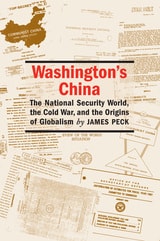
Washington's China
The National Security World, the Cold War, and the Origins of GlobalismJames L. Peck
University of Massachusetts Press, 2006
This book addresses a central question about the Cold War that has never been adequately resolved. Why did the United States go to such lengths not merely to “contain” the People's Republic of China but to isolate it from all diplomatic, cultural, and economic ties to other nations? Why, in other words, was American policy more hostile to China than to the Soviet Union, at least until President Nixon visited China in 1972?
The answer, as set out here, lies in the fear of China's emergence as a power capable of challenging the new Asian order the United States sought to shape in the wake of World War II. To meet this threat, American policymakers fashioned an ideology that was not simply or exclusively anticommunist, but one that aimed at creating an integrated, cooperative world capitalism under U.S. leadership—an ideology, in short, designed to outlive the Cold War.
In building his argument, James Peck draws on a wide variety of little-known documents from the archives of the National Security Council and the CIA. He shows how American officials initially viewed China as a “puppet” of the Soviet Union, then as “independent junior partner” in a Sino-Soviet bloc, and finally as “revolutionary model” and sponsor of social upheaval in the Third World. Each of these constructs revealed more about U.S. perceptions and strategic priorities than about actual shifts in Chinese thought and conduct. All were based on the assumption that China posed a direct threat not just to specific U.S. interests and objectives abroad but to the larger vision of a new global order dominated by American economic and military power. Although the nature of “Washington's China” may have changed over the years, Peck contends that the ideology behind it remains unchanged, even today.
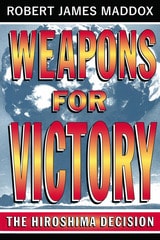
Weapons for Victory
The Hiroshima Decision Fifty Years LaterRobert James Maddox
University of Missouri Press, 2004
The highly acclaimed Weapons for Victory originally appeared in 1995, the fiftieth anniversary of the end of World War II. Now, in this paperback edition, Robert James Maddox provides a new introduction about the ongoing controversy related to the decision to bomb Hiroshima.
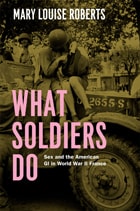
What Soldiers Do
Sex and the American GI in World War II FranceMary Louise Roberts
University of Chicago Press, 2013
That’s not the picture of the Greatest Generation that we’ve been given, but it’s the one Mary Louise Roberts paints to devastating effect in What Soldiers Do. Drawing on an incredible range of sources, including news reports, propaganda and training materials, official planning documents, wartime diaries, and memoirs, Roberts tells the fascinating and troubling story of how the US military command systematically spread—and then exploited—the myth of French women as sexually experienced and available. The resulting chaos—ranging from flagrant public sex with prostitutes to outright rape and rampant venereal disease—horrified the war-weary and demoralized French population. The sexual predation, and the blithe response of the American military leadership, also caused serious friction between the two nations just as they were attempting to settle questions of long-term control over the liberated territories and the restoration of French sovereignty.
While never denying the achievement of D-Day, or the bravery of the soldiers who took part, What Soldiers Do reminds us that history is always more useful—and more interesting—when it is most honest, and when it goes beyond the burnished beauty of nostalgia to grapple with the real lives and real mistakes of the people who lived it.
When Roosevelt Planned to Govern France
Charles L. Robertson
University of Massachusetts Press, 2011
This book tells the story of a plan put forth by President Franklin Roosevelt during World War II for an Allied military occupation of France in the aftermath of liberation, and of General Charles de Gaulle's efforts as self-appointed leader of the Free French Movement to thwart FDR's intentions. Charles L. Robertson frames the narrative as a mystery in which he plays the role of detective. He begins at a dinner party thirty years ago, where he first learned of the alleged plan from an elderly former aide to de Gaulle. Yet it wasn't until 2004, when he heard the same story repeated during the 60th commemoration of D-Day, that he set out to investigate whether it was true.
Many French are aware of this episode and believe, on the basis of later Gaullist officials' writings, that until the last moment a military occupation of their country was imminent. This view, across the years, has helped darken relations between France and the United States. Yet few if any Americans have ever heard of this plan, and in the event, no Allied military government of France was ever established.
How and why it never came to be, and why the French still believe it almost did, is the subject of this book. Robertson recounts how the president of the most powerful nation in the world was outmaneuvered in both his earlier plans for an occupation of France and his subsequent attempts to keep General de Gaulle from “seizing” power—in a France that ultimately, despite Roosevelt's intentions and expectations, regained its place among the victorious powers under de Gaulle's leadership.
Why the American Century?
Olivier Zunz
University of Chicago Press, 1998
"It should certainly be the task of historians to explain the nation's triumphs as effectively as they have explained its failures, and Zunz in this intelligent, learned and ambitious book suggests a valuable new model for doing so."—Alan Brinkley, Times Literary Supplement
"Zunz is evenhanded in his judgments. . . . His thesis is both imaginative and well grounded in the appropriate sources."—David M. Oshinsky, New York Times Book Review
"Zunz is an innovative and perceptive social critic. He crosses disciplinary boundaries with ease and felicity, and is particularly adept at illustrating large themes with unusual but telling details."—Kent Blaser, American Studies
"An eye-opening introduction to the shaping of modern America."—Foreign Affairs
William Massey
New ZealandJames Watson
Haus Publishing, 2010

Witness through Encounter
The Diplomacy of Benedict XVIBernard J. O'Connor
St. Augustine's Press, 2019
Appealing to dialogue is often just a safe way of referring to something negative, or at best blandly neutral: the avoidance of conflict, the denial of similarity, not stirring deep-seated disagreement, etc. When Bernard o’Connor says pope Benedict XVI facilitated dialogue, however, he means something quite positive, very much tangible and certainly transformative. In providing an account of the pope’s interactions with various groups of the international community, O’Connor attempts to convey Benedict XVI’s diplomacy as encounter, where even in the sphere of international relations exhortations to “dialogue” are invitations to see more clearly and be moved as much as move.
To dialogue is to embrace, revise perception such that our approaches to the great questions of our day are not simply shared but correct. As O’Connor writes, “Pope Benedict attempts to promote the outlook that a renewed emphasis upon objective, critical and structured philosophical reasoning positions practice, diplomatic and otherwise, to regain its lost foundation and framework. the quest for integrity, if nothing else, should motivate our fidelity to academic pursuit, to intellectual investigation, and to rigorous interdisciplinary inquiry. so influenced, practice will then reject what is arbitrary and be guided by what is time-tested and enduring.”
O’Connor illustrates true dialogue emerging from the encounter, and in turn provides scores of characteristics of this encounter as it unfolds in papal diplomacy. In providing scores of addresses and speeches to various bodies, O’Connor presents pope Benedict XVI as an example of effective diplomacy that treats the meetings on the world stage as engaging in true dialogue. encounter is the true basis of dialogue and one that allows it to open to what is truly a catalyst for change toward cooperation––witness, both personal and collective. As o’Connor shows, “where there is authentic encounter, as meeting in mutual trust, what arises is context for witness.” If authentic even the diplomatic encounter has the means to deepen and transform one’s being.
Witness Through Encounter intends to fulfill multiple needs. the diplomatic approach exemplified herein is singular and worthy of study among political scientists, sociologists, philosophers and diplomats eager to embrace a worldview that is more personal than simply humanistic. this work will also be useful in inter-religious settings. An additional advantage of O’Connor’s presentation of Benedict XVI’s diplomatic approach, his witness through encounter, is that it contains insight valuable to the scholar alongside the resources used.
World Politics and International Law
Francis Anthony Boyle
Duke University Press, 1985
In the second part, the author dissects the Entebbe raid, where Israeli forces rescued a group of hostages being detained by hijackers at a Ugandan airport. His analysis shows the deficiencies of the international system in dealing with such a complex issue, where several contradictory principles of international law could be applied and were defended by various protagonists.
The third part starts with a parallel problem--the Iranian hostages crisis, where a group of U.S. officials found themselves in an unprecedented situation of being captured by a band of students. A critical analysis of the handling of this problem by the Carter Administration is followed by vignettes of other crises faced by the Administration and by its successor, the Reagan Administration. This part is less analytical and more prescriptive. The author is no long satisfied with pointing out what went wrong; instead, he departs from the usual hands-off policy of political scientists and tries to indicate how much better each situation could have been handled if the decision makers had been paying more attention to international law and international organizations. The theme is slowly developed that in the long run national interest is better served not by practicing power politics and relying on the use of threat of force but by strengthening those international institutions that can provide a neutral environment for first slowing down a crisis and then finding an equitable solution acceptable to most of the parties in conflict.
The value of this book lies primarily in giving the reader a real insight into several important issues of today that are familiar to most people only from newspaper headlines and television news. While not everybody can agree with all his criticisms of the mistakes of various governments, there is an honest attempt by the author to present issues impartially and to let the blame fall where it may. Being both an international lawyer and a political scientist, the author has had the advantage of combining the methodology of these two social sciences into a rich tapestry with some startling shades and tones.
Worlds Apart
Bosnian Lessons for Global SecuritySwanee Hunt
Duke University Press, 2011