Results by title
81 books match the query 'French literature' and 3 start with w

Womb Fantasies
Subjective Architectures in Postmodern Literature, Cinema, and ArtCaroline Rupprecht
Northwestern University Press, 2013

Women's Words
Essay on French SingularityMona Ozouf
University of Chicago Press, 1997
Ozouf uses the woman's portrait, traditionally a male genre, to portray ten French women of letters whose lives span the period from the eve of the French Revolution to the resurgence of the feminist movement in the late twentieth century. She studies the letters and memoirs of Mme du Deffand, Mme de Charrière, Mme Roland, Mme de Staël, Mme de Rémusat, George Sand, Hubertine Auclert, Colette, Simone Weil, and Simone de Beauvoir. Rejecting the male constructions of femininity typical of this genre, Ozouf restores these women's voices in order to study their own often-conflicted attitudes toward education, marriage, motherhood, sex, and work, as well as the dilemma of writing in a literary world that did not support women's work.
Ozouf claims that a uniquely French feminism informed these women's lives, one that stems from the great egalitarian spirit of the French Revolution and is more tolerant of difference than its American counterparts. She argues that as a result, modern French culture has not isolated women from men in the same ways as American and British cultures have done.
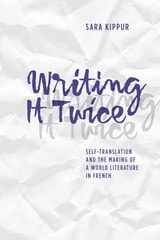
Writing It Twice
Self-Translation and the Making of a World Literature in FrenchSara Kippur
Northwestern University Press, 2015
Though the practice of self-translation long predates modernity, it has found new forms of expression in the global literary market of the late twentieth and early twenty-first century. The international renown of self-translating authors Samuel Beckett, Joseph Brodsky, and Vladimir Nabokov has offered motivation to a new generation of writers who actively translate themselves.
Intervening in recent debates in world literature and translation studies, Writing It Twice establishes the prominence and vitality of self-translation in contemporary French literature. Because of its intrinsic connection to multiple literary communities, self-translation prompts a reexamination of the aesthetics and politics of reading across national lines. Kippur argues that self-translated works should be understood as the paradigmatic example of world literature and, as such, crucial for interpreting the dynamics of literary circulation into and out of French.