Results by title
130 books match the query 'Gender identity' and 7 start with w
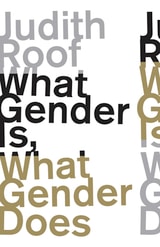
What Gender Is, What Gender Does
Judith Roof
University of Minnesota Press, 2016
What Gender Is, What Gender Does provides a forceful new paradigm for considering genders. With depth and insight, Judith Roof argues that genders are much more than binary. And they are constantly morphing: they are conscious and unconscious, simultaneously conventional and idiosyncratic. At any moment, more than one gender dynamic is at work in any individual.
Roof’s interpretation of genders isn’t content with either biological duality or endlessly open performativity, and what results is a nuanced and surprising representation of gender—an account that captures the complexities of lived experience as well as lived ideology. For Roof, genders are interacting sets of operations that link individual desires to multiple, shifting manifestations of sociocultural positioning and self-presentation. Thus, “to gender” is to signal, mask, suggest, mislead, and simplify the uncontainable chaos of desires characteristic of subjects but roundly contained by society.
Drawing illustrative material from contemporary popular culture productions, including My Big Fat Greek Wedding, Spider-Man, Shrek, Shallow Hal, Sex and the City, Bridesmaids, Bond films, and “bromance” movies, What Gender Is, What Gender Does demonstrates how the persistent conflation of gender and sexual difference is, on the one hand, a simple taxonomic urge and, on the other, a cover that offers the security of identity in place of the frustrations and fears of the real asymmetries of personal power dynamics.

When Monsters Speak
A Susan Stryker ReaderSusan Stryker. Edited by McKenzie Wark
Duke University Press, 2024
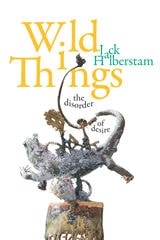
Wild Things
The Disorder of DesireJack Halberstam
Duke University Press, 2020
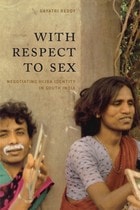
With Respect to Sex
Negotiating Hijra Identity in South IndiaGayatri Reddy
University of Chicago Press, 2005
Hijras are men who sacrifice their genitalia to a goddess in return for the power to confer fertility on newlyweds and newborn children, a ritual role they are respected for, at the same time as they are stigmatized for their ambiguous sexuality. By focusing on the hijra community, Gayatri Reddy sheds new light on Indian society and the intricate negotiations of identity across various domains of everyday life. Further, by reframing hijra identity through the local economy of respect, this ethnography highlights the complex relationships among local and global, sexual and moral, economies.
This book will be regarded as the definitive work on hijras, one that will be of enormous interest to anthropologists, students of South Asian culture, and specialists in the study of gender and sexuality.
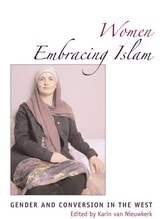
Women Embracing Islam
Gender and Conversion in the WestEdited by Karin van Nieuwkerk
University of Texas Press, 2006
Many Westerners view Islam as a religion that restricts and subordinates women in both private and public life. Yet a surprising number of women in Western Europe and America are converting to Islam. What attracts these women to a belief system that is markedly different from both Western Christianity and Western secularism? What benefits do they gain by converting, and what are the costs? How do Western women converts live their new Islamic faith, and how does their conversion affect their families and communities? How do women converts transmit Islamic values to their children? These are some of the questions that Women Embracing Islam seeks to answer.
In this vanguard study of gender and conversion to Islam, leading historians, sociologists, anthropologists, and theologians investigate why non-Muslim women in the United States, several European countries, and South Africa are converting to Islam. Drawing on extensive interviews with female converts, the authors explore the life experiences that lead Western women to adopt Islam, as well as the appeal that various forms of Islam, as well as the Nation of Islam, have for women. The authors find that while no single set of factors can explain why Western women are embracing Islamic faith traditions, some common motivations emerge. These include an attraction to Islam's high regard for family and community, its strict moral and ethical standards, and the rationality and spirituality of its theology, as well as a disillusionment with Christianity and with the unrestrained sexuality of so much of Western culture.
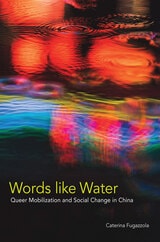
Words like Water
Queer Mobilization and Social Change in ChinaFugazzola, Caterina
Temple University Press, 2023
Words like Water explores the nonconfrontational strategies the tongzhi movement uses in contemporary China. Caterina Fugazzola analyzes tongzhi organizers’ conceptualizations of, and approaches to, social change, explaining how they avoid the backlash that meets Western tactics, such as protests, confrontation, and language about individual freedoms. In contrast, the groups’ intentional use of community and family-oriented narratives, discourses, and understandings of sexual identity are more effective, especially in situations where direct political engagement is not possible.
Providing on-the-ground stories that examine the social, cultural, and political constraints and opportunities, Words like Water emphasizes the value of discursive flexibility that allows activists to adapt to changing social and political conditions.
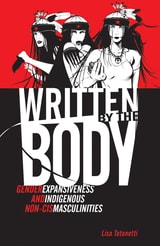
Written by the Body
Gender Expansiveness and Indigenous Non-Cis MasculinitiesLisa Tatonetti
University of Minnesota Press, 2021
Examining the expansive nature of Indigenous gender representations in history, literature, and film
Within Native American and Indigenous studies, the rise of Indigenous masculinities has engendered both productive conversations and critiques. Lisa Tatonetti intervenes in this conversation with Written by the Body by centering how female, queer, and/or Two-Spirit Indigenous people take up or refute masculinity, and, in the process, offer more expansive understandings of gender.
Written by the Body moves from the eighteenth- and nineteenth-century archive to turn-of-the-century and late-twentieth-century fiction to documentaries, HIV/AIDS activism, and, finally, recent experimental film and literature. Across it all, Tatonetti shows how Indigenous gender expansiveness, and particularly queer and non-cis gender articulations, moves between and among Native peoples to forge kinship, offer protection, and make change. She charts how the body functions as a somatic archive of Indigenous knowledge in Native histories, literatures, and activisms—exploring representations of Idle No More in the documentary Trick or Treaty, the all-female wildland firefighting crew depicted in Apache 8, Chief Theresa Spence, activist Carole laFavor, S. Alice Callahan, Thirza Cuthand, Joshua Whitehead, Carrie House, and more.
In response to criticisms of Indigenous masculinity studies, Written by the Body de-sutures masculinity from the cis-gendered body and investigates the ways in which female, trans, and otherwise nonconforming masculinities carry the traces of Two-Spirit histories and exceed the limitations of settler colonial imaginings of gender.