66 books match the query 'Genealogy' and 2 start with w
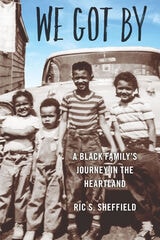
cover of We Got By: A Black Family’s Journey in the Heartland

We Got By

A Black Family’s Journey in the Heartland

Ric S. Sheffield

The Ohio State University Press, 2022

Life along the color line in rural Ohio was hard. Being Black often meant feeling frightened and alone. For a family like Ric S. Sheffield’s, examining this reality closely meant confronting challenges and tragedies that often felt overwhelming, even as their odyssey also included the joyful and inspiring. Navigating day-to-day existence in a world where trusting white neighbors required a careful mixture of caution and faith, Sheffield and his kin existed in a space where they were both seen and unseen. 
 
Spanning four generations and assessing the legacies of traumatic events (arrests, murders, suicide) that are inextricable from the racial dynamics of the small community his family called home, this gripping memoir is a heartfelt, clear-eyed, and rare chronicle of Black life in the rural Midwest. Experiencing the burden of racism among people who refused to accept that such a thing existed only made the isolation feel that much worse to Sheffield and his relatives. And yet, they overcame the obstacles and managed to persist: they got by.
 
[more]
cover of Working Fictions: A Genealogy of the Victorian Novel

Working Fictions

A Genealogy of the Victorian Novel

Carolyn Lesjak

Duke University Press, 2006

Working Fictions takes as its point of departure the common and painful truth that the vast majority of human beings toil for a wage and rarely for their own enjoyment or satisfaction. In this striking reconceptualization of Victorian literary history, Carolyn Lesjak interrogates the relationship between labor and pleasure, two concepts that were central to the Victorian imagination and the literary output of the era. Through the creation of a new genealogy of the “labor novel,” Lesjak challenges the prevailing assumption about the portrayal of work in Victorian fiction, namely that it disappears with the fall from prominence of the industrial novel. She proposes that the “problematic of labor” persists throughout the nineteenth century and continues to animate texts as diverse as Elizabeth Gaskell’s Mary Barton, George Eliot’s Felix Holt and Daniel Deronda, Charles Dickens’s Great Expectations, and the essays and literary work of William Morris and Oscar Wilde.

Lesjak demonstrates how the ideological work of the literature of the Victorian era, the “golden age of the novel,” revolved around separating the domains of labor and pleasure and emphasizing the latter as the proper realm of literary representation. She reveals how the utopian works of Morris and Wilde grapple with this divide and attempt to imagine new relationships between work and pleasure, relationships that might enable a future in which work is not the antithesis of pleasure. In Working Fictions, Lesjak argues for the contemporary relevance of the “labor novel,” suggesting that within its pages lie resources with which to confront the gulf between work and pleasure that continues to characterize our world today.

[more]