Results by title
86 books match the query 'Gerontology' and 8 start with w
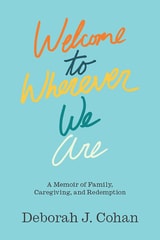
Welcome to Wherever We Are
A Memoir of Family, Caregiving, and RedemptionDeborah J. Cohan
Rutgers University Press, 2020
ESS Public Sociology Award
Recommended Book in Domestic Violence by DomesticShelters.org
How do you go about caregiving for an ill and elderly parent with a lifelong history of abuse and control, intertwined with expressions of intense love and adoration? How do you reconcile the resulting ambivalence, fear, and anger?
Welcome to Wherever We Are is a meditation on what we hold onto, what we let go of, how we remember others and ultimately how we’re remembered. Deborah Cohan shares her story of caring for her father, a man who was simultaneously loud, gentle, loving and cruel and whose brilliant career as an advertising executive included creating slogans like “Hey, how ‘bout a nice Hawaiian punch?” Wrestling with emotional extremes that characterize abusive relationships, Cohan shows how she navigated life with a man who was at once generous and affectionate, creating magical coat pockets filled with chocolate kisses when she was a little girl, yet who was also prone to searing, vicious remarks like “You’d make my life easier if you’d commit suicide.”
In this gripping memoir, Cohan tells her unique personal story while also weaving in her expertise as a sociologist and domestic abuse counselor to address broader questions related to marriage, violence, divorce, only children, intimacy and loss. A story most of us can relate to as we reckon with past and future choices against the backdrop of complicated family dynamics, Welcome to Wherever We Are is about how we might come to live our own lives better amidst unpredictable changes through grief and healing.
Questions for Discussion (https://d3tto5i5w9ogdd.cloudfront.net/wp-content/uploads/2020/05/11140346/Cohan_Discussion.docx)

What Does It Mean to Grow Old?
Reflections from the HumanitiesThomas R. Cole and Sally Gadow, eds.
Duke University Press, 1986
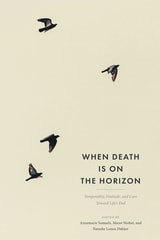
When Death Is on the Horizon
Temporality, Finitude, and Care Toward Life’s EndAnnemarie Samuels
Rutgers University Press, 2026
The urge to engage with finitude is increasingly central in our present apocalyptic time of political and ecological turmoil. Aging populations and the rapid development of advanced, but expensive, technologies to ever further postpone death pose significant healthcare challenges for societies around the world. In these times, how do people care when the end of life is near? How do they orient toward death? Do they see death as an absolute end, and if not, what sort of horizon does death present? Questioning taken for granted assumptions about end-of-life care, When Death Is on the Horizon analyzes how people approach death in a wide variety of geographical locations and social contexts. Through in-depth ethnographic case studies, it shows how people orient toward, beyond, and away from death, and how they do so within a world marked by historic and ongoing socio-political and structural inequalities.
This book is also freely available online as an open access digital edition.
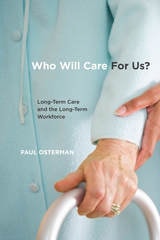
Who Will Care For Us?
Long-Term Care and the Long-Term WorkforcePaul Osterman
Russell Sage Foundation, 2017
Using national surveys, administrative data, and nearly 120 original interviews with workers, employers, advocates, and policymakers, Osterman finds that direct care workers are marginalized and often invisible in the health care system. While doctors and families alike agree that good home care aides and CNAs are crucial to the well-being of their patients, the workers report poverty-level wages, erratic schedules, exclusion from care teams, and frequent incidences of physical injury on the job. Direct care workers are also highly constrained by policies that specify what they are allowed to do on the job, and in some states are even prevented from simple tasks such as administering eye drops.
Osterman concludes that broadening the scope of care workers’ duties will simultaneously boost the quality of care for patients and lead to better jobs and higher wages. He proposes integrating home care aides and CNAs into larger medical teams and training them as “health coaches” who educate patients on concerns such as managing chronic conditions and transitioning out of hospitals. Osterman shows that restructuring direct care workers’ jobs, and providing the appropriate training, could lower health spending in the long term by reducing unnecessary emergency room and hospital visits, limiting the use of nursing homes, and lowering the rate of turnover among care workers.
As the Baby Boom generation ages, Who Will Care for Us? demonstrates the importance of restructuring the long-term care industry and establishing a new relationship between direct care workers, patients, and the medical system.
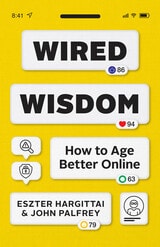
Wired Wisdom
How to Age Better OnlineEszter Hargittai and John Palfrey
University of Chicago Press, 2025
Many popular accounts say the older you are, the greater your tech struggles. And it’s worrying to think of loved ones emailing cringe-worthy misinformation, falling for phishing attacks, or becoming lonelier with increasing time spent online.
But in their eye-opening book on the internet’s fastest-growing demographic, researchers Eszter Hargittai and John Palfrey offer a more nuanced picture—debunking common myths about older adults’ internet use to offer hope and a necessary call to action. Incorporating original interviews and survey results from thousands of people sixty and over, Wired Wisdom shows that many, in fact, use technology in ways that put younger peers to shame. Over-sixties are often nimble online and quicker to abandon social media platforms that don’t meet their needs. Despite being targeted more often, they also may be less likely to fall for scams than younger peers. And fake news actually fools fewer people over sixty, who have far more experience evaluating sources and detecting propaganda. Still, there are unseen risks and missed opportunities for this group. Hargittai and Palfrey offer practical advice and show that our stereotypes can be hurdles that keep us from building intergenerational support communities, helping loved ones adopt new technology that may improve their lives, and thriving together online.
Wired Wisdom
How to Age Better OnlineEszter Hargittai and John Palfrey
University of Chicago Press, 2025
A surprising window into the online lives of people sixty and over—offering essential insights, no matter your age.
Many popular accounts say the older you are, the greater your tech struggles. And it’s worrying to think of loved ones emailing cringe-worthy misinformation, falling for phishing attacks, or becoming lonelier with increasing time spent online.
But in their eye-opening book on the internet’s fastest-growing demographic, researchers Eszter Hargittai and John Palfrey offer a more nuanced picture—debunking common myths about older adults’ internet use to offer hope and a necessary call to action. Incorporating original interviews and survey results from thousands of people sixty and over, Wired Wisdom shows that many, in fact, use technology in ways that put younger peers to shame. Over-sixties are often nimble online and quicker to abandon social media platforms that don’t meet their needs. Despite being targeted more often, they also may be less likely to fall for scams than younger peers. And fake news actually fools fewer people over sixty, who have far more experience evaluating sources and detecting propaganda. Still, there are unseen risks and missed opportunities for this group. Hargittai and Palfrey offer practical advice and show that our stereotypes can be hurdles that keep us from building intergenerational support communities, helping loved ones adopt new technology that may improve their lives, and thriving together online.
Work, Retire, Repeat
The Uncertainty of Retirement in the New EconomyTeresa Ghilarducci
University of Chicago Press, 2024
A damning portrait of the dire realities of retirement in the United States—and how we can fix it.
While the French went on strike in 2023 to protest the increase in the national retirement age, workers in the United States have all but given up on the notion of dignified retirement for all. Instead, Americans—whose elders face the highest risk of poverty compared to workers in peer nations—are fed feel-good stories about Walmart clerks who can finally retire because a customer raised the necessary funds through a GoFundMe campaign.
Many argue that the solution to the financial straits of American retirement is simple: people need to just work longer. Yet this call to work longer is misleading in a multitude of ways, including its endangering of the health of workers and its discrimination against people who work in lower-wage occupations. In Work, Retire, Repeat, Teresa Ghilarducci tells the stories of elders locked into jobs—not because they love to work but because they must.
But this doesn’t need to be the reality. Work, Retire, Repeat shows how relatively low-cost changes to how we finance and manage retirement will allow people to truly choose how they spend their golden years.
Work, Retire, Repeat
The Uncertainty of Retirement in the New EconomyTeresa Ghilarducci
University of Chicago Press, 2024
A damning portrait of the dire realities of retirement in the United States—and how we can fix it.
While the French went on strike in 2023 to protest the increase in the national retirement age, workers in the United States have all but given up on the notion of dignified retirement for all. Instead, Americans—whose elders face the highest risk of poverty compared to workers in peer nations—are fed feel-good stories about Walmart clerks who can finally retire because a customer raised the necessary funds through a GoFundMe campaign.
Many argue that the solution to the financial straits of American retirement is simple: people need to just work longer. Yet this call to work longer is misleading in a multitude of ways, including its endangering of the health of workers and its discrimination against people who work in lower-wage occupations. In Work, Retire, Repeat, Teresa Ghilarducci tells the stories of elders locked into jobs—not because they love to work but because they must.
But this doesn’t need to be the reality. Work, Retire, Repeat shows how relatively low-cost changes to how we finance and manage retirement will allow people to truly choose how they spend their golden years.