Results by title
60 books match the query 'Ghana' and 2 start with w

Waste Works
Vital Politics in Urban GhanaBrenda Chalfin
Duke University Press, 2023
In Waste Works, Brenda Chalfin examines Ghana’s planned city of Tema, theorizing about the formative role of waste infrastructure in urban politics and public life. Chalfin argues that at Tema’s midcentury founding, a prime objective of governing authorities was to cultivate self-contained citizens by means of tightly orchestrated domestic infrastructure and centralized control of bodily excrement to both develop and depoliticize the new nation. Comparing infrastructural innovations across the city, Chalfin excavates how Tema residents pursue novel approaches to urban waste and sanitation built on the ruins of the inherited order, profoundly altering the urban public sphere. Once decreed a private matter to be guaranteed by state authorities, excrement becomes a public issue, collectively managed by private persons. Pushing self-care into public space and extending domestic responsibility for public well-being and bodily outputs, popularly devised waste infrastructures are a decisive arena to make claims, build coalitions, and cultivate status. Confounding high-modernist ideals, excremental infrastructures unlock bodily waste’s diverse political potentials.
[more]
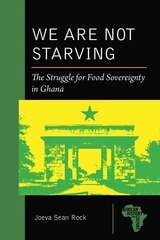
We Are Not Starving
The Struggle for Food Sovereignty in GhanaJoeva Sean Rock
Michigan State University Press, 2022
This critical text is a timely ethnography of how global powers, local resistance, and capital flows are shaping contemporary African foodways. Ghana was one of the first countries targeted by a group of US donors and agribusiness corporations that funded an ambitious plan to develop genetically modified (GM) crops for African farmers. The collective believed that GM crops would help farmers increase their yields and help spark a “new” Green Revolution on the continent. Soon after the project began in Ghana, a nationwide food sovereignty movement emerged in opposition to GM crops. Today, in spite of impressive efforts and investments by proponents, only two GM crops remain in the pipeline. Why, after years of preparation, millions of dollars of funding, and multiple policy reforms, did these megaprojects effectively come to a halt? One of the first ethnographies to take on the question of GM crops in the African context, We Are Not Starving: The Struggle for Food Sovereignty in Ghana blends archival analysis, interviews, and participant observation with Ghanaian scientists, farmers, activists, and officials. Ultimately the text aims to illuminate why GM crops have animated the country and to highlight how their introduction has opened an opportunity to air grievances about the systematic de-valuing and exploitation of African land, labor, and knowledge that have been centuries in the making.
[more]