Results by title
67 books match the query 'Global Warming & Climate Change' and 3 start with w
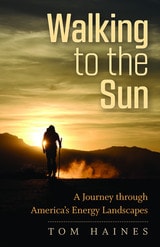
Walking to the Sun
A Journey through America's Energy LandscapesTom Haines
University Press of New England, 2018
On a winter day in 2013, Tom Haines stood in front of his basement furnace and wondered about the source of the natural gas that fueled his insulated life. During the next four years, Haines, an award-winning journalist and experienced wanderer, walked hundreds of miles through landscapes of fuel—oil, gas, and coal, and water, wind, and sun—on a crucial exploration of how we live on Earth in the face of a growing climate crisis. Can we get from the fossil fuels of today to the renewables of tomorrow? The story Haines tells in Walking to the Sun is full not only of human encounters—with roustabouts working on an oil rig, farmers tilling fields beneath wind turbines, and many others—but also of the meditative range that arrives with solitude far from home. Walking to the Sun overcomes the dislocation of our industrial times to look closely at the world around us and to consider what might come next.
[more]
Water Always Wins
Thriving in an Age of Drought and DelugeErica Gies
University of Chicago Press, 2022
Winner of the Rachel Carson Award for Excellence in Environmental Journalism, Water Always Wins is a hopeful journey around the world and across time, illuminating better ways to live with water.
Nearly every human endeavor on the planet was conceived and constructed with a relatively stable climate in mind. But as new climate disasters remind us every day, our world is not stable—and it is changing in ways that expose the deep dysfunction of our relationship with water. Increasingly severe and frequent floods and droughts inevitably spur calls for higher levees, bigger drains, and longer aqueducts. But as we grapple with extreme weather, a hard truth is emerging: our development, including concrete infrastructure designed to control water, is actually exacerbating our problems. Because sooner or later, water always wins.
In this quietly radical book, science journalist Erica Gies introduces us to innovators in what she calls the Slow Water movement who start by asking a revolutionary question: What does water want? Using close observation, historical research, and cutting-edge science, these experts in hydrology, restoration ecology, engineering, and urban planning are already transforming our relationship with water.
Modern civilizations tend to speed water away, erasing its slow phases on the land. Gies reminds us that water’s true nature is to flex with the rhythms of the earth: the slow phases absorb floods, store water for droughts, and feed natural systems. Figuring out what water wants—and accommodating its desires within our human landscapes—is now a crucial survival strategy. By putting these new approaches to the test, innovators in the Slow Water movement are reshaping the future.
[more]
Wildlife Conservation in a Changing Climate
Edited by Jedediah F. Brodie, Eric S. Post, and Daniel F. Doak
University of Chicago Press, 2012
Human-induced climate change is emerging as one of the gravest threats to biodiversity in history, and while a vast amount of literature on the ecological impact of climate change exists, very little has been dedicated to the management of wildlife populations and communities in the wake of unprecedented habitat changes. Wildlife Conservation in a Changing Climate is an essential resource, bringing together leaders in the fields of climate change ecology, wildlife population dynamics, and environmental policy to examine the impacts of climate change on populations of terrestrial vertebrates. Chapters assess the details of climate change ecology, including demographic implications for individual populations, evolutionary responses, impacts on movement patterns, alterations of species interactions, and predicting impacts across regions. The contributors also present a number of strategies by which conservationists and wildlife managers can counter or mitigate the impacts of climate change as well as increase the resilience of wildlife populations to such changes. A seminal contribution to the fields of ecology and conservation biology, Wildlife Conservation in a Changing Climate will serve as the spark that ignites a new direction of discussions about and action on the ecology and conservation of wildlife in a changing climate.
[more]