Results by title
98 books match the query 'Government' and 3 start with w
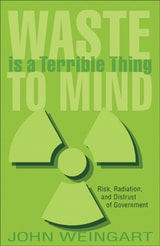
Waste is a Terrible Thing to Mind
Risk, Radiation, and Distrust of GovernmentWeingart, John
Rutgers University Press, 2007
It is an unenviable task, but one that all state governments face: finding a final “resting place” for low-level nuclear waste from power plants, hospitals, university laboratories, and other industries. John Weingart was the official in New Jersey who for many years led this onerous charge. This book is the story of how he and a commission appointed by the governor, instead of imposing a top-down solution, designed an approach that would confront public fears by seeking a community that would volunteer to host a disposal facility. Initially, this novel approach was surprisingly successful, as leaders in a dozen municipalities stepped forward to say they might be interested. Once their interest became known, however, the process in each town derailed. Residents demanded assurances of zero-percent risk and expressed profound distrust of government assertions and promises.
Waste Is a Terrible Thing to Mind is a compelling, suspenseful, and amusing insider’s account of New Jersey policy and politics, but it is also a larger saga of the challenges facing society in the post–9/11 era when the public’s distrust of government is increasing at the same time that its sensitivity to health and safety threats is heightened.
For more information, see: http://wasteisaterriblethingtomind.com/
"Written with a wry sense of humor, it is a pleasure to read and could provide the blueprint for future efforts to find locations for controversial land uses."
- Marie Curtis, Executive Director, New Jersey Environmental Lobby
"A penetrating look at one state's struggle with radioactive waste ... offering some tantalizing reflections on the public understanding of science and how we, in a democratic society, deal with complexity and uncertainty."
- Jay Kaufman, State Senator, Massachusetts State Legislature
"A provocative story, laced with humor, demonstrates how public distrust of government can make it impotent. It should be read by anyone working on public policy issues, especially planning, growth, and the environment."
- Harriet Keyserling, Former Energy Committee Chair, South Carolina State Legislature
"Readers interested in environmental policy, land use and how governments make decisions will learn much from this fine reflective insider's account. It's also a primer on how to survive and thrive in state government."
- David N. Kinsey, Visiting Professor, Woodrow Wilson School Princeton University
"... a fascinating case study of how a government agency creatively tried to solve an intractable public issue. Although the agency failed in its quest to recruit a town to host a low-level radioactive waste site, Weingart's detailed and often humorous narrative of the agency's efforts is a clear winner."
- Jack Sabatino, Judge, New Jersey Superior Court
"... a very engaging and sometimes discouraging case study about the pitfalls and perils of trying to site a controversial facility the right way."
- Gregg Larson, Administrator, Center for Biometric Research, University of Minnesota
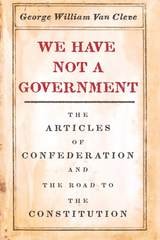
We Have Not a Government
The Articles of Confederation and the Road to the ConstitutionGeorge William Van Cleve
University of Chicago Press, 2017
In George William Van Cleve’s book, we encounter a sharply divided America. The Confederation faced massive war debts with virtually no authority to compel its members to pay them. It experienced punishing trade restrictions and strong resistance to American territorial expansion from powerful European governments. Bitter sectional divisions that deadlocked the Continental Congress arose from exploding western settlement. And a deep, long-lasting recession led to sharp controversies and social unrest across the country amid roiling debates over greatly increased taxes, debt relief, and paper money. Van Cleve shows how these remarkable stresses transformed the Confederation into a stalemate government and eventually led previously conflicting states, sections, and interest groups to advocate for a union powerful enough to govern a continental empire.
Touching on the stories of a wide-ranging cast of characters—including John Adams, Patrick Henry, Daniel Shays, George Washington, and Thayendanegea—Van Cleve makes clear that it was the Confederation’s failures that created a political crisis and led to the 1787 Constitution. Clearly argued and superbly written, We Have Not a Government is a must-read history of this crucial period in our nation’s early life.
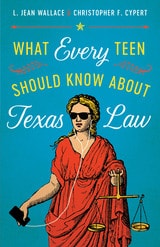
What Every Teen Should Know about Texas Law
By L. Jean Wallace and Christopher F. Cypert
University of Texas Press, 2018
From reviews of earlier editions:
“Young people get into legal trouble for two reasons: they do not know what the law is, and they do not stop to think about the consequences of their actions. This book would make a good text for a preparation for life class. . . . The book is written in plain language, unencumbered by a lot of legal citations, and with no expectation that the reader will have any working knowledge of the law.”
—Texas Bar Journal
“A book any parent should consider giving their child. . . . But before you do, take a look at it yourself. No matter the title, Wallace’s book . . . contains information everyone . . . should know.”
—Austin American-Statesman
What Every Teen Should Know about Texas Law is the only single-source guide for accurate, easy-to-understand information about most areas of civil law in Texas. L. Jean Wallace drew on years of experience as a students’ attorney at Texas Tech University to inform young adults about the areas of law that affect them most: driving and car ownership, pranks and crimes (including alcohol and drug offenses), personal relationships, employment and consumer concerns, and living on their own. She illustrated her points with true, sometimes humorous, stories of young adults’ encounters with the law.
For this new edition, municipal judge Christopher F. Cypert has completely updated the book to reflect the current state of the law. He covers specific topics that are now mandated to be taught in schools, including the proper way to interact with peace officers during traffic stops and other in-person encounters, as well as internet-era misbehaviors such as sexting and cyberbullying. Like Wallace, Cypert has helped many young people navigate the sometimes confusing processes of the legal world, often loaning earlier editions of this book to young offenders in his court. Both authors’ real-world experience and legal expertise ensure that What Every Teen Should Know about Texas Law is indeed a complete and practical guide for assuming the responsibilities of adulthood—as well as a good refresher course for all legal-age Texans.