Results by title
56 books match the query 'Great Basin' and 7 start with w
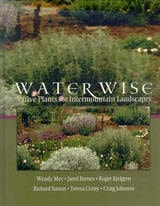
Water Wise
Native Plants for Intermountain LandscapesWendy Mee, Jared Barnes, Roger Kjelgren, Richard Sutton, Teresa Cerny, and Craig Johnson
Utah State University Press, 2003
Today, native plants and water conservation are subjects of vital interest to cities, offices, homeowners, and agriculture alike, as all are affected by the growing shortage of water in the Intermountain region.
This comprehensive volume provides specific information about shrubs, trees, grasses, forbs, and cacti that are native to most states in the Intermountain West, and that can be used in landscaping to conserve water, reflect and preserve the region's landscape character, and help protect its ecological integrity. The book is an invaluable guide for the professional landscaper, horticulturist, and others in the Intermountain nursery industry, as well as for the student, general reader, gardener, and homeowner.
Water Wise is both convenient and comprehensive. The heart of the book presents hundreds of species, devoting a full page to each, with a description of appearance, habitat, landscape use, and other comments. Color photographs illustrate each plant described. A reader-friendly introduction provides important background on the ecology of the Intermountain West, along with full descriptions of native plant habitats and associations.
An accessible resource of accurate native plant information for all readers, Water Wise will be indispensable to professional landscapers and amateurs alike.
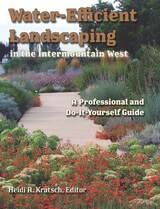
Water-Efficient Landscaping in the Intermountain West
A Professional and Do-It-Yourself GuideHeidi Kratsch
Utah State University Press, 2011
This working manual provides complete information on the technical aspects of designing, building, and maintaining waterwise landscapes in the Mountain West. Written particularly for professionals, including landscape designers, architects, contractors, and maintenance and irrigation specialists, it has an attractive, well-illustrated, user-friendly format that will make it useful as well to DIY homeowners and to educators, plant retailers, extension agents, and many others.
The manual is organized according to landscape principles that are adapted to the climate of the intermountain region. Beginning with planning and design, the topical principles proceed through soil preparation, appropriate plant selection, practicalities of turfgrass, use of mulch, and irrigation planning, winding up with landscape maintenance. Designed for onsite, handy use, the book is illustrated with color images of landscapes, plants, and materials. Tables, charts, diagrams, landscape plans, plant lists, checklists, and other graphic resources are scattered throughout the manual, which is written in an accessible but information-rich style. Water-Efficient Landscaping in the Intermountain West answers, more comprehensively than any other single book, the need for professional information that addresses both growing awareness of the necessity for water conservation and the desire for beautiful, healthy yards and properties.
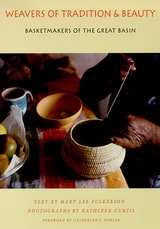
Weavers of Tradition and Beauty
Basketmakers of the Great BasinMary Lee Fulkerson
University of Nevada Press, 1995
Weavers of Tradition and Beauty presents new information on contemporary Native American basketry of the Great Basin, largely from the viewpoint of the weavers themselves. In collecting their stories, Kathleen Curtis and Mary Lee Fulkerson traveled throughout Nevada, never dreaming their odyssey over back-roads and to reservations would stretch into years. Finding a deep connection to the people of the sage, the authors accompanied the weavers as they gathered and prepared their special willow, dyed the bracken fern root, and wove their baskets. Baskets—and the people who weave them—have always been revered and honored by Native Americans. Fulkerson and Curtis depict, in text and full color and black and white photographs, how their art prevails—even over adverse environmental, social, and economic conditions. Today, contemporary weavers continue their work by creating baskets in the manner of their ancestors. Teaching their children and grandchildren how to weave baskets, these artisans carry on a long and strong tradition. By documenting the basketry of Nevada's native people, the authors make a significant contribution in preserving this ancient and beautiful craft. Foreword by Catherine S. Fowler.
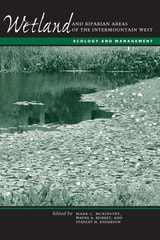
Wetland and Riparian Areas of the Intermountain West
Ecology and ManagementEdited by Mark C. McKinstry, Wayne A. Hubert, and Stanley H. Anderson
University of Texas Press, 2004
Wetlands and riparian areas between the Rocky Mountains and the Sierra Nevada are incredibly diverse and valuable habitats. More than 80 percent of the wildlife species in this intermountain region depend on these wetlands—which account for less than 2 percent of the land area—for their survival. At the same time, the wetlands also serve the water needs of ranchers and farmers, recreationists, vacation communities, and cities. It is no exaggeration to call water the "liquid gold" of the West, and the burgeoning human demands on this scarce resource make it imperative to understand and properly manage the wetlands and riverine areas of the Intermountain West.
This book offers land managers, biologists, and research scientists a state-of-the-art survey of the ecology and management practices of wetland and riparian areas in the Intermountain West. Twelve articles examine such diverse issues as laws and regulations affecting these habitats, the unique physiographic features of the region, the importance of wetlands and riparian areas to fish, wildlife, and livestock, the ecological function of these areas, their value to humans, and the methods to evaluate these habitats. The authors also address the human impacts on the land from urban and suburban development, mining, grazing, energy extraction, recreation, water diversions, and timber harvesting and suggest ways to mitigate such impacts.
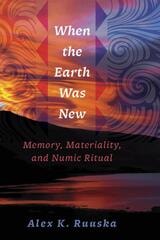
When the Earth Was New
Memory, Materiality, and Numic RitualAlex K. Ruuska
University of Utah Press, 2025
In When the Earth Was New, Alex K. Ruuska explores riveting multigenerational memories of Numic-speaking communities that extend back, potentially, to the late Pleistocene. These diverse oral traditions describe geological, climatic, and ecological events that occurred over thousands of years and were passed down across many generations. Through the examination of place-based memories and the architecture of Numic knowledge, Ruuska demonstrates convergences of oral traditions, ethnography, ethnohistory, archaeology, and geology.
When the Earth Was New critically compares and considers multiple forms of knowledge that contribute to overlapping as well as disparate understandings of both recent and distant pasts in the regions of California, the Great Basin, and the Colorado Plateau. It works at balancing key themes in these regions’ histories within a more holistic framework, exploring ancient and modern strands of knowledge with the assistance of twenty-four Tribes and Consolidated Organizations.
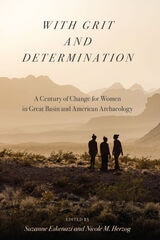
With Grit and Determination
A Century of Change for Women in Great Basin and American ArchaeologyEdited by Suzanne Eskenazi and Nicole M. Herzog
University of Utah Press, 2020
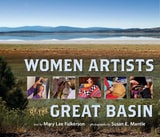
Women Artists of the Great Basin
Mary Lee Fulkerson
University of Nevada Press, 2017
Fulkerson and Mantle, longtime artists and residents of the Great Basin themselves, offer a behind-the-scenes intimate glimpse into these women’s lives and artwork—showing not only what they create, but why they create it. Too often overlooked, the women covered here prove there is much richness, life, and creativity in what has often been dismissed as a barren desert. Their stories of overcoming great obstacles unfold right alongside images of their art. Many circle outside the conventional world of galleries, museums, and art publications and have created varied paths to their success. They are indeed true originals, rooted in a land of unique geography, a stew of cultures, and stories like no other.