Results by title
133 books match the query 'Guatemala' and 6 start with w
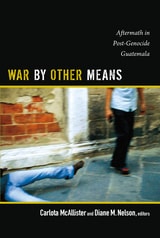
War by Other Means
Aftermath in Post-Genocide GuatemalaCarlota McAllister and Diane M. Nelson, eds.
Duke University Press, 2013
Contributors consider a wide range of issues confronting present-day Guatemala: returning refugees, land reform, gang violence, neoliberal economic restructuring, indigenous and women's rights, complex race relations, the politics of memory, and the challenges of sustaining hope. From a sweeping account of Guatemalan elites' centuries-long use of violence to suppress dissent to studies of intimate experiences of complicity and contestation in richly drawn localities, War by Other Means provides a nuanced reckoning of the injustices that made genocide possible and the ongoing attempts to overcome them.
Contributors. Santiago Bastos, Jennifer Burrell, Manuela Camus, Matilde González-Izás, Jorge Ramón González Ponciano, Greg Grandin, Paul Kobrak, Deborah T. Levenson, Carlota McAllister, Diane M. Nelson, Elizabeth Oglesby, Luis Solano, Irmalicia Velásquez Nimatuj, Paula Worby
Warfare and the Fall of a Fortified Center
Archaeological Investigations at AguatecaTakeshi Inomata
Vanderbilt University Press, 2006
VIMA Series #3
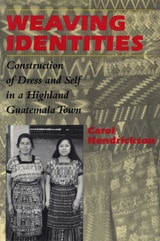
Weaving Identities
Construction of Dress and Self in a Highland Guatemala TownBy Carol Hendrickson
University of Texas Press, 1995
Traje, the brightly colored traditional dress of the highland Maya, is the principal visual expression of indigenous identity in Guatemala today. Whether worn in beauty pageants, made for religious celebrations, or sold in tourist markets, traje is more than "mere cloth"—it plays an active role in the construction and expression of ethnicity, gender, education, politics, wealth, and nationality for Maya and non-Maya alike.
Carol Hendrickson presents an ethnography of clothing focused on the traje—particularly women's traje—of Tecpán, Guatemala, a bi-ethnic community in the central highlands. She covers the period from 1980, when the recent round of violence began, to the early 1990s, when Maya revitalization efforts emerged.
Using a symbolic analysis informed by political concerns, Hendrickson seeks to increase the value accorded to a subject like weaving, which is sometimes disparaged as "craft" or "women's work." She examines traje in three dimensions—as part of the enduring images of the "Indian," as an indicator of change in the human life cycle and cloth production, and as a medium for innovation and creative expression.
From this study emerges a picture of highland life in which traje and the people who wear it are bound to tradition and place, yet are also actively changing and reflecting the wider world. The book will be important reading for all those interested in the contemporary Maya, the cultural analysis of material culture, and the role of women in culture preservation and change.
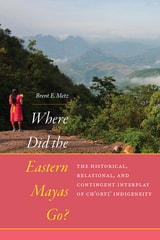
Where Did the Eastern Mayas Go?
The Historical, Relational, and Contingent Interplay of Ch’orti’ Indigeneityby Brent E. Metz
University Press of Colorado, 2022
Copublished with the Institute for Mesoamerican Studies, University of Albany
In Where Did the Eastern Mayas Go? Brent E. Metz explores the complicated issue of who is Indigenous by focusing on the sociohistorical transformations over the past two millennia of the population currently known as the Ch’orti’ Maya. Epigraphers agree that the language of elite writers in Classic Maya civilization was Proto-Ch’olan, the precursor of the Maya languages Ch’orti’, Ch’olti’, Ch’ol, and Chontal. When the Spanish invaded in the early 1500s, the eastern half of this area was dominated by people speaking various dialects of Ch’olti’ and closely related Apay (Ch’orti’), but by the end of the colonial period (1524–1821) only a few pockets of Ch’orti’ speakers remained.
From 2003 to 2018 Metz partnered with Indigenous leaders to conduct a historical and ethnographic survey of Ch’orti’ Maya identity in what was once the eastern side of the Classic period lowland Maya region and colonial period Ch’orti’-speaking region of eastern Guatemala, western Honduras, and northwestern El Salvador. Today only 15,000 Ch’orti’ speakers remain, concentrated in two municipalities in eastern Guatemala, but since the 1990s nearly 100,000 impoverished farmers have identified as Ch’orti’ in thirteen Guatemalan and Honduran municipalities, with signs of Indigenous revitalization in several Salvadoran municipalities as well. Indigenous movements have raised the ethnic consciousness of many non-Ch’orti’-speaking semi-subsistence farmers, or campesinos. The region’s inhabitants employ diverse measures to assess identity, referencing language, history, traditions, rurality, “blood,” lineage, discrimination, and more.
Where Did the Eastern Mayas Go? approaches Indigenous identity as being grounded in historical processes, contemporary politics, and distinctive senses of place. The book is an engaged, activist ethnography not on but, rather, in collaboration with a marginalized population that will be of interest to scholars of the eastern lowland Maya region, indigeneity generally, and ethnographic experimentation.
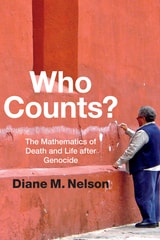
Who Counts?
The Mathematics of Death and Life after GenocideDiane M. Nelson
Duke University Press, 2015
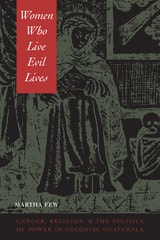
Women Who Live Evil Lives
Gender, Religion, and the Politics of Power in Colonial GuatemalaBy Martha Few
University of Texas Press, 2002
Women Who Live Evil Lives documents the lives and practices of mixed-race, Black, Spanish, and Maya women sorcerers, spell-casters, magical healers, and midwives in the social relations of power in Santiago de Guatemala, the capital of colonial Central America. Men and women from all sectors of society consulted them to intervene in sexual and familial relations and disputes between neighbors and rival shop owners; to counter abusive colonial officials, employers, or husbands; and in cases of inexplicable illness.
Applying historical, anthropological, and gender studies analysis, Martha Few argues that women's local practices of magic, curing, and religion revealed opportunities for women's cultural authority and power in colonial Guatemala. Few draws on archival research conducted in Guatemala, Mexico, and Spain to shed new light on women's critical public roles in Santiago, the cultural and social connections between the capital city and the countryside, and the gender dynamics of power in the ethnic and cultural contestation of Spanish colonial rule in daily life.