Results by title
332 books match the query 'Health & Fitness' and 13 start with w
Waiting for Cancer to Come
Women’s Experiences with Genetic Testing and Medical Decision Making for Breast and Ovarian CancerSharlene Hesse-Biber
University of Michigan Press, 2014
Waiting for Cancer to Come tells the stories of women who are struggling with their high risk for cancer. Based on interviews and surveys of dozens of women, this book pieces together the diverse yet interlocking experiences of women who have tested positive for the BRCA 1/2 gene mutations, which indicate a higher risk of developing breast and ovarian cancer. Sharlene Hesse-Biber brings these narratives to light and follows women’s journeys from deciding to get screened for BRCA, to learning the test has come back positive, to dealing with their risk. Many women already know the challenges of a family history riddled with cancer and now find themselves with the devastating knowledge of their own genetic risk. Using the voices of the women themselves to describe the under-explored BRCA experience, Waiting for Cancer to Come looks at the varied emotional, social, economic, and psychological factors at play in women’s decisions about testing and cancer prevention.
Watching Our Weights
The Contradictions of Televising Fatness in the “Obesity Epidemic”Zimdars, Melissa
Rutgers University Press, 2019
Watching Our Weights explores the competing and contradictory fat representations on television that are related to weight-loss and health, medicalization and disease, and body positivity and fat acceptance. While television—especially reality television—is typically understood to promote individual self-discipline and expert interventions as necessary for transforming fat bodies into thin bodies, fat representations and narratives on television also create space for alternative as well as resistant discourses of the body. Melissa Zimdars thus examines the resistance inherent within TV representations and narratives of fatness as a global health issue, the inherent and overt resistance found across stories of medicalized fatness, and programs that actively avoid dieting narratives in favor of less oppressive ways of thinking about the fat body. Watching Our Weights weaves together analyses of media industry lore and decisions, communication and health policies, medical research, activist projects, popular culture, and media texts to establish both how television shapes our knowledge of fatness and how fatness helps us better understand contemporary television.
We Are Having This Conversation Now
The Times of AIDS Cultural ProductionAlexandra Juhasz and Theodore Kerr
Duke University Press, 2022
Weighty Problems
Embodied Inequality at a Children’s Weight Loss CampLaura Backstrom
Rutgers University Press, 2019

Well-Being and Creative Careers
What Makes You Happy Can Also Make You SickMark Deuze
Intellect Books, 2025
The media and creative industries thrive on passion, but that passion often comes at a cost. Behind the glamour of journalism, filmmaking, games, music, advertising, and online content creation lies a growing crisis—one of burnout, anxiety, substance abuse, and exhaustion. Why do so many creative professionals report feeling both deeply fulfilled and profoundly unwell?
Mark Deuze investigates the systemic issues that make creative work both exhilarating and unsustainable. Drawing on extensive research and in-depth interviews with media professionals, he notes the hidden downsides of doing what you love and offers a candid analysis of how workplace structures, high workloads, and perceived injustices contribute to mental and physical distress.
But this book is not just about what’s broken; it’s about what can be done. Deuze provides a roadmap for rethinking the culture of creative industries and offers strategies for balancing passion with sustainability. A practical resource for media scholars and those navigating the highs and lows of a creative career, this work challenges us to imagine a healthier future for our labor of love.

Wet Earth and Dreams
A Narrative of Grief and RecoveryJane Lazarre
Duke University Press, 1998
As she contends with the pain and many indignities of her treatment for cancer, Lazarre realizes that successful medical treatment will only be part of her healing process. Her own illness becomes the vehicle for coming to terms with key moments of loss and grief—the death of a beloved therapist from breast cancer, her brother-in-law’s death from AIDS, a traumatic disappointment in her work life, and the unresolved pain of being a motherless child. The gift of Lazarre’s writing is her ability to transform her narratives of grief and loss into a story whose power to heal lies in its ability to penetrate the unconscious and give voice to the elusive truths hidden there. Through her writing, Lazarre is able to embrace grief—even her own inarticulate grief as a child—and find her way through the story to a restored sense of wholeness.
In Wet Earth and Dreams Jane Lazarre once again proves herself to be both companion and guide through some of the most difficult challenges life has to offer. As always, she draws strength not only from sustaining friendship and love, but also from her own faith in the power of storytelling to make bearable the seemingly unbearable. Lazarre’s bravely and beautifully written account of grief, illness, and death is at the last a celebration of the redemptive possibilities of the creative spirit.
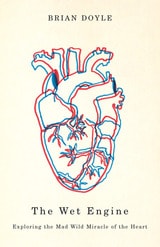
Wet Engine
Exploring the Mad Wild Miracle of the HeartBrian Doyle
Oregon State University Press, 2012
In this poignant and startlingly original book, Brian Doyle examines the heart as a physical organ—how it is supposed to work, how surgeons try to fix it when it doesn’t—and as a metaphor: the seat of the soul, the power house of the body, the essence of spirituality. In a series of profoundly moving ruminations, Doyle considers the scientific, emotional, literary, philosophical, and spiritual understandings of the heart—from cardiology to courage, from love letters and pop songs to Jesus. Weaving these strands together is the torment of Doyle’s own infant son’s heart surgery and the inspiring story of the young heart doctor who saved Liam’s life.
The Wet Engine is a book that will change how you feel and think about the mysterious, fragile human heart. This new paperback edition includes a foreword by Dr. Marla Salmon, dean of the University of Washington School of Nursing.

What Every Senior Needs to Know About Health Care
J Nora
University Press of Colorado, 2004
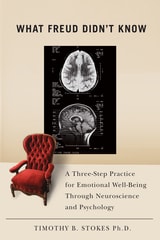
What Freud Didn't Know
A Three-Step Practice for Emotional Well-Being through Neuroscience and PsychologyStokes, Timothy B
Rutgers University Press, 2009
What Freud Didn't Know, well-supported by research and groundbreaking in theory, combines neuroscience and psychology to explain how the amygdala region of the brain evolved to unconsciously record, store, and activate emotional memory loops and imagery associated with painful events, especially those of childhood. This book is the first to bring together diverse, post-Freudian discoveries to produce a coherent three-step practice for understanding problematic aspects of the human mind which can be mastered easily, in a clinical or self-help setting. Stokes explores recent breakthroughs, many in marked contrast to Freud's views, which will change how we view psychological and emotional problems and their treatments.
Grounded in current theories about brain circuitry, What Freud Didn't Know integrates ideas about mindfulness, habitual thinking, and insight imagery and provides readers with the tools to rescript their personal narratives for psychological well-being. As an alternative approach to treating stress, most types of depression, anxiety, and phobias without prescription drugs, Stokes's three-step practice can be used to build resiliency and inner peace.
What's That Pig Outdoors?
A Memoir of DeafnessHenry Kisor
University of Illinois Press, 2010
Women Living With Self-Injury
Jane Wegscheider Hyman
Temple University Press, 1999
In this book, author Jane Wegschneider sheds light on this misunderstood condition. Fifteen women talk about their battle with self-injury and explain how and why they repeatedly and deliberately injure themselves. Most admit they do it because it makes them feel high or safe. They also describe living with ceaseless shame, secrecy, and fear of discovery which could make them unemployable and ostracized. Candidly discussing their attempted and successful recoveries, they reveal the impact living with self-injury has on their day-to-day lives -- where they are competent workers, partners, friends, and mothers.
Hear the voices of these women as they speak to a public that generally sees self-injury as frightening, senseless, and repulsive. Concealing scars or other signs of injury is crucial for them and partly dictates their daily routines, choice of clothes, and the lies they tell to excuse any traces of injury. For these productive women who work outside of the home and often raise children, hiding self-injury is of paramount importance during their workdays and in their relationships with partners, families, and friends.
Hyman's approach is unique in that she not only talked to these women but also really listened to their stories -- something rare in the misunderstood realm of self-injury. Professionals, perplexed by self-injury, have not always tolerated its complexity. As a result those who injure themselves have remained shrouded in secrecy, isolation, and shame -- until now.
This book offers compassion as well as encouragement for recovery by making available the emotional experiences of sufferers in their own words. It is an important book for those who self-injure, their loved ones, anyone who knows of or suspects self-injury in a friend, and mental care professionals.
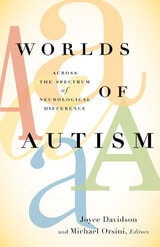
Worlds of Autism
Across the Spectrum of Neurological DifferenceJoyce Davidson
University of Minnesota Press, 2013
Since first being identified as a distinct psychiatric disorder in 1943, autism has been steeped in contestation and controversy. Present-day skirmishes over the potential causes of autism, how or even if it should be treated, and the place of Asperger’s syndrome on the autism spectrum are the subjects of intense debate in the research community, in the media, and among those with autism and their families. Bringing together innovative work on autism by international scholars in the social sciences and humanities, Worlds of Autism boldly challenges the deficit narrative prevalent in both popular and scientific accounts of autism spectrum disorders, instead situating autism within an abilities framework that respects the complex personhood of individuals with autism.
A major contribution to the emerging, interdisciplinary field of critical autism studies, this book is methodologically and conceptually broad. Its authors explore the philosophical questions raised by autism, such as how it complicates neurotypical understandings of personhood; grapple with the politics that inform autism research, treatment, and care; investigate the diagnosis of autism and the recognition of difference; and assess representations of autism and stories told by and about those with autism.
From empathy, social circles, and Internet communities to biopolitics, genetics, and diagnoses, Worlds of Autism features a range of perspectives on autistic subjectivities and the politics of cognitive difference, confronting society’s assumptions about those with autism and the characterization of autism as a disability.
Contributors: Dana Lee Baker, Washington State U; Beatrice Bonniau, Paris Descartes U; Charlotte Brownlow, U of Southern Queensland, Australia; Kristin Bumiller, Amherst College; Brigitte Chamak, Paris Descartes U; Kristina Chew, Saint Peter’s U, New Jersey; Patrick McDonagh, Concordia U, Montreal; Stuart Murray, U of Leeds; Majia Holmer Nadesan, Arizona State U; Christina Nicolaidis, Portland State U; Lindsay O'Dell, Open U, London; Francisco Ortega, State U of Rio de Janeiro; Mark Osteen, Loyola U, Maryland; Dawn Eddings Prince; Dora Raymaker; Sara Ryan, U of Oxford; Lila Walsh.
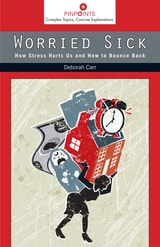
Worried Sick
How Stress Hurts Us and How to Bounce BackCarr, Deborah
Rutgers University Press, 2014
We have all experienced stressful times—maybe a major work deadline or relocating cross-country for a new job—when we came out unscathed, feeling not only emotionally and physically healthy, but better than we did prior to the crisis. Why do some people withstand adversity without a scratch, while others fall ill or become emotionally despondent when faced with even a seemingly minor hassle? Without oversimplifying the discussion, Deborah Carr succinctly provides readers with key themes and contemporary research on the concept of stress. Understanding individuals’ own sources of strength and vulnerability is an important step toward developing personal strategies to minimize stress and its unhealthy consequences. Yet Carr also challenges the notion that merely reducing stress in our lives will help us to stay healthy. Many of the stressors that we face in everyday life are not our problems alone; rather, they are symptoms of much larger, sweeping problems in contemporary U.S. society.
To readers interested in the broad range of chronic, acute, and daily life stressors facing Americans in the twenty-first century, as well as those with interest in the many ways that our physical and emotional health is shaped by our experiences, this brief book will be an immediate and quick look at these significant issues.
View a three minute video of Deborah Carr speaking about Worried Sick.