Results by title
184 books match the query 'Hispanic Americans' and 5 start with w
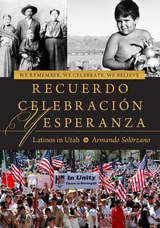
We Remember, We Celebrate, We Believe / Recuerdo, Celebración, y Esperanza
Latinos in UtahArmando Solórzano
University of Utah Press, 2014
The history of Mexican Americans in Utah is complex, but it is also a history that is neither well represented in mainstream recounting nor well recognized in the mainstream understanding of Utah’s past. Convoluted interactions among Native Americans, Spaniards, French, Mexicans, Anglos, and others shaped the story of Utah. Awareness of the long presence of Hispanics in Utah is essential to understanding the history of the state. This volume is an attempt to piece together that history through photos and oral histories.
As Armando Solórzano and other researchers conducted oral history interviews with Mexicans, Mexican Americans, and other Latinos throughout the state, a number of participants began giving the team photographs, some dating back to 1895, which provided an opportunity to begin reconstructing a history through pictures, as a community project. Within two years, Solórzano and his colleagues were able to create the pictorial history of Mexican-Americans and Latinos in Utah and launched their efforts as a photo-documentary exhibit. This book collects photographs to represent different historical periods and the manifold contributions of Latinos to the state of Utah.
Readers who delve into this book may see these photos as artistic expressions or artifacts of history and photographic technique. Some readers will see images of their relatives and precursors who labored to create a better life in Utah. The images evoke both nostalgia for a time gone by and the possibility of reconstructing history with a fairer premise. The book does not tell the full story of Latinos in Utah but should prove to be a catalyst, inspiring others to continue documenting and reconstructing the neglected threads of Utah’s history, making it truly the history of all of us.
Recipient of the Meritorious Book Award from the Utah Division of State History.
[more]
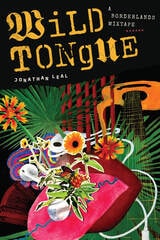
Wild Tongue
A Borderlands MixtapeJonathan Leal
Duke University Press, 2026
In Wild Tongue, writer, scholar, and musician Jonathan Leal invites readers to the Texas borderlands to witness contemporary sonic cultures and expressive forms of Latine struggle and world-making. Blending autoethnography, music criticism, and border theory into an epistolary mixtape, Leal depicts the borderlands as a generative place made by its inhabitants, a geography where creativity and cultural performance engage powerfully with politico-aesthetic issues, create communal identity, and challenge xenophobic and nationalist dominance. Across the mixtape’s contrasting “tracks,” Leal situates living artistries within longer, local arcs of borderlands creativity, amplifying Gloria Anzaldúa’s durable, pathbreaking observation, “Wild tongues can’t be tamed, they can only be cut out.” Combining lyric nonfiction, artist interviews, archival research, transdisciplinary analysis, and popular music criticism and production, Wild Tongue presents an exhilarating, embracing account of freedoms pursued between worlds.
[more]
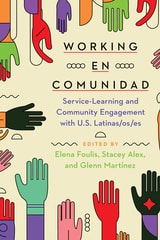
Working en comunidad
Service-Learning and Community Engagement with U.S. Latinas/os/esEdited by Elena Foulis, Stacey Alex, and Glenn Martínez
University of Arizona Press, 2024
Working in community is critical to several fields. Working en comunidad focuses on service-learning and Latina/o/e communities within a variety of institutional contexts. It provides a practical framework grounded in theoretical approaches that center Latina/o/e experiences as foundational to understanding how to prepare students to work in the community and en comunidad.
The volume tackles three major themes: ethical approaches to working with Latina/o/e communities within language courses and beyond; preparing Latina/o/e students for working with their own communities in different environments; and ensuring equitable practices and building relationships that are mutually beneficial for students and community members. The editors forward two central arguments: (1) Equitable community engagement in higher education is a reflective and reciprocal process that develops empathy and personal and professional growth in students; and (2) service-learning is most transformative when it explicitly guides students and the community to build cultural humility and recognize Latina/o/e experiences and agency as foundational to the learning process.
Many of the contributors and editors are Latina/o/e-identified scholars, practitioners, and researchers, who lend a rich body of experience and a personal dedication to this work. They present distinct approaches and geographies, as well as range of institutions, to offer a wide scope of engaged work that builds on the concept of comunidad to advance a critical new conceptual framework of equitable education and racial justice.
Contributors
Stacey Alex
Elena Foulis
Christina García
Catherine Komisaruk
Kelly Lowther Pereira
Glenn Martínez
María Luisa Parra-Velasco
[more]
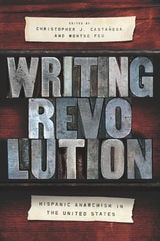
Writing Revolution
Hispanic Anarchism in the United StatesEdited by Christopher J. Castañeda and Montse Feu
University of Illinois Press, 2019
In the late nineteenth through mid-twentieth centuries, the anarchist effort to promote free thought, individual liberty, and social equality relied upon an international Spanish-language print network. These channels for journalism and literature promoted anarchist ideas and practices while fostering transnational solidarity and activism from Buenos Aires to Los Angeles to Barcelona. Christopher J. Castañeda and Montse Feu edit a collection that examines many facets of Spanish-language anarchist history. Arranged chronologically and thematically, the essays investigate anarchist print culture's transatlantic origins; Latina/o labor-oriented anarchism in the United States; the anarchist print presence in locales like Mexico's borderlands and Steubenville, Ohio; the history of essential publications and the individuals behind them; and the circulation of anarchist writing from the Spanish-American War to the twenty-first century.Contributors: Jon Bekken, Christopher Castañeda, Jesse Cohn, Sergio Sánchez Collantes, María José Domínguez, Antonio Herrería Fernández, Montse Feu, Sonia Hernández, Jorell A. Meléndez-Badillo, Javier Navarro Navarro, Michel Otayek, Mario Martín Revellado, Susana Sueiro Seoane, Kirwin R. Shaffer, Alejandro de la Torre, and David Watson
[more]
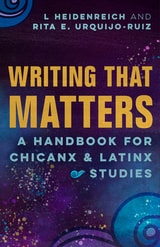
Writing that Matters
A Handbook for Chicanx and Latinx StudiesL Heidenreich and Rita E. Urquijo-Ruiz
University of Arizona Press, 2024
Have you ever wanted a writing and research manual that centered Chicanx and Latinx scholarship? Writing that Matters does just that.
While it includes a brief history of the roots of the fields of Chicanx literature and history, Writing that Matters emphasizes practice: how to research and write a Chicanx or Latinx history paper; how to research and write a Chicanx or Latinx literature or cultural studies essay; and how to conduct interviews, frame pláticas, and conduct oral histories. It also includes a brief chapter on nomenclature and a grammar guide. Each chapter includes questions for discussion, and all examples from across the subfields are from noted Chicanx and Latinx scholars. Women’s and queer scholarship and methods are not addressed in a separate chapter but are instead integral to the work.
For years Professors Heidenreich and Urquijo-Ruiz waited for a writing and research manual that was rooted in critical Chicanx and Latinx studies. Now, they have crafted one.
[more]