Results by title
93 books match the query 'Historians' and 4 start with w
What History Tells
George L. Mosse and the Culture of Modern EuropeEdited by Stanley G. Payne, David J. Sorkin, and John S. Tortorice
University of Wisconsin Press, 2004
The contributors include Walter Laqueur, David Sabean, Johann Sommerville, Emilio Gentile, Roger Griffin, Saul Friedländer, Jay Winter, Rudy Koshar, Robert Nye, Janna Bourke, Shulamit Volkov, and Steven E. Aschheim.
William Hickling Prescott
A BiographyBy C. Harvey Gardiner
University of Texas Press, 1969
This biography of a distinguished historian and man of letters is the first study of William Hickling Prescott (1796–1859) to be written by a historian who has worked with the very themes explored by Prescott. And it is the first to treat him not only as creative historian but also as family man, as traveler and clubman, as investor and humanitarian, and as private citizen with strong political preferences.
Prescott the socialite and Prescott the introvert writer emerge in the round as the magnificent amateur who helped establish canons that have enriched American historical scholarship ever since. Blending history and literature, his multivolume works won Prescott the first significant international reputation to be accorded to an American historian.
Working despite persistent obstacles of health and against a penchant for society and leisure that was always part of his personality, Prescott came to be considered the finest interpreter of the Hispanic world produced by the Anglo-Saxon world. His Conquest of Mexico and Conquest of Peru were pronounced classics.
C. Harvey Gardiner takes the reader back to the nineteenth century in style and in subject to present William Hickling Prescott, gentleman and scholar, firmly fixed in relationship to his community and his times. But Gardiner's Victorian stance and respect for nineteenth-century historiography do not prevent his presenting Prescott as a whole man, viewed in retrospect, stripped of myth, and evaluated for moderns.
Writing Western History
Essays on Major Western HistoriansRichard W. Etulain
University of Nevada Press, 2002
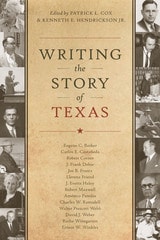
Writing the Story of Texas
Edited by Patrick L. Cox and Kenneth E. Hendrickson Jr.
University of Texas Press, 2013
The history of the Lone Star state is a narrative dominated by larger-than-life personalities and often-contentious legends, presenting interesting challenges for historians. Perhaps for this reason, Texas has produced a cadre of revered historians who have had a significant impact on the preservation (some would argue creation) of our state’s past. An anthology of biographical essays, Writing the Story of Texas pays tribute to the scholars who shaped our understanding of Texas’s past and, ultimately, the Texan identity.
Edited by esteemed historians Patrick Cox and Kenneth Hendrickson, this collection includes insightful, cross-generational examinations of pivotal individuals who interpreted our history. On these pages, the contributors chart the progression from Eugene C. Barker’s groundbreaking research to his public confrontations with Texas political leaders and his fellow historians. They look at Walter Prescott Webb’s fundamental, innovative vision as a promoter of the past and Ruthe Winegarten’s efforts to shine the spotlight on minorities and women who made history across the state. Other essayists explore Llerena Friend delving into an ambitious study of Sam Houston, Charles Ramsdell courageously addressing delicate issues such as racism and launching his controversial examination of Reconstruction in Texas, Robert Cotner—an Ohio-born product of the Ivy League—bringing a fresh perspective to the field, and Robert Maxwell engaged in early work in environmental history.