Results by title
131 books match the query 'History, Local' and 6 start with w
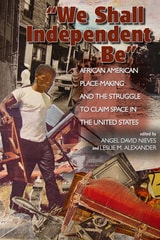
We Shall Independent Be
African American Place-Making and the Struggle to Claim Space in the United StatesAngel David Nieves
University Press of Colorado, 2008
Contributors define space to include physical, social, and intellectual sites throughout the Northern and Southern regions of the United States, ranging from urban milieus to the suburbs and even to swamps and forests. They explore under-represented locations such as burial grounds, courtrooms, schools, and churches. Moreover, contributors demonstrate how Black consciousness and ideology challenged key concepts of American democracy - such as freedom, justice, citizenship, and equality - establishing African American space in social and intellectual areas.
Ultimately, "We Shall Independent Be " recovers the voices of African American men and women from the antebellum United States through the present and chronicles their quest to assert their right to a place in American society. By identifying, examining, and telling the stories of contested sites, this volume demonstrates the power of African American self-definition and agency in the process of staking a physical and ideological claim to public space
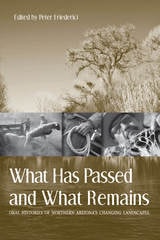
What Has Passed and What Remains
Oral Histories of Northern Arizona's Changing LandscapesEdited by Peter Friederici
University of Arizona Press, 2010
Thirteen narratives—from ranchers, foresters, scientists, Native American farmers, and others—tell how northern Arizona landscapes and livelihoods reflect rapid social and environmental change. The twentieth century saw huge changes as Arizona’s human population swelled and vacation-home developments arose in the backcountry. Riparian areas dried up, cattle ranching declined, and some wildlife species vanished while others thrived. The people whose words are preserved here have watched it all happen.
The book is a product of Northern Arizona University’s Ecological Oral Histories project, which has been collecting remembrances of long-time area residents who have observed changes to the land from the 1930s to the present day. It carves a wide swath, from the Arizona Strip to the Mogollon Rim, from valleys near Prescott to the New Mexico line. It takes readers to the Bar Heart Ranch north of Williams and to the Doy Reidhead Ranch southeast of Holbrook, to the forests of Flagstaff and the mesas of Indian country.
Enhanced with more than fifty illustrations, this book brings environmental change down to earth by allowing us to see it through the eyes of those whose lives it has directly touched. What Has Passed and What Remains is a window on the past that carries important lessons for the future.
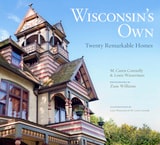
Wisconsin’s Own
Twenty Remarkable HomesM. Caren Connolly
Wisconsin Historical Society Press, 2010
Take an intimate journey through the family, history, and architecture of 20 residential treasures in Wisconsin’s Own by M. Caren Connolly and Louis Wasserman. Richly illustrated with the photography of Zane Williams and complemented by historical images and watercolors and line drawings, Wisconsin’s Own profiles the architectural history of state’s most remarkable residences built between 1854 and 1939. The houses are a mix of public and private homes that are representative of varied architectural styles, from an Italianate along the Mississippi River and an interpretation of a sixteenth-century northern Italian villa overlooking Lake Michigan to an Adirondack-style camp in the North Woods and a fourteen-bedroom Georgian Revival mansion on Lake Geneva. Frank Lloyd Wright’s Prairie School is, of course, represented as well with examples by Wright and his mentor Louis Sullivan.
Wisconsin’s Own tells the story of the considerable contribution that each of these historic homes have made to American residential architecture. It also answers the questions who built the house, what brought them to Wisconsin, why they selected that particular style, and how it is that this historic home still stands—and shines—today.
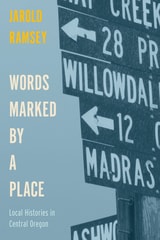
Words Marked by a Place
Local Histories in Central OregonJarold Ramsey
Oregon State University Press, 2018
While telling these local stories, Jarold Ramsey explores alternative ways of engaging history in the act of writing, breaking new ground by discovering and exploring primary sources that bear on the region’s colorful but little-known past. Throughout the collection, he interrogates “local history” as a subject. What is local history? How is it related to mainstream academic history? What are legitimate ways of doing it? How do the details of what we call local history inform “history-at-large,” and vice-versa?
From the opening narrative concerning Lieutenant Henry Larcom Abbot’s “Railroad Survey” of the region in 1855 to the concluding account of Lieutenant Robert Cranston’s last months and dramatic death, when his “Airacobra” fighter plane crashed near Madras in 1944, Words Marked by a Place sheds new light on the ongoing story of central Oregon by illuminating forgotten corners of its past. Through both theory and example, it represents an important contribution to the history of the region and the endeavors of local historians, wherever they happen to work.
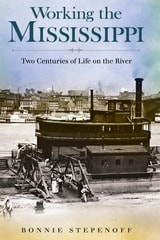
Working the Mississippi
Two Centuries of Life on the RiverBonnie Stepenoff
University of Missouri Press, 2015
The Mississippi River occupies a sacred place in American culture and mythology. Often called The Father of Rivers, it winds through American life in equal measure as a symbol and as a topographic feature. To the people who know it best, the river is life and a livelihood. River boatmen working the wide Mississippi are never far from land. Even in the dark, they can smell plants and animals and hear people on the banks and wharves.
Bonnie Stepenoff takes readers on a cruise through history, showing how workers from St. Louis to Memphis changed the river and were in turn changed by it. Each chapter of this fast-moving narrative focuses on representative workers: captains and pilots, gamblers and musicians, cooks and craftsmen. Readers will find workers who are themselves part of the country’s mythology from Mark Twain and anti-slavery crusader William Wells Brown to musicians Fate Marable and Louis Armstrong.
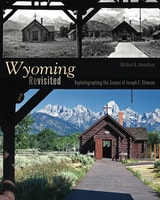
Wyoming Revisited
Rephotographing the Scenes of Joseph E. StimsonMichael A. Amundson
University Press of Colorado, 2014
The 117 locations feature street views of Wyoming towns and cities, as well as views from the state's famous natural landmarks like Yellowstone National Park, Grand Teton National Park, Devil's Tower National Monument, Hot Springs State Park, and Big Horn and Shoshone National Forests. In addition, Amundson provides six in-depth essays that explore the life of Joseph E. Stimson, the rephotographic process and how it has evolved, and how repeat photography can be used to understand history, landscape, historic preservation, and globalization.
Wyoming Revisited highlights the historic evolution of the American West over the past century and showcases the significant changes that have occurred over the past twenty-five years. This book will appeal to photographers, historians of the American West, and anyone interested in Wyoming's history or landscape.
The publication of this book is supported in part by the Wyoming Cultural Trust Fund.