Results by title
148 books match the query 'History, Military' and 14 start with w
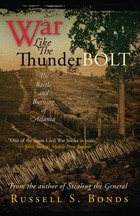
War Like the Thunderbolt
The Battle and Burning of AtlantaRussell S. Bonds
Westholme Publishing, 2009
A masterpiece of prose and research, the definitive history of the struggle for Atlanta during the Civil War, an episode immortalized by the novel Gone with the Wind
Called “the greatest event of the Civil War” by New York diarist George Templeton Strong, the epic struggle for the city of Atlanta in the bloody summer of 1864 was a pivotal moment in American history. Union commander William Tecumseh Sherman’s relentless fight for the city secured the reelection of Abraham Lincoln, sealed the fate of the Southern Confederacy, and set a precedent for military campaigns that endures today. Its depiction in the novel and motion picture Gone with the Wind established the fight for Atlanta as an iconic episode in our nation’s most terrible war. In War Like the Thunderbolt: The Battle and Burning of Atlanta, award-winning author Russell S. Bonds takes the reader behind the lines and across the smoky battlefields of Peachtree Creek, Atlanta, Ezra Church, and Jonesboro, and into the lives of fascinating characters, both the famous and the forgotten, including the fiery and brilliant Sherman; General John Bell Hood, the Confederacy’s last hope to defend Atlanta; Benjamin Harrison, the diminutive young Indiana colonel who would rise to become President of the United States; Patrick Cleburne, the Irishmanturned- Southern officer; and ten-year-old diarist Carrie Berry, who bravely withstood and bore witness to the fall of the city. Here also is the dramatic story of the ordeal of Atlanta itself—the five-week artillery bombardment, the expulsion of its civilian population, and the infamous fire that followed. Based on new research in diaries, newspapers, previously unpublished letters, and other archival sources, War Like the Thunderbolt is a combination of captivating narrative and insightful military analysis—a stirring account of the battle and burning of the “Gate City of the South.”
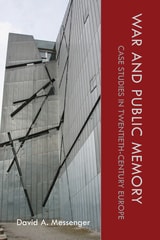
War and Public Memory
Case Studies in Twentieth-Century EuropeDavid A. Messenger
University of Alabama Press, 2020
In order to understand the history of twentieth-century Europe, we must first appreciate and accept how different societies and cultures remember their national conflicts. We must also be aware of the ways that those memories evolve over time. In War and Public Memory: Case Studies in Twentieth-Century Europe, Messenger outlines the relevant history of war and its impact on different European nations and assesses how and where the memory of these conflicts emerges in political and public discourse and in the public sphere and public spaces of Europe.
The case studies presented emphasize the major wars fought on European soil as well as the violence perpetrated against civilian populations. Each chapter begins with a brief overview of the conflict and then proceeds with a study of how memory of that struggle has entered into public consciousness in different national societies. The focus throughout is on collective social, cultural, and public memory, and in particular how memory has emerged in public spaces throughout Europe, such as parks, museums, and memorial sites.
Messenger discusses memories of the First World War for both the victors and the vanquished as well as their successor states. Other events discussed include the Bolshevik Revolution and subsequent conflicts in the former Soviet Union, the Armenian genocide, the collapse of Yugoslavia, the legacy of the civil war in Spain, Germanys reckoning with its Nazi past, and the memory of occupation and the Holocaust in France and Poland.
War in Syria and the Middle East
A Political and Economic HistoryFederico Manfredi Firmian
University of Texas Press, 2025
A wide-ranging examination of the causes of war in Syria and the Middle East.
In War in Syria and the Middle East, Federico Manfredi Firmian uses historical, political, and economic lenses to examine how Syria’s civil war is part of a broad pattern of social breakdown increasingly prevalent across the Arab and Islamic worlds. This expansive book argues that many conflicts across the Middle East today are rooted in fundamental ideological divides that originated with European imperialism. In Syria, the iniquities of French rule gave way to the radicalism of the Arab Socialist Baʿth Party, which promised to dismantle imperial legacies and capitalist logics through nationalizations, land redistribution, and central planning.
Baʿthist Syria, however, ultimately failed to provide a viable alternative to capitalism. In fact, its failures, and the failures of other revolutionary regimes of socialist inspiration, provided an opening for armed Islamist movements to challenge both secular authoritarian rule and US foreign policies—ultimately leading to civil war. Combining a multidisciplinary approach with fieldwork, War in Syria and the Middle East argues for a global perspective on a pressing, ongoing conflict.
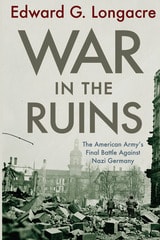
War in the Ruins
The American Army's Final Battle Against Nazi GermanyEdward G. Longacre
Westholme Publishing, 2010
The Last Major Combat for American Troops in Germany During the Final Days of World War II
By April 1945, the last German counteroffensive in the west had been defeated, the vaunted Siegfried Line was no more, the Rhine River had been crossed, and major German cities were being bombed relentlessly. The war in Europe appeared to be in its final stages. As American and British armies overran central Germany, the Russians were smashing their way from the east toward Berlin. Optimism reigned up and down the Allied lines. But as the American Army’s 100th Infantry Division pushed along the west bank of the Neckar River across from bomb-shattered Heilbronn, resistance unexpectedly stiffened. In that 700-year-old city, a major industrial and communications center still operating for the benefit of the Nazi war machine, Hitler’s subordinates had battened down for a last-ditch stand. For sheer ferocity, it would exceed anything the now-battle-hardened Americans had experienced. Here, American troops faced a grueling campaign of house-to-house fighting, with Hitler Youth, Volkssturm militia, and an SS division attempting to stop the American advance at this critical sector of the European theater. Having been repeatedly targeted by Alllied aircraft, the city resembled a vast, Hellish ruin, and as American soldiers inched their way forward, they encountered booby traps, withering sniper fire, deadly Panzerfaust rounds, and a fanatical enemy. The nine-day battle for Heilbronn would be the last major combat for American troops in Europe. Within three weeks of their securing the city, Hitler would be dead and Germany defeated.
In War in the Ruins: The American Army’s Final Battle Against Nazi Germany, Edward G. Longacre recounts this neglected but essential chapter in the history of World War II, describing the 100th Division’s swift but grueling advance through the Vosges Mountains, their Rhine River crossing, the assault on the historic Maginot Line, and the ominous approach to Heilbronn. The author then describes the entire bitter battle and its aftermath, using private letters, journals, German and American action reports, and other primary source material, to establish War in the Ruins as an essential volume in the history of World War II in Europe.
Warfare and Diplomacy in Pre-Colonial West Africa
Robert S. Smith
University of Wisconsin Press, 1989
Warring over Valor
How Race and Gender Shaped American Military Heroism in the Twentieth and Twenty-First CenturiesWendt, Simon
Rutgers University Press, 2019

Warriors and Scholars
A Modern War ReaderPeter B. Lane
University of North Texas Press, 2005
Wartime in Burma
A Diary, January to June 1942Theippan Maung Wa
Ohio University Press, 2009
This diary, begun after the Japanese attack on Pearl Harbor and covering the invasion of Burma up to June 1942, is a moving account of the dilemmas faced by the well-loved and prolific Burmese author Theippan Maung Wa (a pseudonym of U Sein Tin) and his family. At the time of the Japanese invasion, U Sein Tin was deputy secretary in the Ministry of Home and Defense Affairs. An Oxford-trained member of the Indian Civil Service, working for the British administration on the eve of the invasion, he lived with his wife and three small children in Rangoon.
Wartime in Burma is a stirring memoir that presents a personal account of U Sein Tin’s feelings about the war, his anxiety for the safety of his family, the bombing of Rangoon, and what happened to them during the next six chaotic months of the British retreat. The author and his family leave Rangoon to live in a remote forest in Upper Burma with several other Burmese civil servants, their staff, and valuable possessions—rich pickings for robbers. His diary ends abruptly on June 5, his forty-second birthday; U Sein Tin was murdered on June 6 by a gang of Burmese bandits. The diary pages, scattered on the floor of the house, were rescued by his wife and eventually published in Burma in 1966. What survives is a unique account that shines new light on the military retreat from Burma.
West African Challenge To Empire
Culture and History in the Volta-Bani Anticolonial WarMahir Saul
Ohio University Press, 2002
West African Challenge to Empire examines the anticolonial war in the Volta and Bani region in 1915–16. It was the largest challenge that the French ever faced in their West African colonial empire, and one of the largest armed oppositions to colonialism anywhere in Africa. How such a movement could be organized in the face of European technological superiority despite the fact that this region is generally described as having consisted of rival villages and descent groups is a puzzle. In this jointly written book the two authors provide a detailed political and military history of this event based on archival research and ethnographic fieldwork. Using cultural and sociological analysis, it probes the origins of the movement, its internal organization, its strategy, and the reasons for its initial success and why it spread.
In 2001 the authors of West African Challenge to Empire were awarded the Amaury Talbot Prize for African Anthropology by the Royal Anthropological Institute.
When War Becomes Personal
Soldiers' Accounts from the Civil War to IraqDonald Anderson
University of Iowa Press, 2008
The thirteen essays in When War Becomes Personal tell the enduring truths of battle, stripping away much of the romance, myth, and fantasy.
Soldiers more than anyone know what they are capable of destroying; when they write about war, they are trying to preserve the world.
When the Wolf Came
The Civil War and the Indian TerritoryMary Jane Warde
University of Arkansas Press, 2013
Winner of the 2014 Pate Award from the Fort Worth Civil War Round Table.
When the peoples of the Indian Territory found themselves in the midst of the American Civil War, squeezed between Union Kansas and Confederate Texas and Arkansas, they had no way to escape a conflict not of their choosing--and no alternative but to suffer its consequences. When the Wolf Came explores how the war in the Indian Territory involved almost every resident, killed many civilians as well as soldiers, left the country stripped and devastated, and cost Indian nations millions of acres of land. Using a solid foundation of both published and unpublished sources, including the records of Cherokee, Choctaw, and Creek nations, Mary Jane Warde details how the coming of the war set off a wave of migration into neighboring Kansas, the Red River Valley, and Texas. She describes how Indian Territory troops in Unionist regiments or as Confederate allies battled enemies--some from their own nations--in the territory and in neighboring Kansas, Missouri, and Arkansas. And she shows how post-war land cessions forced by the federal government on Indian nations formerly allied with the Confederacy allowed the removal of still more tribes to the Indian Territory, leaving millions of acres open for homesteads, railroads, and development in at least ten states. Enhanced by maps and photographs from the Oklahoma Historical Society's photographic archives, When the Wolf Came will be welcomed by both general readers and scholars interested in the signal public events that marked that tumultuous era and the consequences for the territory's tens of thousands of native peoples.
Wings over the Mexican Border
Pioneer Military Aviation in the Big BendBy Kenneth Baxter Ragsdale
University of Texas Press, 1997
Against a backdrop of revolution, border banditry, freewheeling aerial dramatics, and World War II comes this compelling look at the rise of U.S. combat aviation at an unlikely proving ground—a remote airfield in the rugged reaches of the southwestern Texas borderlands. Here, at Elmo Johnson's Big Bend ranch, hundreds of young Army Air Corps pilots demonstrated the U.S. military's reconnaissance and emergency response capabilities and, in so doing, dramatized the changing role of the airplane as an instrument of war and peace.
Kenneth Ragsdale's gripping account not only sets the United States squarely in the forefront of aerial development but also provides a reflective look at U.S.-Mexican relations of the 1920s, 1930s, and 1940s, particularly the tense days and aftermath of the Escobar Rebellion of 1929. He paints a vivid picture of the development of the U.S. aerial strike force; the character, ideals, and expectations of the men who would one day become combat leaders; and the high esteem in which U.S. citizens held the courageous pilots.
Particularly noteworthy is Ragsdale's portrait of Elmo Johnson, the Big Bend rancher, trader, and rural sage who emerges as the dominant figure at one of the most unusual facilities in the annals of the Air Corps. Wings over the Mexican Border tells a stirring story of the American frontier juxtaposed with the new age of aerial technology.
World War II and Nevada
The Silver State's Contribution to VictoryCharles Weller
University of Nevada Press, 2024
World War II and Nevada is an in-depth examination of the state’s role in the war. Nevada’s geographic location, land, sky, mineral resources, and the sacrifices of its people were crucial to victory—and transformed the state. The war brought the first significant development of the gaming industry; the introduction of a huge, permanent military presence; the diversification of its population; and a shift in political and economic power within the region.
Nevada’s previously unexamined role in the internment of Japanese Americans is explored, and so too is the role of women and minority groups in support of the war. The book concludes with a comprehensive list of those killed, wounded, or made prisoners of war during the conflict.
Weller provides the most thorough analysis of Nevada’s war effort to date and historians will find the book a valuable addition to their World War II history collections.
Worlds Apart
Bosnian Lessons for Global SecuritySwanee Hunt
Duke University Press, 2011