Results by title
668 books match the query 'History & Surveys' and 16 start with w
Ways of Releasement
Writings on God, Eckhart, and ZenReiner Schürmann
Diaphanes, 2023
In 1962, Reiner Schürmann began studying at the Dominican school of theology Le Saulchoir, outside Paris. That experience radically shaped his life and work, enabling him to begin to develop many of the ideas for which he would later be known: letting be, life without why, ontological anarchy, and the tragic double bind.
Ways of Releasement contains never-before-published material from Schürmann’s early period as well as a report Schürmann wrote about his encounter with Heidegger; a précis of his autobiographical novel, Origins; and translations and new editions of later groundbreaking essays. Ways of Releasement concludes with an extensive afterword setting Schürmann’s writings in the context of his thinking and life.

Whale
K.L. Evans
University of Minnesota Press, 2003
An entirely fresh approach to Moby Dick, by way of Ludwig Wittgenstein
The aim of this thoroughly unconventional work is to demonstrate that Herman Melville’s Moby Dick and Ludwig Wittgenstein’s Philosophical Investigations share the same projects and are, in effect, one and the same book. Confounding and improbable as such an enterprise might seem, Whale! not only successfully reveals the vital intersections between Melville and Wittgenstein but also, more important, makes a compelling argument for why such intersections are essential to understanding common political projects in literature and philosophy.
Written with grace, passion, and wit, Whale! manages to produce a startling and remarkably original reading of one of the most written-about and interpreted books in the American canon. K. L. Evans explores Melville’s vast work as a tale not of vengeance but of affection, and Ahab’s near-pathological agitation as indicative of his refusal to accept the world as unknowable. Between Ahab and the whale, Evans traces a longing for connection and meaning and finds a forceful response to the skeptical view that language is bankrupt and knowledge is uncertain. In Ahab’s hunt for Moby Dick, Whale! discovers a way to reconnect matter with meaning, object with knowledge.
What Did the Romans Know?
An Inquiry into Science and WorldmakingDaryn Lehoux
University of Chicago Press, 2012
What Is History? And Other Late Unpublished Writings (CW28)
Eric Voegelin & Edited & Intro by Thomas A. Hollweck and Paul Caringella
University of Missouri Press, 0
What Is Nietzsche's Zarathustra?
A Philosophical ConfrontationHeinrich Meier
University of Chicago Press, 2021
A masterful, nuanced, and novel examination of Nietzsche’s Zarathustra.
Thus Spoke Zarathustra is Nietzsche’s most famous and most puzzling work, one in which he makes the greatest use of poetry to explore the questions posed by philosophy. But in order to understand the movement of this drama, we must first understand the character of its protagonist: we must ask, What Is Nietzsche’s Zarathustra?
Heinrich Meier attempts to penetrate the core of the drama, following as a guiding thread the question of whether Zarathustra is a philosopher or a prophet, or, if he is meant to be both, whether Zarathustra is able to unite philosopher and prophet in himself. Via a close reading that uncovers the book’s hidden structure, Meier develops a highly stimulating and original interpretation of this much-discussed but still ill-understood masterwork of German poetic prose. In the process, he carefully overturns long-established canons in the academic discourse of Nietzsche interpretation. The result is a fresh and surprising grasp of Nietzsche’s well-known teachings of the overman, the will to power, and the eternal return.
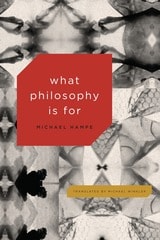
What Philosophy Is For
Michael Hampe
University of Chicago Press, 2018
Philosophers generally develop systematic theories that lay out the basic structures of human experience, in order to teach the rest of humanity how to rightly understand our place in the world. This “scientific” approach to philosophy, Hampe argues, is too one-sided. In this magnum opus of an essay, Hampe aims to rescue philosophy from its current narrow claims of doctrine and to remind us what it is really for—to productively disillusion us into clearer thinking. Hampe takes us through twenty-five hundred years of intellectual history, starting with Socrates. That archetype of the philosophical teacher did not develop strict doctrines and rules, but rather criticized and refuted doctrines. With the Socratic method, we see the power of narration at work. Narrative and analytical disillusionment, Hampe argues, are the most helpful long-term enterprises of thought, the ones most worth preserving and developing again.
What Philosophy Is For is simultaneously an introduction, a critique, and a call to action. Hampe shows how and why philosophy became what it is today, and, crucially, shows what it could be once more, if it would only turn its back on its pretensions to dogma: a privileged space for reflecting on the human condition.
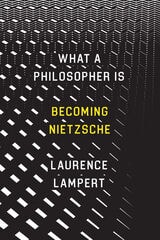
What a Philosopher Is
Becoming NietzscheLaurence Lampert
University of Chicago Press, 2018
With this book, Laurence Lampert answers that question. He does so through his trademark technique of close readings of key works in Nietzsche’s journey to philosophy: The Birth of Tragedy, Schopenhauer as Educator, Richard Wagner in Bayreuth, Human All Too Human, and “Sanctus Januarius,” the final book of the 1882 Gay Science. Relying partly on how Nietzsche himself characterized his books in his many autobiographical guides to the trajectory of his thought, Lampert sets each in the context of Nietzsche’s writings as a whole, and looks at how they individually treat the question of what a philosopher is. Indispensable to his conclusions are the workbooks in which Nietzsche first recorded his advances, especially the 1881 workbook which shows him gradually gaining insights into the two foundations of his mature thinking. The result is the most complete picture we’ve had yet of the philosopher’s development, one that gives us a Promethean Nietzsche, gaining knowledge even as he was expanding his thought to create new worlds.
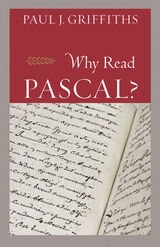
Why Read Pascal?
Paul J. Griffiths
Catholic University of America Press, 2021
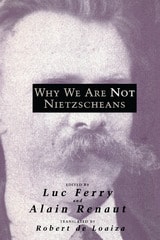
Why We Are Not Nietzscheans
Edited by Luc Ferry and Alain Renaut
University of Chicago Press, 1997
Though linked by no common dogma, these essays all argue that the "French Nietzsche" transmitted through the deconstructionists must be reexamined in light of the original context in which Nietzsche worked. Each essay questions the viability of Nietzsche's thought in the modern world, variously critiquing his philosophy of history as obsessed with hierarchy, his views on religion and art as myopic and irrational, and his stance on science as hopelessly reactionary.
Contending that we must abandon the Nietzsche propped up as patron saint by French deconstructionists in order to return to reason, these essays will stimulate debate not just among Nietzscheans but among all with a stake in modern French philosophy.
Contributors are Alain Boyer, André Compte-Sponville, Vincent Descombes, Luc Ferry, Robert Legros, Philippe Raynaud, Alain Renault, and Pierre-André Taguieff.
Wisdom in Bonaventure's <i>Hexameron</i>
Philosophical Problems, Theological SolutionsBenjamin Winter
Catholic University of America Press, 2024
Witnessing
Beyond RecognitionKelly Oliver
University of Minnesota Press, 2001
A new, ethically based theory of identity by a major scholar.
Challenging the fundamental tenet of the multicultural movement-that social struggles turning upon race, gender, and sexuality are struggles for recognition-this work offers a powerful critique of current conceptions of identity and subjectivity based on Hegelian notions of recognition. The author’s critical engagement with major texts of contemporary philosophy prepares the way for a highly original conception of ethics based on witnessing.
Central to this project is Oliver’s contention that the demand for recognition is a symptom of the pathology of oppression that perpetuates subject-object and same-different hierarchies. While theorists across the disciplines of the humanities and social sciences focus their research on multiculturalism around the struggle for recognition, Oliver argues that the actual texts and survivors’ accounts from the aftermath of the Holocaust and slavery are testimonials to a pathos that is “beyond recognition.” Oliver traces many of the problems with the recognition model of subjective identity to a particular notion of vision presupposed in theories of recognition and misrecognition. Contesting the idea of an objectifying gaze, she reformulates vision as a loving look that facilitates connection rather than necessitates alienation. As an alternative, Oliver develops a theory of witnessing subjectivity. She suggests that the notion of witnessing, with its double meaning as either eyewitness or bearing witness to the unseen, is more promising than recognition for describing the onset and sustenance of subjectivity. Subjectivity is born out of and sustained by the process of witnessing-the possibility of address and response-which puts ethical obligations at its heart.
Wittgenstein and Modernism
Edited by Michael LeMahieu and Karen Zumhagen-Yekplé
University of Chicago Press, 2016
Michael LeMahieu Karen Zumhagen-Yekplé bring together scholars in both twentieth-century philosophy and modern literary studies to put Wittgenstein into dialogue with some of modernism’s most iconic figures, including Samuel Beckett, Saul Bellow, Walter Benjamin, Henry James, James Joyce, Franz Kafka, Adolf Loos, Robert Musil, Wallace Stevens, and Virginia Woolf. The contributors touch on two important aspects of Wittgenstein’s work and modernism itself: form and medium. They discuss issues ranging from Wittgenstein and poetics to his use of numbered propositions in the Tractatus as a virtuoso performance of modernist form; from Wittgenstein’s persistence metaphoric use of religion, music, and photography to an exploration of how he and Henry James both negotiated the relationship between the aesthetic and the ethical.
Covering many other fascinating intersections of the philosopher and the arts, this book offers an important bridge across the disciplinary divides that have kept us from a fuller picture of both Wittgenstein and the larger intellectual and cultural movement of which he was a part.
Wittgenstein's Ladder
Poetic Language and the Strangeness of the OrdinaryMarjorie Perloff
University of Chicago Press, 1996
"This book has the lucidity and the intelligence we have come to expect from Marjorie Perloff.—Linda Munk, American Literature
"[Perloff] has brilliantly adapted Wittgenstein's conception of meaning and use to an analysis of contemporary language poetry."—Linda Voris, Boston Review
"Wittgenstein's Ladder offers significant insights into the current state of poetry, literature, and literary study. Perloff emphasizes the vitality of reading and thinking about poetry, and the absolute necessity of pushing against the boundaries that define and limit our worlds."—David Clippinger, Chicago Review
"Majorie Perloff has done more to illuminate our understanding of twentieth century poetic language than perhaps any other critic. . . . Entertaining, witty, and above all highly original."—Willard Bohn, Sub-Stance
Wittgenstein's Tractatus
An IntroductionH. O. Mounce
University of Chicago Press, 1981
Wittgenstein
The Senses of UseSandra Laugier
University of Chicago Press, 2025
One of philosopher Ludwig Wittgenstein’s most consequential claims was that the meaning of the word, its sense, is its use in language. This deceptively simple claim, the foundation of what became known as ordinary language philosophy, has animated thinkers across disciplinary bounds from metaphysics to ethics and more. In The Senses of Use, Sandra Laugier embarks on a fresh journey through Wittgenstein’s corpus that emphasizes the place of ordinary life and language in its thought. Through his Tractatus Logico-Philosophicus, Philosophical Investigations, and rich posthumously published works, Laugier offers a compelling new look at Wittgenstein as a philosopher of mind.
Word and Object in Husserl, Frege, and Russell
The Roots of Twentieth-Century PhilosophyClaire Oritz Hill
Ohio University Press, 2001
In search of the origins of some of the most fundamental problems that have beset philosophers in English-speaking countries in the past century, Claire Ortiz Hill maintains that philosophers are treating symptoms of ills whose causes lie buried in history. Substantial linguistic hurdles have blocked access to Gottlob Frege's thought and even to Bertrand Russell's work to remedy the problems he found in it. Misleading translations of key concepts like intention, content, presentation, idea, meaning, concept, etc., severed analytic philosophy from its roots.
Hill argues that once linguistic and historical barriers are removed, Edmund Husserl's critical study of Frege's logic in his 1891 Philosophy of Arithmetic provides important insights into issues in philosophy now.
She supports her conclusions with analyses of Frege's, Husserl's, and Russell's works, including Principia Mathematica, and with linguistic analyses of the principal concepts of analytic philosophy. She re-establishes links that existed between English and Continental thought to show Husserl's expertise as a philosopher of mathematics and logic who had been Weierstrass's assistant and had long maintained ties with Cantor, Hilbert, and Zermelo.