Results by title
123 books match the query 'Human Sexuality' and 2 start with w
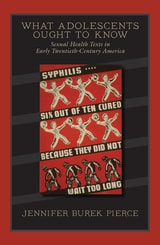
What Adolescents Ought to Know
Sexual Health Texts in Early Twentieth-Century AmericaJennifer Burek Pierce
University of Massachusetts Press, 2011
In 1901, Dr. Alfred Fournier committed an act both simple and revolutionary: he wrote ForOur Sons, When They Turn 18, a sexual and reproductive health treatise based on his clinical work at a leading Paris hospital. If this booklet aided adolescent understanding of health, it also encouraged reformers around the world to publish. By 1913, countless works on venereal disease prevention were available to adolescents.
During this period, authors wrestled with how to make still-developing scientific information available to a reader also in the process of maturing. What would convince a young person to avoid acting on desire? What norms should be employed in these arguments, when social and legal precedents warned against committing ideas about sex to print? How, in other words, could information about sex be made both decent and compelling? Health reformers struggled with these challenges as doctors' ability to diagnose diseases such as syphilis outpaced the production of medicines that could restore health. In this context, information represented the best and truest prophylactic. When publications were successful, from the perspective of information dissemination, they were translated and distributed worldwide.
What Adolescents Ought to Know explores the evolution of these printed materials—from a single tract, written by a medical researcher and given free to anyone, to a thriving commercial enterprise. It tells the story of how sex education moved from private conversation to purchased text in early twentieth-century America.
What's Love Got to Do with It?
Transnational Desires and Sex Tourism in the Dominican RepublicDenise Brennan
Duke University Press, 2004
Illuminating the complex world of Sosúa’s sex business in rich detail, Brennan draws on extensive interviews not only with sex workers and clients, but also with others who facilitate and benefit from the sex trade. She weaves these voices into an analysis of Dominican economic and migration histories to consider the opportunities—or lack thereof—available to poor Dominican women. She shows how these women, local actors caught in a web of global economic relations, try to take advantage of the foreign men who are in Sosúa to take advantage of them. Through her detailed study of the lives and working conditions of the women in Sosúa’s sex trade, Brennan raises important questions about women’s power, control, and opportunities in a globalized economy.