Results by title
260 books match the query 'Human ecology' and 7 start with w
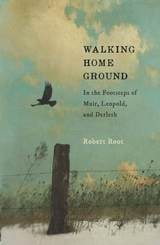
Walking Home Ground
In the Footsteps of Muir, Leopold, and DerlethRobert Root
Wisconsin Historical Society Press, 2017
When longtime author Robert Root moves to a small town in southeast Wisconsin, he gets to know his new home by walking the same terrain traveled by three Wisconsin luminaries who were deeply rooted in place—John Muir, Aldo Leopold, and August Derleth. Root walks with Muir at John Muir State Natural Area, with Leopold at the Shack, and with Derleth in Sac Prairie; closer to home, he traverses the Ice Age Trail, often guided by such figures as pioneering scientist Increase Lapham. Along the way, Root investigates the changes to the natural landscape over nearly two centuries, and he chronicles his own transition from someone on unfamiliar terrain to someone secure on his home ground.In prose that is at turns introspective and haunting, Walking Home Ground inspires us to see history’s echo all around us: the parking lot that once was forest; the city that once was glacier. "Perhaps this book is an invitation to walk home ground," Root tells us. "Perhaps, too, it’s a time capsule, a message in a bottle from someone given to looking over his shoulder even as he tries to examine the ground beneath his feet."

What Comes after Entanglement?
Activism, Anthropocentrism, and an Ethics of ExclusionEva Haifa Giraud
Duke University Press, 2019
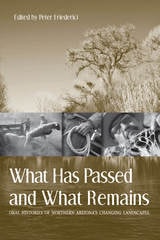
What Has Passed and What Remains
Oral Histories of Northern Arizona's Changing LandscapesEdited by Peter Friederici
University of Arizona Press, 2010
Thirteen narratives—from ranchers, foresters, scientists, Native American farmers, and others—tell how northern Arizona landscapes and livelihoods reflect rapid social and environmental change. The twentieth century saw huge changes as Arizona’s human population swelled and vacation-home developments arose in the backcountry. Riparian areas dried up, cattle ranching declined, and some wildlife species vanished while others thrived. The people whose words are preserved here have watched it all happen.
The book is a product of Northern Arizona University’s Ecological Oral Histories project, which has been collecting remembrances of long-time area residents who have observed changes to the land from the 1930s to the present day. It carves a wide swath, from the Arizona Strip to the Mogollon Rim, from valleys near Prescott to the New Mexico line. It takes readers to the Bar Heart Ranch north of Williams and to the Doy Reidhead Ranch southeast of Holbrook, to the forests of Flagstaff and the mesas of Indian country.
Enhanced with more than fifty illustrations, this book brings environmental change down to earth by allowing us to see it through the eyes of those whose lives it has directly touched. What Has Passed and What Remains is a window on the past that carries important lessons for the future.
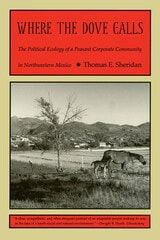
Where the Dove Calls
The Political Ecology of a Peasant Corporate Community in Northwestern MexicoThomas E. Sheridan
University of Arizona Press, 1988
Sheridan has written an ethnography of resource control, one that weds the approaches of political economy and cultural ecology in order to focus upon both the external linkages and internal adaptations that shape three peasant corporate communities. He examines the ecological and economic constraints which scarce and necessary resources place upon households in Cucurpe, and then investigates why many such households have formed corporate communities to insure their access to resources beyond their control. Finally, he identifies the class differences that exist within the corporate communities as well as between members of those organizations and the private ranchers who surround them.
Where the Dove Calls (the meaning of "Cucurpe" in the language of the Opata Indians), an important contribution to peasant studies, reveals the household as the basic unit of Cucurpe society. By viewing Cucurpe's corporate communities as organizations of fiercely independent domestic units rather than as expressions of communal solidarity, Sheridan shows that peasants are among the exploiters as well as the exploited. Cucurpe¤os struggle to maintain the autonomy of their households even as they join together to protect corporate grazing lands and irrigation water. Any attempt to weaken or destroy that independence is met with opposition that ranges from passive resistance to violence.
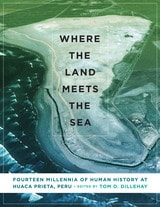
Where the Land Meets the Sea
Fourteen Millennia of Human History at Huaca Prieta, PeruEdited by Tom D. Dillehay
University of Texas Press, 2017
Huaca Prieta—one the world’s best-known, yet least understood, early maritime mound sites—and other Preceramic sites on the north coast of Peru bear witness to the beginnings of civilization in the Americas. Across more than fourteen millennia of human occupation, the coalescence of maritime, agricultural, and pastoral economies in the north coast settlements set in motion long-term biological and cultural transformations that led to increased social complexity and food production, and later the emergence of preindustrial states and urbanism. These developments make Huaca Prieta a site of global importance in world archaeology.
This landmark volume presents the findings of a major archaeological investigation carried out at Huaca Prieta, the nearby mound Paredones, and several Preceramic domestic sites in the lower Chicama Valley between 2006 and 2013 by an interdisciplinary team of more than fifty international specialists. The book’s contributors report on and analyze the extensive material records from the sites, including data on the architecture and spatial patterns; floral, faunal, and lithic remains; textiles; basketry; and more. Using this rich data, they build new models of the social, economic, and ontological practices of these early peoples, who appear to have favored cooperation and living in harmony with the environment over the accumulation of power and the development of ruling elites. This discovery adds a crucial new dimension to our understanding of emergent social complexity, cosmology, and religion in the Neolithic period.
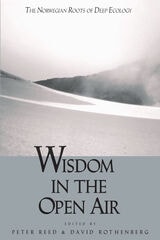
Wisdom In The Open Air
The Norwegian Roots of Deep EcologyPeter Reed
University of Minnesota Press, 1992
Wisdom in the Open Air traces the Norwegian roots of the strain of thinking called “deep ecology”—the search for the solutions to environmental problems by examining the fundamental tenets of our culture. Although Arne Naess coined the term in the 1970s, the insights of deep ecology actually reflect a tradition of thought that can be seen in the history of Norwegian culture, from ancient mountain myths to the radical ecoactivism of today.
Beginning with an introduction to Norway’s emphasis on nature and the wild, Reed and Rothenberg explore the birth of the environmental movement in the 1960s and 1970s. What follows is a collection of writings by prominent Norwegian thinkers on humanity and nature, most never before published in English. From Peter Wessel Zapffe, a twentieth-century Kierkegaardian figure, the list goes on to include Norwegian philosopher Arne Naess, activist-critic-artist Sigmund Kvaloy, wilderness educator Nils Faarland, novelist Finn Alneas, sociologist Johan Galtung, and social reformer Erik Dammann. Their fascinating points of view offer thoughts on the significance of modern life and what it means to be human in the face of the deteriorating global environment of the twentieth century. Wisdom in the Open Air asks and answers a fundamental question concerning the ecomovement: what is the role of deep, often abstract, thinking in the attempt to avert a very real ecological crisis?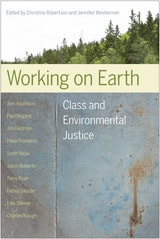
Working on Earth
Class and Environmental JusticeChristina Robertson
University of Nevada Press, 2015
The authors challenge prevailing cultural narratives that separate ecological and human health from the impacts of modern industrial capitalism. Essay themes range from how human survival is linked to nature to how the use and abuse of nature benefit the wealthy elite at the expense of working-class people and the working poor as well as how climate change will affect cultures deeply rooted in the land.
Ultimately, Working on Earth calls for a working-class ecology as an integral part of achieving just and sustainable human development.