Results by title
178 books match the query 'Identification' and 15 start with w
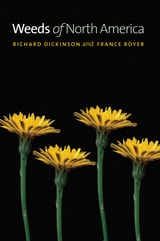
Weeds of North America
Richard Dickinson and France Royer
University of Chicago Press, 2014
Encyclopedic in scope, the book is the first to cover North American weeds at every stage of growth. The book is organized by plant family, and more than five hundred species are featured. Each receives a two-page spread with images and text identification keys. Species are arranged within family alphabetically by scientific name, and entries include vital information on seed viability and germination requirements.
Whether you believe, like Donald Culross Peattie, that “a weed is a plant out of place,” or align with Elizabeth Wheeler Wilcox’s “weeds are but unloved flowers,” Dickinson and Royer provide much-needed background on these intrusive organisms. In the battle with weeds, knowledge truly is power. Weeds of North America is the perfect tool for gardeners, as well as anyone working in the business of weed ecology and control.
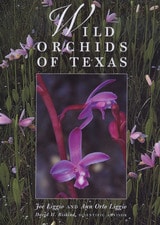
Wild Orchids of Texas
By Joe Liggio and Ann Orto Liggio
University of Texas Press, 1999
Best of Show Award, Society for Technical Communication International
From the East Texas swamps and forests to the Edwards Plateau canyons and the Trans-Pecos mountains, Texas hosts a surprising number of native orchids. Their exquisite beauty endears them to everyone from wildflower lovers to professional botanists and conservationists.
This beautifully illustrated book presents all 54 wild orchids of Texas. The species descriptions that accompany Joe Liggio's lovely color photos discuss the plant's flowers, blooming season, pollinators, typical habitats, and range (also shown by map), including its distribution within and beyond Texas. The species are grouped by genus and also listed by color, county, and habitat for easy reference.
In addition to the species accounts, the authors offer a general natural history of Texas orchids that discusses such topics as pollination and reproduction, special growing requirements, and threats to orchids from loss of habitats and careless collecting. They also describe the many orchid habitats in Texas and the species that grow in each. This wide variety of information, which has never before been collected in one volume for a general readership, makes this book the essential guide to Texas' wild orchids.

Wild Plants for a Sustainable Future
Edited by Tiziana Ulian, César Flores, Rafael Lira, Avhatakali Mamatsharaga, Kebadire K. Mogotsi, Patrick Muthoka, Samodimo Ngwako, Desterio O. Nyamongo, William Omondi, Abdoul K. Sanogo, Sidi Sanogo, and Efisio Mattana
Royal Botanic Gardens, Kew, 2018
The publication forms one of the main dissemination achievements of The MGU–Useful Plants Project, developed under Kew’s Millennium Seed Bank partnership, to conserve and use sustainably wild plants important for rural communities in Botswana, Kenya, Mali, South Africa, and Mexico. Institutional partners led the project in each country, involving rural communities, local authorities, and schools. A scientific approach was applied throughout.
The core of this book presents detailed species profiles of 110 plants selected for their importance to communities and livelihoods. The profiles are structured in a clear and consistent format, providing information on taxonomy and nomenclature, plant descriptions, fruit and seed structures, distribution, habitat, uses, known hazards and safety, conservation status, seed conservation, propagation, and trading, along with key references from the literature.
Wild Plants of the Sierra Nevada
Ray S. Vizgirdas
University of Nevada Press, 2009
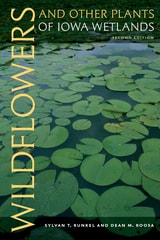
Wildflowers and Other Plants of Iowa Wetlands, 2nd edition
Sylvan T. Runkel, Dean M. Roosa, Thomas Rosburg
University of Iowa Press, 2015
In clear and accessible prose, authors Sylvan Runkel and Dean Roosa provide common, scientific, and family names; the Latin or Greek meaning of the scientific names; habitat and blooming times; and a complete description. Plants are presented by habitat (terrestrial or aquatic), then refined by habit (e.g., emergent, floating, or submerged) or taxonomic group (e.g., ferns and allies or trees, shrubs, and vines). Particularly interesting is the information on the many ways in which Native Americans and early pioneers used these plants for everything from pain relief to tonics to soup and the ways that wildlife today use them for food and shelter. Each of the more than 150 species accounts is accompanied by a brilliant full-page color photograph by botanist Thomas Rosburg, who has also updated the nomenclature and descriptions for certain species.
After decades of being considered an enemy of the settler, the farmer, and the citizen, Iowa’s wetlands have come into their own. We are finally caring for these important habitats. Runkel and Roosa’s updated field companion will be a valuable guide to today’s preservation and restoration initiatives.
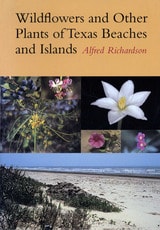
Wildflowers and Other Plants of Texas Beaches and Islands
By Alfred Richardson
University of Texas Press, 2002
Winner, Carroll Abbott Memorial Award, Native Plant Society of Texas, 2002
Many visitors to Texas beaches see only the sands between the surf and the first low dunes. Because few plants grow there, it's easy to get the impression that Texas beaches consist mostly of barren sand—while just the opposite is true. Beyond the dunes grow an amazing variety and abundance of native plants. Many of them, like Indian Blanket, Goldenrod, and Seaside Gerardia, produce great splashes of flowering color. Others display more modest flowers or are interesting for their growing habits. In all, over seven hundred species of flowering plants grow on Texas beaches and islands.
This handy field guide will aid you in identifying some 275 common and/or noteworthy flowering plants of the Texas beaches and islands from the Rio Grande to the Louisiana border. Each plant is illustrated by a color photograph, accompanied by a description of its appearance, habitat, and blooming time. The plants are grouped by families, which in turn are arranged according to relationships and similarities for easy reference. An introduction to beach habitats and plant life, references for further reading, and a glossary of terms make this book fully useful for everyone who wants a good, general understanding of beach plant life and wildflowers.
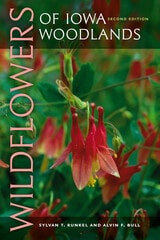
Wildflowers of Iowa Woodlands
Sylvan T. Runkel
University of Iowa Press, 2009
The species accounts are accompanied by brilliant full-page color photographs by Larry Stone, Thomas Rosburg, and Carl Kurtz. In clear, straightforward, and accessible prose, authors Sylvan Runkel and Alvin Bull provide common, scientific, and family names; the Latin or Greek meaning of the scientific names; habitat and blooming times; and a complete description of plant, flower, and fruit. Particularly interesting is the information on the many ways in which Native Americans and early pioneers used these plants for everything from pain relief to insecticides to tonics.
Iowa’s original savannas, woodlands, and forests were cleared with amazing thoroughness, yet enough beauty and diversity remain to give joy to hikers, birders, and mushroomers. Wildflowers of Iowa Woodlands will inspire both amateurs and professionals with the desire to learn more about the wonders of today’s woodlands.
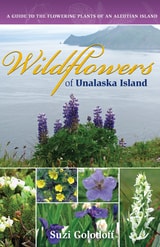
Wildflowers of Unalaska Island
A Guide to the Flowering Plants of an Aleutian Island, Second EditionSuzi Golodoff
University of Alaska Press, 2013
Each species is introduced and clearly defined and is accompanied by a photograph and line drawings. Many of these plants occur across a wide range of coastal Alaska; others are unique to the Aleutians. The introduction includes background on the unique geologic history, climate, and habitats of the archipelago to fully round out the user’s appreciation of the dramatic environment in which these hardy plants thrive.
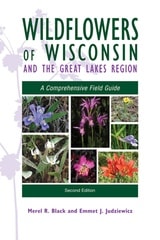
Wildflowers of Wisconsin and the Great Lakes Region
A Comprehensive Field GuideMerel R. Black and Emmet J. Judziewicz
University of Wisconsin Press, 2009
• more than 1,100 species from 459 genera in 100 families
• many rare and previously overlooked species
• 2,100 color photographs and 300 drawings
• Wisconsin distribution maps for almost all plants
• brief descriptions including distinguishing characteristics of the species
• Wisconsin status levels for each species of wildflower (native, invasive, endangered, etc.)
• derivation of Latin names.
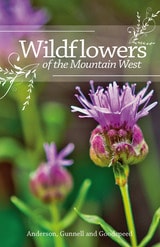
Wildflowers of the Mountain West
Richard M. Anderson, Jay Dee Gunnell, Jerry L. Goodspeed
Utah State University Press, 2012
Many recreational hikers have stopped along the trail to admire a wildflower only to wonder what, exactly, they are looking at. Wildflowers of the Mountain West is a useful field guide that makes flower identification easy for the general outdoor enthusiast.
Many available plant guides are too technical or cumbersome for non-specialists to embrace. Covering New Mexico, Colorado, Wyoming, Idaho, Utah, Nevada and Oregon, this book is perfect for the enthusiasts who has little botanical knowledge but would like to know more about the wildflowers they are seeing. Organized by flower color for easy reference, plant records include the common and scientific names, a description of typical characteristics, habitat information and distribution maps, look-alike species, color photographs, and informative commentary. In addition, the book provides a useful introduction to the Mountain West region, along with line drawings to illustrate basic flower parts, shapes, and arrangements; a glossary of common botanical terms; a quick search key; and an index.
The book is spiral-bound, making it easy to bring along while hiking, backpacking, or biking, and stunning full color photographs make visual confirmation of flower type simple and straightforward.
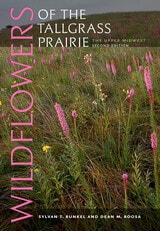
Wildflowers of the Tallgrass Prairie
The Upper MidwestSylvan T. Runkel
University of Iowa Press, 2009
This classic of midwestern natural history is back in print with a new format and new photographs. Originally published in 1989, Wildflowers of the Tallgrass Prairie introduced many naturalists to the beauty and diversity of the native plants of the huge grasslands that once stretched from Manitoba to Texas. Now redesigned with updated names and all-new photographs, this reliable field companion will introduce tallgrass prairie wildflowers to a new generation of outdoor enthusiasts in the Upper Midwest.
Each species account is accompanied by a brilliant full-page color photograph by botanist Thomas Rosburg. In clear, straightforward, and accessible prose, authors Sylvan Runkel and Dean Roosa provide common, scientific, and family names; the Latin or Greek meaning of the scientific names; habitat and blooming times; and a complete description of plant, flower, and fruit. Particularly interesting is the information on the many ways in which Native Americans and early pioneers used these plants for everything from pain relief to dyes to hairbrushes.
Runkel and Roosa say that prairies can be among the most peaceful places on earth; certainly they are among the most beleaguered. Wildflowers of the Tallgrass Prairie will inspire both amateurs and professionals with the desire to learn more about the wonders of the prairie landscape.
Winter Twigs, Revised Edition
A Wintertime Key to Deciduous Trees and Shrubs of Northwestern Oregon and Western WashingtonHelen Gilkey
Oregon State University Press, 2001

Woody Plants in Winter
by Earl L. Core and Nelle P. Ammons
West Virginia University Press, 1958
A manual to identify trees and shrubs in winter when the lack of leaves, fruits, and flowers makes them least identifiable, Woody Plants in Winter has become a classic for naturalists, botanists, gardeners, and hobbyists. Earl L. Core and Nell P. Ammons, both West Virginia University Professors of distinction, originally published this book with The Boxwood Press in 1958. Now in its fifteenth printing, the title has come home to West Virginia University Press.
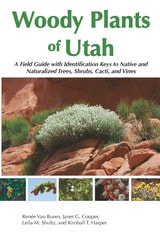
Woody Plants of Utah
A Field Guide with Identification Keys to Native and Naturalized Trees, Shrubs, Cacti, and VinesRenée Van Buren, Janet G. Cooper, Leila M. Shultz, and Kimball T. Harper
Utah State University Press, 2011
A comprehensive guide that includes a vast range of species and plant communities and employs thorough, original keys. Based primarily on vegetative characteristics, the keys don't require that flowers or other reproductive features be present, like many plant guides. And this guide's attention to woody plants as a whole allows one to identify a much greater variety of plants. That especially suits an arid region such as Utah with less diverse native trees. Woody plants are those that have stems that persist above ground even through seasons that don't favor growth, due to low precipitation or temperatures.
Woody Plants of Utah employs dichotomous identification keys that are comparable to a game of twenty questions. They work through a process of elimination by choosing sequential alternatives.
Detailed, illustrated plant descriptions complement the keys and provide additional botanical and environmental information in relation to a useful introductory categorization of Utah plant communities. Supplementary tools include photos, distribution maps, and an illustrated glossary.
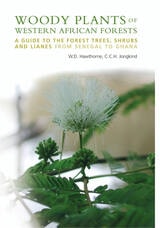
Woody Plants of Western African Forests
A Guide to the Forest Trees, Shrubs and Lianes from Senegal to GhanaWilliam Hawthorne, and Carel Jongkin
Royal Botanic Gardens, Kew, 2006
Laid out as keys and with short descriptions of each species, it contains over 5,600 photographs, line drawings and maps. And, while many guides only offer hints to naming plants when they are not in flower, here the authors have based identification on leaves, bark, shoots, scent ,taste and other characters easily observed at most times.
Funded by the European Union, through its ECOSYN project (based at Wageningen University), which supports forest biodiversity and management in Upper Guinea, this magnificent, beautiful book is an indispensable reference for everyone committed to the conservation and sustainable development of Africa’s forest.