Results by title
95 books match the query 'Ideology' and 3 start with w
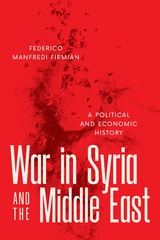
War in Syria and the Middle East
A Political and Economic HistoryFederico Manfredi Firmian
University of Texas Press, 2025
A wide-ranging examination of the causes of war in Syria and the Middle East.
In War in Syria and the Middle East, Federico Manfredi Firmian uses historical, political, and economic lenses to examine how Syria’s civil war is part of a broad pattern of social breakdown increasingly prevalent across the Arab and Islamic worlds. This expansive book argues that many conflicts across the Middle East today are rooted in fundamental ideological divides that originated with European imperialism. In Syria, the iniquities of French rule gave way to the radicalism of the Arab Socialist Baʿth Party, which promised to dismantle imperial legacies and capitalist logics through nationalizations, land redistribution, and central planning.
Baʿthist Syria, however, ultimately failed to provide a viable alternative to capitalism. In fact, its failures, and the failures of other revolutionary regimes of socialist inspiration, provided an opening for armed Islamist movements to challenge both secular authoritarian rule and US foreign policies—ultimately leading to civil war. Combining a multidisciplinary approach with fieldwork, War in Syria and the Middle East argues for a global perspective on a pressing, ongoing conflict.
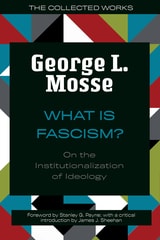
What Is Fascism?
On the Institutionalization of IdeologyGeorge L. Mosse
University of Wisconsin Press, 2026
In 1963, nearly two decades after the end of the most destructive war in human history, George L. Mosse assembled a group of interdisciplinary scholars from diverse backgrounds to answer a seemingly simple question: What is fascism? The landmark seminar that followed, held at Stanford University, came to define the intellectual conversation about European fascism throughout the postwar era. Mosse strove to better understand the legacy of fascism by debating its origins—often contentiously—with the sharpest minds of his generation.
In this volume, which collects Mosse’s lectures as well as his peers’ responses, Mosse and his colleagues wrestle with fascism’s origins and impact. The straightforward question that launched the seminar quickly expands to deeper debates: What are the intellectual foundations of right-wing populist political movements? How had these particular movements risen to power so quickly and then left so much devastation in their wakes? Were charismatic leaders like Hitler and Mussolini driving forces or did the various incarnations of fascism throughout Europe and beyond constitute a broader “revolution”? What was the relationship of religious and cultural institutions to fascism’s rise and cataclysmic fall?
As the word “fascism” takes on new meaning in the twenty-first century, it is more urgent than ever to revisit the work of scholars who witnessed its birth—and its defeat. In the foreword, Stanley G. Payne situates the lively debate in its historical context, and in the critical introduction, James J. Sheehan shares his own memories of the seminar and reflects on how the experience drove Mosse’s later work.

Winners and Losers
Social and Political Polarities in AmericaIrving Louis Horowitz
Duke University Press, 1984