Results by title
69 books match the query 'Images' and 4 start with w
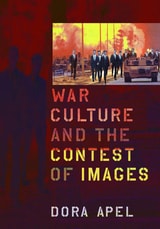
War Culture and the Contest of Images
Apel, Dora
Rutgers University Press, 2012
War Culture and the Contest of Images analyzes the relationships among contemporary war, documentary practices, and democratic ideals. Dora Apel examines a wide variety of images and cultural representations of war in the United States and the Middle East, including photography, performance art, video games, reenactment, and social media images. Simultaneously, she explores the merging of photojournalism and artistic practices, the effects of visual framing, and the construction of both sanctioned and counter-hegemonic narratives in a global contest of images.
As a result of the global visual culture in which anyone may produce as well as consume public imagery, the wide variety of visual and documentary practices present realities that would otherwise be invisible or officially off-limits. In our digital era, the prohibition and control of images has become nearly impossible to maintain. Using carefully chosen case studies—such as Krzysztof Wodiczko’s video projections and public works in response to 9/11 and the wars in Iraq and Afghanistan, the performance works of Coco Fusco and Regina Galindo, and the practices of Israeli and Palestinian artists—Apel posits that contemporary war images serve as mediating agents in social relations and as a source of protection or refuge for those robbed of formal or state-sanctioned citizenship.
While never suggesting that documentary practices are objective translations of reality, Apel shows that they are powerful polemical tools both for legitimizing war and for making its devastating effects visible. In modern warfare and in the accompanying culture of war that capitalism produces as a permanent feature of modern society, she asserts that the contest of images is as critical as the war on the ground.
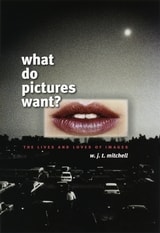
What Do Pictures Want?
The Lives and Loves of ImagesW. J. T. Mitchell
University of Chicago Press, 2005
According to W. J. T. Mitchell, we need to reckon with images not just as inert objects that convey meaning but as animated beings with desires, needs, appetites, demands, and drives of their own. What Do Pictures Want? explores this idea and highlights Mitchell's innovative and profoundly influential thinking on picture theory and the lives and loves of images. Ranging across the visual arts, literature, and mass media, Mitchell applies characteristically brilliant and wry analyses to Byzantine icons and cyberpunk films, racial stereotypes and public monuments, ancient idols and modern clones, offensive images and found objects, American photography and aboriginal painting. Opening new vistas in iconology and the emergent field of visual culture, he also considers the importance of Dolly the Sheep—who, as a clone, fulfills the ancient dream of creating a living image—and the destruction of the World Trade Center on 9/11, which, among other things, signifies a new and virulent form of iconoclasm.
What Do Pictures Want? offers an immensely rich and suggestive account of the interplay between the visible and the readable. A work by one of our leading theorists of visual representation, it will be a touchstone for art historians, literary critics, anthropologists, and philosophers alike.
What If?
Twenty-Two Scenarios in Search of ImagesVilém Flusser
University of Minnesota Press, 2022
An imagination of possibilities, of miscalculations, of futures off-kilter
“Probability is a chimera, its head is true, its tail a suggestion. Futurologists attempt to compel the head to eat the tail (ouroboros). Here, though, we will try to wag the tail.” —Vilém Flusser
Two years after his Vampyroteuthis Infernalis, the philosopher Vilém Flusser engaged in another thought experiment: a collection of twenty-two “scenarios for the future” to be produced as computer-generated media, or technical images, that would break the imaginative logjam in conceiving the social, political, and economic future of the universe. What If? is not just an “impossible journey” to which Flusser invites us in the first scenario; it functions also as a distorting mirror held up to humanity.
Flusser’s disarming scenarios of an Anthropocene fraught with nightmares offer new visions that range from the scientific to the fantastic to the playful and whimsical. Each essay reflects our present sense of understanding the world, considering the exploitation of nature and the dangers of global warming, overpopulation, and blind reliance on the promises of scientific knowledge and invention. What If? offers insight into the radical futures of a slipstream Anthropocene that have much to do with speculative fiction, with Flusser’s concept of design as “crafty” or slippery, and with art and the immense creative potential of failure versus reasonable, “good” computing or calculability. As such, the book is both a warning and a nudge to imagine what we may yet become and be.
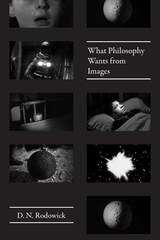
What Philosophy Wants from Images
D. N. Rodowick
University of Chicago Press, 2017
Rodowick here explores work by artists such as Ken Jacobs, Ernie Gehr, Victor Burgin, Harun Farocki, and others—artists who are creating forms that express a new historical consciousness of images. These forms acknowledge a complex relationship to the disappearing past even as they point toward new media that will challenge viewers’ confidence in what the images they see are or are becoming. What philosophy wants from images, Rodowick shows, is to renew itself conceptually through deep engagement with new forms of aesthetic experience.