Results by title
732 books match the query 'Indigenous' and 31 start with w
Wabanaki Homeland and the New State of Maine
The 1820 Journal and Plans of Survey of Joseph TreatMicah A. Pawling
University of Massachusetts Press, 2007
Edited, annotated, and with an introduction by Micah Pawling, this volume includes a complete transcription of Treat's journal, reproductions of dozens of hand-drawn maps, and records pertaining to the 1820 treaty between the Penobscot Nation and the governing authorities of Maine. As Pawling points out, Treat's journal offers more than the observations of a state agent conducting a survey. It re-creates a dialogue between Euro-Americans and Native peoples, showing how different perceptions of the land were negotiated and disseminated, and exposing the tensions that surfaced when assumptions and expectations clashed. In large part because of Neptune's influence, the maps, in addition to detailing the location of Wabanaki settlements, reflect a river-oriented Native perspective that would later serve as a key to Euro-American access to the region's interior.
The groundwork for cooperation between Treat and Neptune had been laid during the 1820 treaty negotiations, in which both men participated and which were successfully concluded just over a month before their expedition departed from Bangor, Maine. Despite conflicting interests and mutual suspicions, they were able to work together and cultivate a measure of trust as they traveled across northern Maine and western New Brunswick, mapping an old world together while envisioning its uncertain future.
Walking the Clouds
An Anthology of Indigenous Science FictionEdited by Grace L. Dillon
University of Arizona Press, 2012
In this first-ever anthology of Indigenous science fiction Grace Dillon collects some of the finest examples of the craft with contributions by Native American, First Nations, Aboriginal Australian, and New Zealand Maori authors. The collection includes seminal authors such as Gerald Vizenor, historically important contributions often categorized as "magical realism" by authors like Leslie Marmon Silko and Sherman Alexie, and authors more recognizable to science fiction fans like William Sanders and Stephen Graham Jones. Dillon's engaging introduction situates the pieces in the larger context of science fiction and its conventions.
Organized by sub-genre, the book starts with Native slipstream, stories infused with time travel, alternate realities and alternative history like Vizenor's "Custer on the Slipstream." Next up are stories about contact with other beings featuring, among others, an excerpt from Gerry William's The Black Ship. Dillon includes stories that highlight Indigenous science like a piece from Archie Weller's Land of the Golden Clouds, asserting that one of the roles of Native science fiction is to disentangle that science from notions of "primitive" knowledge and myth. The fourth section calls out stories of apocalypse like William Sanders' "When This World Is All on Fire" and a piece from Zainab Amadahy's The Moons of Palmares. The anthology closes with examples of biskaabiiyang, or "returning to ourselves," bringing together stories like Eden Robinson's "Terminal Avenue" and a piece from Robert Sullivan's Star Waka.
An essential book for readers and students of both Native literature and science fiction, Walking the Clouds is an invaluable collection. It brings together not only great examples of Native science fiction from an internationally-known cast of authors, but Dillon's insightful scholarship sheds new light on the traditions of imagining an Indigenous future.
War in the Peaceable Kingdom
The Kittanning Raid of 1756Brady J. Crytzer
Westholme Publishing, 2016
On the morning of September 8, 1756, a band of about three hundred volunteers of a newly created Pennsylvania militia led by Lt. Col. John Armstrong crept slowly through the western Pennsylvania brush. The night before they had reviewed a plan to quietly surround and attack the Lenape, or Delaware, Indian village of Kittanning. The Pennsylvanians had learned that several prominent Delaware who had led recent attacks on frontier settlements as well as a number of white prisoners were at the village. Seeking reprisal, Armstrong’s force successfully assaulted Kittanning, killing one of the Delaware they sought, but causing most to flee—along with their prisoners. Armstrong then ordered the village burned. The raid did not achieve all of its goals, but it did lead to the Indians relocating their villages further away from the frontier settlements. However, it was a major victory for those Pennsylvanians—including some Quaker legislators—who believed the colony must be able to defend itself from outside attack, whether from the French, Indians, or another colony.
In War in the Peaceable Kingdom: The Kittanning Raid of 1756, historian Brady J. Crytzer follows the two major threads that intertwined at Kittanning: the French and Indian War that began in the Pennsylvania frontier, and the bitter struggle between pacifist Quakers and those Quakers and others—most notably, Benjamin Franklin—who supported the need to take up arms. It was a transformational moment for the American colonies. Rather than having a large, pacifist Pennsylvania in the heart of British North America, the colony now joined the others in training soldiers for defense. Ironically, it would be Pennsylvania soldiers who, in the early days of the American Revolution, would be crucial to the survival of George Washington’s army.
Wars of the Iroquois
A Study in Intertribal Trade RelationsGeorge T. Hunt
University of Wisconsin Press, 1960
George T. Hunt’s classic 1940 study of the Iroquois during the middle and late seventeenth century presents warfare as a result of depletion of natural resources in the Iroquois homeland and tribal efforts to assume the role of middlemen in the fur trade between the Indians to the west and the Europeans.
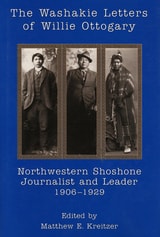
Washakie Letters Of Willie Ottogary
Matthew Kreitzer
Utah State University Press, 2000
Writings by American Indians from the early twentieth century or earlier are rare. Willie Ottogary's letters have the distinction of being firsthand reports of an Indian community's ongoing social life by a community member and leader. The Northwestern Shoshone residing at the Washakie colony in northern Utah descended from survivors of the Bear River Massacre. Most had converted to the Mormon Church and remained in northern Utah rather than moving to a federal Indian reservation. For over twenty years, local newspapers in Utah and southern Idaho regularly published letters from Ottogary reporting happenings-personal milestones and health crises, comings and goings, social events, economic conditions and activities, efforts at political redress-at Washakie and other Shoshone communities in the intermountain West.
Matthew Kreitzer compiled and edited the letters of Ottogary and added historical commentary and appendices, biographical data on individuals Ottogary mentioned, and eighty-five rare historical photographs. Written in a vernacular English and printed unedited in the newspapers, the letters describe a society in cultural transition and present Ottogary's distinctively Shoshone point of view on anything affecting his people. Thus, they provide an unusual picture of Shoshone life through a critical period, a time when many Indian communities reached a historical nadir. While the letters unflinchingly report the many difficulties and challenges the Shoshone faced, they portray a vital and dynamic society, whose members led full lives and actively pursued their own interests. Ottogary lobbied constantly for Shoshone rights, forging alliances with Shoshone throughout the region, visiting Washington D.C., advocating legislation, and participating in Goshute-Western Shoshone draft resistance during World War I.
Wastelanding
Legacies of Uranium Mining in Navajo CountryTraci Brynne Voyles
University of Minnesota Press, 2015
Wastelanding tells the history of the uranium industry on Navajo land in the U.S. Southwest, asking why certain landscapes and the peoples who inhabit them come to be targeted for disproportionate exposure to environmental harm. Uranium mines and mills on the Navajo Nation land have long supplied U.S. nuclear weapons and energy programs. By 1942, mines on the reservation were the main source of uranium for the top-secret Manhattan Project. Today, the Navajo Nation is home to more than a thousand abandoned uranium sites. Radiation-related diseases are endemic, claiming the health and lives of former miners and nonminers alike.
Traci Brynne Voyles argues that the presence of uranium mining on Diné (Navajo) land constitutes a clear case of environmental racism. Looking at discursive constructions of landscapes, she explores how environmental racism develops over time. For Voyles, the “wasteland,” where toxic materials are excavated, exploited, and dumped, is both a racial and a spatial signifier that renders an environment and the bodies that inhabit it pollutable. Because environmental inequality is inherent in the way industrialism operates, the wasteland is the “other” through which modern industrialism is established.
In examining the history of wastelanding in Navajo country, Voyles provides “an environmental justice history” of uranium mining, revealing how just as “civilization” has been defined on and through “savagery,” environmental privilege is produced by portraying other landscapes as marginal, worthless, and pollutable.
We Are Not a Vanishing People
The Society of American Indians, 1911–1923Thomas Constantine Maroukis
University of Arizona Press, 2021
Historian Thomas Constantine Maroukis discusses the goals, strategies, successes, and failures of the Indigenous intellectuals who came together to form the SAI. They engaged in lobbying, producing publications, informing the media, hundreds of speaking engagements, and annual conferences to argue for reform. Unfortunately, the forces of this era were against reforming federal policies: The group faced racism, a steady stream of negative stereotyping as a so-called vanishing race, and an indifferent federal bureaucracy. They were also beset by internal struggles, which weakened the organization.
This work sheds new light on the origins of modern protest in the twentieth century, and it shows how the intellectuals and activists associated with the SAI were able to bring Indian issues before the American public, challenging stereotypes and the “vanishing people” trope. Maroukis argues that that the SAI was not an assimilationist organization; they were political activists trying to free Indians from government wardship while maintaining their cultural heritage.
We Are a People in This World
The Lakota Sioux and the Massacre at Wounded KneeConger Beasley Jr.
University of Arkansas Press, 1997
We Are the Stars
Colonizing and Decolonizing the Oceti Sakowin Literary TraditionSarah Hernandez
University of Arizona Press, 2023
Women and land form the core themes of the book, which brings tribal and settler colonial narratives into comparative analysis. Divided into two parts, the first section of the work explores how settler colonizers used the printing press and boarding schools to displace Oceti Sakowin women as traditional culture keepers and culture bearers with the goal of internally and externally colonizing the Dakota, Nakota, and Lakota nations. The second section focuses on decolonization and explores how contemporary Oceti Sakowin writers and scholars have started to reclaim Dakota, Nakota, and Lakota literatures to decolonize and heal their families, communities, and nations.
We Could Perceive No Sign of Them
Failed Colonies in North America, 1526–1689David MacDonald
Westholme Publishing, 2020
The nations of the modern Americas began as successful colonies, but not all colonies succeeded, and the margin between colonies that survived and those that failed was small. Both contribute to our understanding of the ordeals of the Europeans who first settled in the New World and of the Native Americans who had to interact with them, but with the exception of the famous lost Roanoke colony, the failed colonies of North America remain largely unknown except to specialists in colonial history. The Spanish and French repeatedly attempted to colonize parts of Georgia, Florida, and Virginia, while the Dutch, French, and English sought to establish permanent settlements along the northern waterways of the New World. The greatest problem faced by every colony was the specter of starvation. Native Americans gave food to newly arrived colonists, but such generosity could not endure. Indigenous people soon realized that colonists of every nationality were prepared to make war against Native peoples, conquer, subjugate, and even massacre whole communities unless they were cooperative and offered no resistance to the intrusion into their territory. In response, Native Americans withheld aid or resorted to retaliatory violence, dooming many European settlements.
In We Could Perceive No Sign of Them: Failed Colonies in North America, 1526–1689, historians David MacDonald and Raine Waters tell the fascinating stories of the many attempts to establish a European foothold in the New World, from the first Spanish colony in 1526 on the coast of Georgia to the final disastrous French endeavors near the arctic. Using primary source texts, the authors synthesize the shared experiences of Europeans to better understand the very fine line between success and failure and the varieties of Native American responses.
We Will Secure Our Future
Empowering the Navajo NationPeterson Zah and Peter Iverson
University of Arizona Press, 2012
And so began a career that took Zah to the presidency of the Navajo Nation. His life and accomplishments have exemplified the ongoing efforts by American Indian communities to gain greater control over their lives and lands. He has made important contributions in many areas, but education has always been one of his main priorities. Perhaps no one in the Southwest has done more than Peterson Zah to increase the recruitment, retention, and graduation of American Indian students from colleges and universities.
Zah's presentations to Peter Iverson's classes at Arizona State University, employed examples drawn from his own experiences. Students praised his thoughtful, honest and direct observations. He reinforced a central theme in Iverson's classesthat Indian history encompasses triumph as well as tragedy and victory as well as victimization.
This book grew out of Iverson's determination to share Zah's insights with a wider audience. The two met every few months to consider many subjects related to Zah's life. These sessions formed the foundation for this volume.
Part autobiography, part interview, and part conversation, Zah and Iverson's account touches on a wide range of overlapping topics, but two central themes prevail: education and empowerment. We Will Secure Our Future is a fascinating look into the life of a man who became a respected visionary and passionate advocate for his people.
We are an Indian Nation
A History of the Hualapai PeopleJeffrey P. Shepherd
University of Arizona Press, 2010
This book focuses on the historical construction of the Hualapai Nation in the face of modern American colonialism. Drawing on archival research, interviews, and participant observation, Jeffrey Shepherd describes how thirteen bands of extended families known as The Pai confronted American colonialism and in the process recast themselves as a modern Indigenous nation.
Shepherd shows that Hualapai nation-building was a complex process shaped by band identities, competing visions of the past, creative reactions to modernity, and resistance to state power. He analyzes how the Hualapais transformed an externally imposed tribal identity through nationalist discourses of protecting aboriginal territory; and he examines how that discourse strengthened the Hualapais’ claim to land and water while simultaneously reifying a politicized version of their own history. Along the way, he sheds new light on familiar topics—Indian–white conflict, the creation of tribal government, wage labor, federal policy, and Native activism—by applying theories of race, space, historical memory, and decolonization.
Drawing on recent work in American Indian history and Native American studies, Shepherd shows how the Hualapai have strived to reclaim a distinct identity and culture in the face of ongoing colonialism. We Are an Indian Nation is grounded in Hualapai voices and agendas while simultaneously situating their history in the larger tapestry of Native peoples’ confrontations with colonialism and modernity.
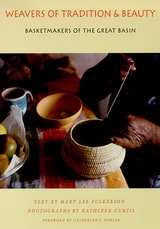
Weavers of Tradition and Beauty
Basketmakers of the Great BasinMary Lee Fulkerson
University of Nevada Press, 1995
Weavers of Tradition and Beauty presents new information on contemporary Native American basketry of the Great Basin, largely from the viewpoint of the weavers themselves. In collecting their stories, Kathleen Curtis and Mary Lee Fulkerson traveled throughout Nevada, never dreaming their odyssey over back-roads and to reservations would stretch into years. Finding a deep connection to the people of the sage, the authors accompanied the weavers as they gathered and prepared their special willow, dyed the bracken fern root, and wove their baskets. Baskets—and the people who weave them—have always been revered and honored by Native Americans. Fulkerson and Curtis depict, in text and full color and black and white photographs, how their art prevails—even over adverse environmental, social, and economic conditions. Today, contemporary weavers continue their work by creating baskets in the manner of their ancestors. Teaching their children and grandchildren how to weave baskets, these artisans carry on a long and strong tradition. By documenting the basketry of Nevada's native people, the authors make a significant contribution in preserving this ancient and beautiful craft. Foreword by Catherine S. Fowler.
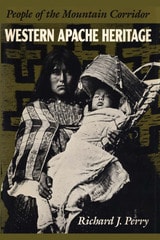
Western Apache Heritage
People of the Mountain CorridorBy Richard J. Perry
University of Texas Press, 1991
Mention "Apaches," and many Anglo-Americans picture the "marauding savages" of western movies or impoverished reservations beset by a host of social problems. But, like most stereotypes, these images distort the complex history and rich cultural heritage of the Apachean peoples, who include the Navajo, as well as the Western, Chiricahua, Mescalero, Jicarilla, Lipan, and Kiowa Apaches. In this pioneering study, Richard Perry synthesizes the findings of anthropology, ethnology, linguistics, archaeology, and ethnohistory to reconstruct the Apachean past and offer a fuller understanding of the forces that have shaped modern Apache culture.
While scholars generally agree that the Apacheans are part of a larger group of Athapaskan-speaking peoples who originated in the western Subarctic, there are few archaeological remains to prove when, where, and why those northern cold dwellers migrated to the hot deserts of the American Southwest. Using an innovative method of ethnographic reconstruction, however, Perry hypothesizes that these nomadic hunters were highly adaptable and used to exploiting the resources of a wide range of mountainous habitats. When changes in their surroundings forced the ancient Apacheans to expand their food quest, it was natural for them to migrate down the "mountain corridor" formed by the Rocky Mountain chain.
This reconstruction of Apachean history and culture sheds much light on the origins, dispersions, and relationships of Apache groups. Perry is the first researcher to attempt such an extensive reconstruction, and his study is the first to deal with the full range of Athapaskan-speaking peoples. His method will be instructive to students of other cultures who face a similar lack of historical and archaeological data.
When Borne Across
Literary Cosmopolitics in the Contemporary Indian NovelBishnupriya Ghosh
Rutgers University Press, 2004
India’s 1997 celebration of the Golden Jubilee marked fifty years of independence from British colonial rule. This anniversary is the impetus for Bishnupriya Ghosh’s exploration of the English language icons of South Asian post-colonial literature: Salman Rushdie, Vikram Chandra, Amitav Ghosh, Upamanyu Chatterjee, and Arundhati Roy. These authors, grouped together as South Asian cosmopolitical writers, produce work challenging and expanding preconceived notions of Indian cultural identity, while being sold simultaneously as popular English literature within the global market. This commodification of Indian language and identity reinforces incomplete and simplified images of India and its writers, and at times counteracts the expressed agenda of the writers. In When Borne Across, Ghosh focuses on the politics of language and history, and the related processes of translation and migration within the global network. In so doing, she develops a new approach to literary studies that adapts conventional literary analysis to the pressures, constraints, and liberties of our present era of globalization.
When the Earth Was New
Memory, Materiality, and Numic RitualAlex K. Ruuska
University of Utah Press, 2025
In When the Earth Was New, Alex K. Ruuska explores riveting multigenerational memories of Numic-speaking communities that extend back, potentially, to the late Pleistocene. These diverse oral traditions describe geological, climatic, and ecological events that occurred over thousands of years and were passed down across many generations. Through the examination of place-based memories and the architecture of Numic knowledge, Ruuska demonstrates convergences of oral traditions, ethnography, ethnohistory, archaeology, and geology.
When the Earth Was New critically compares and considers multiple forms of knowledge that contribute to overlapping as well as disparate understandings of both recent and distant pasts in the regions of California, the Great Basin, and the Colorado Plateau. It works at balancing key themes in these regions’ histories within a more holistic framework, exploring ancient and modern strands of knowledge with the assistance of twenty-four Tribes and Consolidated Organizations.
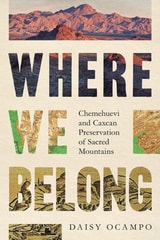
Where We Belong
Chemehuevi and Caxcan Preservation of Sacred MountainsDaisy Ocampo
University of Arizona Press, 2023
The author brings together the history and experiences of the Chemehuevi people and their ties with Mamapukaib, or the Old Woman Mountains in the East Mojave Desert, and the Caxcan people and their relationship with Tlachialoyantepec, or Cerro de las Ventanas, in Zacatecas, Mexico. Through a trans-Indigenous approach, Daisy Ocampo weaves historical methodologies (oral histories, archival research, ethnography) with Native studies and historic preservation to reveal why Native communities are the most knowledgeable and transformational caretakers of their sacred places.
This work transcends national borders to reveal how settler structures are sustained through time and space in the Americas. Challenging these structures, traditions such as the Chemehuevi Salt Songs and Caxcan Xuchitl Dance provide both an old and a fresh look at how Indigenous people are reimagining worlds that promote Indigenous-to-Indigenous futures through preservation.
Ultimately, the stories of these two peoples and places in North America illuminate Indigenous sovereignty within the field of public history, which is closely tied to governmental policies, museums, archives, and agencies involved in historic preservation.
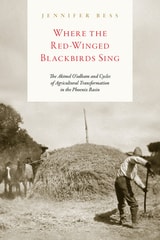
Where the Red-Winged Blackbirds Sing
The Akimel O'odham and Cycles of Agricultural Transformation in the Phoenix BasinJennifer Bess
University Press of Colorado, 2021
Author Jennifer Bess examines the Akimel O’odham’s worldview, which links their origins with a responsibility to farm the Gila River Valley and to honor their history of adaptation and obligations as “world-builders”—co-creators of an evermore life-sustaining environment and participants in flexible networks of economic exchange. Bess considers this worldview in context of the Huhugam–Akimel O’odham agricultural economy over more than a thousand years. Drawing directly on Akimel O’odham traditional ecological knowledge, innovations, and interpretive strategies in archives and interviews, Bess shows how the Akimel O’odham engaged in agricultural economy for the sake of their lifeways, collective identity, enduring future, and actualization of the values modeled in their sacred stories.
Where the Red-Winged Blackbirds Sing highlights the values of adaptation, innovation, and co-creation fundamental to Akimel O’odham lifeways and chronicles the contributions the Akimel O’odham have made to American history and to the history of agriculture. The book will be of interest to scholars of Indigenous, American Southwestern, and agricultural history.
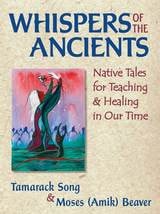
Whispers of the Ancients
Native Tales for Teaching and Healing in Our TimeTamarack Song and Moses (Amik) Beaver
University of Michigan Press, 2010
"Whispers of the Ancients helps us reconnect with the spirit of story that is a part of all our heritages. With respect for the wisdom of the past and with an eye toward the cross-cultural links that legends can make between us, Tamarack Song offers a gathering of tales and insightful comments that point the way back to the circle."
---Joseph Bruchac, author of more than 70 books for children and adults, including (with coauthor Michael J. Caduto) the best-selling Keepers of the Earth: Native American Stories and Environmental Activities for Children
It's easy to imagine yourself transported back to a time when an Elder might have told stories like those in Whispers of the Ancients around a glowing hearth. Thanks to Tamarack Song's storytelling skills, monsters, heroes, and shapeshifters come alive and open a doorway to the mysteries of life. Easily accessible to all ages, this is a book that speaks to each person at his or her own level of comprehension and need. It is as beautiful to read as it is to look at.
Stunning Aboriginal artwork by Moses (Amik) Beaver combines with provocative storytelling to renew, in all their traditional splendor, exceptional legends from around the world. Entertaining, profound, passionate, glorious---these are stories that illustrate and evoke themes common to everyone's life, with an ancient wisdom that helps the listener to cope with today's opportunities for tenderness, grief, passion, and irony.
Easily accessible to all ages, this is a book that speaks to each person at his or her own level of comprehension and need. It's as beautiful to read as it is to look at.
Tamarack Song has sought out the stories of the North African and Central Asian tribal peoples from whom he is descended, and he has listened to the tales of indigenous people from the tundra to the tropics. His books include Journey to the Ancestral Self, and he has contributed to Lois Einhorn's Forgiveness and Child Abuse. He is also a counselor, wilderness skills teacher, rites-of-passage guide, and founder of the Teaching Drum Outdoor School. Song lives in the Nicolet National Forest near Three Lakes, Wisconsin.
Moses (Amik) Beaver is an Ojibwe artist from the isolated fly-in community of Nibinamik (Summer Beaver), Ontario, three hundred miles north of Lake Superior. Grants from the Ontario Arts Council and other sources support his ongoing work with youth, and partial support for this book's illustrations comes from the District School Board of Nibinamik.
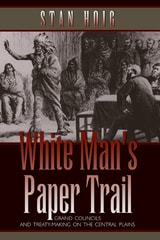
White Man's Paper Trail
Grand Councils and Treaty-Making on the Central PlainsStan Hoig
University Press of Colorado, 2006
Stan Hoig shows how treaty-making - once considered a viable method of peaceably resolving conflicts - degenerated into a deeply flawed system sullied by political deceptions and broken promises.
White Man's Paper Trail illuminates the pivotal role of treaty negotiations in the buildup to the Plains Indian wars, in American Indians' loss of land and self-determination, and in Euro-American westward expansion.
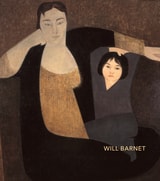
Will Barnet
Will Barnet
The Artist Book Foundation, 2024
The first monograph on Will Barnet in nearly 40 years, this title reflect's the artist's unique interpretation of the world's evolving genres.
Will Barnet’s artistic career as a painter and printmaker spanned nearly eight decades of continuous creativity. Few artists, other than perhaps Picasso or Monet, can claim such an extended period of uninterrupted and innovative art making. From the darkness of the Great Depression to the opening decade of the twenty-first century, his oeuvre reflects his unique interpretation of the art world’s evolving genres: Social Realism, Modernism, Abstract Expressionism, and ultimately representational Minimalism with the human figure as his primary subject.
This book is the first comprehensive monograph on Will Barnet in nearly 40 years. With scholarly essays by the four distinguished authors, an extensive plate section, a comprehensive chronology, lists of awards and exhibitions, and a detailed bibliography, this monograph is a thorough presentation of Barnet's iconic images and consistently evolving style while celebrating his unquenchable joie de vivre.
Barnet was devoted to making art every day and worked diligently even at the very end of his life. "The Old Masters are still alive after 400 years, and that's what I want to be," he once said. "At the age of 10 or 12, I discovered that being an artist would give me an ability to create something which would live on after death." Live on it does; in addition to his acclaimed body of work, he influenced a broad spectrum of artists such as Jackson Pollock, Mark Rothko, James Rosenquist, Cy Twombly, and Ethel Fisher.
Winning the Dust Bowl
Carter Revard
University of Arizona Press, 2001
Wisconsin Indian Literature
Anthology of Native VoicesEdited by Kathleen Tigerman; Foreward by Jim Ottery
University of Wisconsin Press, 2006
Literature of the Indian Nations of Wisconsin is a unique anthology that presents the oral traditions, legends, speeches, myths, histories, literature, and historically significant documents of the current twelve independent bands and Indian Nations of Wisconsin. Kathleen Tigerman sought input from tribe elders and educators to provide an accurate chronological portrait of each nation, including the Siouan Ho-Chunk; the Algonquian Menominee, Ojibwe, and Potawatomi; and three groups originally from what is now New York State: the Iroquoian Oneida, the Stockbridge-Munsee band of the Mohican Nations, and the Brothertown Nation.
Some of these works feature a cultural hero or refer to very ancient times—more than six thousand years ago—and others are contemporary. These pieces focus on issues of Wisconsin Native communities by sharing Native knowledge and dialogue about sovereignty, decolonization, cultural genocide, forced removals, assimilation, and other concerns.
This anthology introduces us to a vivid and unforgettable group of voices, enhanced by many maps, photographs, and chronologies. Literature of the Indian Nations of Wisconsin fosters cross-cultural understanding among non-Native readers and the people of the First Nations.
Wisconsin Indians
Nancy Oestreich Lurie
Wisconsin Historical Society Press, 2002
This best-selling short history of Wisconsin's native peoples is now updated and expanded to include events through the end of the twentieth century. From the treaty-making era to the reawakening of tribal consciousness in the 1960s to the profound changes brought about by Indian gaming, Lurie’s classic account remains the best concise treatment of the subject.
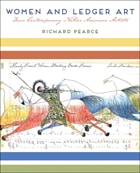
Women and Ledger Art
Four Contemporary Native American ArtistsRichard Pearce
University of Arizona Press, 2013
Women and Ledger Art calls attention to the extraordinary achievements of these strong women who have chosen to express themselves through ledger art. Author Richard Pearce foregrounds these contributions by focusing on four contemporary women ledger artists: Sharron Ahtone Harjo (Kiowa), Colleen Cutschall (Oglala Lakota), Linda Haukaas (Sicangu Lakota), and Dolores Purdy Corcoran (Caddo). Pearce spent six years in continual communication with the women, learning about their work and their lives. Women and Ledger Art examines the artists and explains how they expanded Plains Indian history.
With 46 stunning images of works in various mediums—from traditional forms on recovered ledger pages to simulated quillwork and sculpture, Women in Ledger Art reflects the new life these women have brought to an important transcultural form of expression.
Wooden Ritual Artifacts from Chaco Canyon, New Mexico
The Chetro Ketl CollectionR. Gwinn Vivian, Dulce N. Dodgen, and Gayle H. Hartmann
University of Arizona Press, 1978
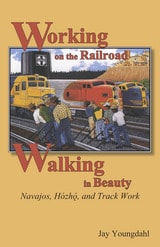
Working on the Railroad, Walking in Beauty
Navajos, Hozho, and Track WorkJay Youngdahl
Utah State University Press, 2011
For over one hundred years, Navajos have gone to work in significant numbers on Southwestern railroads. As they took on the arduous work of laying and anchoring tracks, they turned to traditional religion to anchor their lives.
Jay Youngdahl, an attorney who has represented Navajo workers in claims with their railroad employers since 1992 and who more recently earned a master's in divinity from Harvard, has used oral history and archival research to write a cultural history of Navajos' work on the railroad and the roles their religious traditions play in their lives of hard labor away from home.
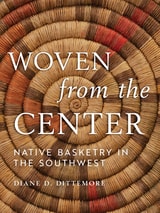
Woven from the Center
Native Basketry in the SouthwestDiane D. Dittemore
University of Arizona Press, 2024
Woven from the Center presents breathtaking basketry from some of the greatest weavers in the Southwest. Each sandal and mat fragment, each bowl and jar, every water bottle and whimsy is infused with layers of aesthetic, cultural, and historical meanings. This book offers stunning photos and descriptions of woven works from Tohono O’odham, Akimel O’odham, Hopi, Western Apache, Yavapai, Navajo, Pai, Paiute, New Mexico Pueblo, Eastern Apache, Seri, Yaqui, Mayo, and Tarahumara communities.
This richly illustrated volume stands on its own as a definitive look at basketry of the Greater Southwest, including northern Mexico. It also serves as a companion to the peerless collection of U.S. Southwest and Northwest Mexican Native American basketry curated at the Arizona State Museum in Tucson, Arizona. Comprehensive in its coverage, this work is based on decades of research on weavers, collectors, and donors. It includes ample illustrations of basket weavers, past and present, bringing to life the people behind these wonderful woven treasures.
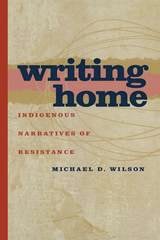
Writing Home
Indigenous Narratives of ResistanceMichael D. Wilson
Michigan State University Press, 2008
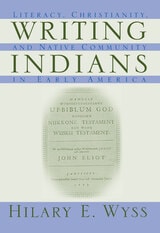
Writing Indians
Literacy, Christianity, and Native Community in Early AmericaHilary E. Wyss
University of Massachusetts Press, 2000
A study of cultural encounter, this book takes a fresh look at the much ignored and often misunderstood experience of Christian Indians in early America. Focusing on New England missionary settlements from the mid-seventeenth to the early nineteenth centuries, Hilary E. Wyss examines the ways in which Native American converts to Christianity developed their own distinct identity within the context of a colonial culture.
With an approach that weaves together literature, religious studies, and ethno-history, Wyss grounds her work in the analysis of a rarely read body of “autobiographical” writings by Christian Indians, including letters, journal entries, and religious confessions. She then juxtaposes these documents to the writings of better known Native Americans like Samson Occom as well as to the published works of Anglo-Americans, such as Mary Rowlandson's famous captivity narrative and Eleazor Wheelock's accounts of his charity schools.
In their search for ostensibly “authentic” Native voices, scholars have tended to overlook the writings of Christian Indians. Yet, Wyss argues, these texts reveal the emergence of a dynamic Native American identity through Christianity. More specifically, they show how the active appropriation of New England Protestantism contributed to the formation of a particular Indian identity that resisted colonialism by using its language against itself.
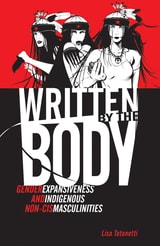
Written by the Body
Gender Expansiveness and Indigenous Non-Cis MasculinitiesLisa Tatonetti
University of Minnesota Press, 2021
Examining the expansive nature of Indigenous gender representations in history, literature, and film
Within Native American and Indigenous studies, the rise of Indigenous masculinities has engendered both productive conversations and critiques. Lisa Tatonetti intervenes in this conversation with Written by the Body by centering how female, queer, and/or Two-Spirit Indigenous people take up or refute masculinity, and, in the process, offer more expansive understandings of gender.
Written by the Body moves from the eighteenth- and nineteenth-century archive to turn-of-the-century and late-twentieth-century fiction to documentaries, HIV/AIDS activism, and, finally, recent experimental film and literature. Across it all, Tatonetti shows how Indigenous gender expansiveness, and particularly queer and non-cis gender articulations, moves between and among Native peoples to forge kinship, offer protection, and make change. She charts how the body functions as a somatic archive of Indigenous knowledge in Native histories, literatures, and activisms—exploring representations of Idle No More in the documentary Trick or Treaty, the all-female wildland firefighting crew depicted in Apache 8, Chief Theresa Spence, activist Carole laFavor, S. Alice Callahan, Thirza Cuthand, Joshua Whitehead, Carrie House, and more.
In response to criticisms of Indigenous masculinity studies, Written by the Body de-sutures masculinity from the cis-gendered body and investigates the ways in which female, trans, and otherwise nonconforming masculinities carry the traces of Two-Spirit histories and exceed the limitations of settler colonial imaginings of gender.