Results by title
129 books match the query 'Individual Philosophers' and 2 start with w
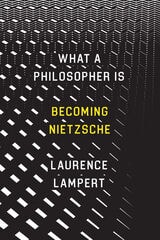
What a Philosopher Is
Becoming NietzscheLaurence Lampert
University of Chicago Press, 2018
With this book, Laurence Lampert answers that question. He does so through his trademark technique of close readings of key works in Nietzsche’s journey to philosophy: The Birth of Tragedy, Schopenhauer as Educator, Richard Wagner in Bayreuth, Human All Too Human, and “Sanctus Januarius,” the final book of the 1882 Gay Science. Relying partly on how Nietzsche himself characterized his books in his many autobiographical guides to the trajectory of his thought, Lampert sets each in the context of Nietzsche’s writings as a whole, and looks at how they individually treat the question of what a philosopher is. Indispensable to his conclusions are the workbooks in which Nietzsche first recorded his advances, especially the 1881 workbook which shows him gradually gaining insights into the two foundations of his mature thinking. The result is the most complete picture we’ve had yet of the philosopher’s development, one that gives us a Promethean Nietzsche, gaining knowledge even as he was expanding his thought to create new worlds.

Wilfrid Sellars and Phenomenology
Intersections, Encounters, OppositionsDaniele De Santis
Ohio University Press, 2023
Wilfrid Sellars tackled the difficult problems of reconciling Pittsburgh school–style analytic thought, Husserlian phenomenology, and the Myth of the Given.
This collection of essays brings into dialogue the analytic philosophy of Wilfrid Sellars—founder of the Pittsburgh school of thought—and phenomenology, with a special focus on the work of Edmund Husserl. The book’s wide-ranging discussions include the famous Myth of the Given but also more traditional problems in the philosophy of mind and phenomenology such as the
- status of perception and imagination
- nature of intentionality
- concept of motivation
- relationship between linguistic and nonlinguistic experiences
- relationship between conceptual and preconceptual experiences
Moreover, the volume addresses the conflicts between Sellars’s manifest and scientific images of the world and Husserl’s ontology of the life-world. The volume takes as a point of departure Sellars’s criticism of the Myth of the Given, but only to show the many problems that label obscures. Contributors explain aspects of Sellars’s philosophy vis-à-vis Husserl’s phenomenology, articulating the central problems and solutions of each. The book is a must-read for scholars and students interested in learning more about Sellars and for those comparing Continental and analytic philosophical thought.
Contributors
Walter Hopp
Wolfgang Huemer
Roberta Lanfredini
Danilo Manca
Karl Mertens
Antonio Nunziante
Jacob Rump
Daniele De Santis
Michela Summa