Results by title
748 books match the query 'Influence' and 28 start with w

WORLDS OF MEDIEVAL WOMEN
"CREATIVITY, INFLUENCE, AND IMAGINATION"CONSTANCE H. BERMAN
West Virginia University Press, 1985
WPAing in a Pandemic and Beyond
Revision, Innovation, and AdvocacyTodd Ruecker
Utah State University Press, 2025
The chapters in this collection include a variety of voices who have been involved in writing program administration in recent years to reflect on the work done in this moment of crisis. Through both short vignettes and longer chapters, this book explores the complicated interactions between WPA work and navigating times of crisis to provide insights for moving forward. Authors explore a variety of topics including professional development, curricular change, advocating in the face of intransigent administrations and others, caring for students, and taking time for self-care. Pointing to specific actions for continued advocacy, WPAing in a Pandemic and Beyond will be of great interest to WPAs and writing studies scholars.
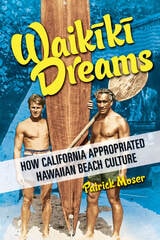
Waikiki Dreams
How California Appropriated Hawaiian Beach CulturePatrick Moser
University of Illinois Press, 2024
Despite a genuine admiration for Native Hawaiian culture, white Californians of the 1930s ignored authentic relationships with Native Hawaiians. Surfing became a central part of what emerged instead: a beach culture of dressing, dancing, and acting like an Indigenous people whites idealized.
Patrick Moser uses surfing to open a door on the cultural appropriation practiced by Depression-era Californians against a backdrop of settler colonialism and white nationalism. Recreating the imagined leisure and romance of life in Waikīkī attracted people buffeted by economic crisis and dislocation. California-manufactured objects like surfboards became a physical manifestation of a dream that, for all its charms, emerged from a white impulse to both remove and replace Indigenous peoples. Moser traces the rise of beach culture through the lives of trendsetters Tom Blake, John “Doc” Ball, Preston “Pete” Peterson, Mary Ann Hawkins, and Lorrin “Whitey” Harrison while also delving into California’s control over images of Native Hawaiians via movies, tourism, and the surfboard industry.
Compelling and innovative, Waikīkī Dreams opens up the origins of a defining California subculture.
Walker Percy, Fyodor Dostoevsky, and the Search for Influence
Jessica Hooten Wilson
The Ohio State University Press, 2017
From Dostoevsky, Percy learned how to captivate his non-Christian readership with fiction saturated by a Christian vision of reality. Not only was his method of imitation in line with this Christian faith but also the aesthetic mode and very content of his narratives centered on his knowledge of Christ. The influence of Dostoevsky on Percy, then, becomes significant as a modern case study for showing the illusion of artistic autonomy and long-held, Romantic assumptions about artistic originality. Ultimately, Wilson suggests, only by studying the good that came before can one translate it in a new voice for the here and now.
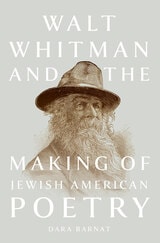
Walt Whitman and the Making of Jewish American Poetry
Dara Barnat
University of Iowa Press, 2023
Dara Barnat presents a genealogy of Jewish American poets in dialogue with Whitman, and with each other, and reveals how the lineage of Jewish American poets responding to Whitman extends far beyond the likes of Allen Ginsberg. From Emma Lazarus and Adah Isaacs Menken, through twentieth-century poets such as Charles Reznikoff, Karl Shapiro, Kenneth Koch, Muriel Rukeyser, Adrienne Rich, Marge Piercy, Alicia Suskin Ostriker, and Gerald Stern, this book demonstrates that Whitman has been adopted by Jewish American poets as a liberal symbol against exclusionary and anti-Semitic elements in high modernist literary culture. The turn to Whitman serves as a mode of exploring Jewish and American identity.

War, Peace, and Prosperity in the Name of God
The Ottoman Role in Europe's Socioeconomic EvolutionMurat Iyigun
University of Chicago Press, 2015
War, Peace, and Prosperity in the Name of God turns the focus on the “big three monotheisms”—Judaism, Islam, and Christianity—to consider these questions. Chronicling the relatively rapid spread of the Abrahamic religions among the Old World, Murat Iyigun shows that societies that adhered to a monotheistic belief in that era lasted longer, suggesting that monotheism brought some sociopolitical advantages. While the inherent belief in one true god meant that these religious communities had sooner or later to contend with one another, Iyigun shows that differences among them were typically strong enough to trump disagreements within. The book concludes by documenting the long-term repercussions of these dynamics for the organization of societies and their politics in Europe and the Middle East.
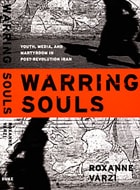
Warring Souls
Youth, Media, and Martyrdom in Post-Revolution IranRoxanne Varzi
Duke University Press, 2006
Highlighting trends that belie the government’s claim that Islamic values have taken hold—including rising rates of suicide, drug use, and sex outside of marriage—Varzi argues that by concentrating on images and the performance of proper behavior, the government’s campaign to produce model Islamic citizens has affected only the appearance of religious orthodoxy, and that the strictly religious public sphere is partly a mirage masking a profound crisis of faith among many Iranians. Warring Souls is a powerful account of contemporary Iran made more vivid by Varzi’s inclusion of excerpts from the diaries she maintained during her research and from journal entries written by Iranian university students with whom she formed a study group.

Warriors Without War
Seminole Leadership in the Late Twentieth CenturyPatricia Riles Wickman
University of Alabama Press, 2012
Warriors Without War takes readers beneath the placid waters of the Seminole’s public image and into the fascinating depths of Seminole society and politics.
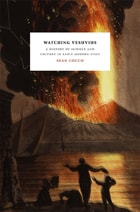
Watching Vesuvius
A History of Science and Culture in Early Modern ItalySean Cocco
University of Chicago Press, 2012

Watsuji on Nature
Japanese Philosophy in the Wake of HeideggerDavid W. Johnson
Northwestern University Press, 2019
In an engagingly lucid and deft analysis, Watsuji on Nature radically expands our appreciation of twentieth-century Japanese philosophy and shows what it has to offer to a global philosophical conversation.
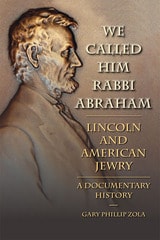
We Called Him Rabbi Abraham
Lincoln and American Jewry, a Documentary HistoryGary Phillip Zola
Southern Illinois University Press, 2014
Over the course of American history, Jews have held many American leaders in high esteem, but they maintain a unique emotional bond with Abraham Lincoln. From the time of his presidency to the present day, American Jews have persistently viewed Lincoln as one of their own, casting him as a Jewish sojourner and, in certain respects, a Jewish role model. This pioneering compendium— The first volume of annotated documents to focus on the history of Lincoln’s image, influence, and reputation among American Jews— considers how Lincoln acquired his exceptional status and how, over the past century and a half, this fascinating relationship has evolved.
Organized into twelve chronological and thematic chapters, these little-known primary source documents—many never before published and some translated into English for the first time—consist of newspaper clippings, journal articles, letters, poems, and sermons, and provide insight into a wide variety of issues relating to Lincoln’s Jewish connection. Topics include Lincoln’s early encounters with Central European Jewish immigrants living in the Old Northwest; Lincoln’s Jewish political allies; his encounters with Jews and the Jewish community as President; Lincoln’s response to the Jewish chaplain controversy; General U. S. Grant’s General Orders No. 11 expelling “Jews, as a class” from the Military Department of Tennessee; the question of amending the U.S. Constitution to legislate the country’s so-called Christian national character; and Jewish eulogies after Lincoln’s assassination. Other chapters consider the crisis of conscience that arose when President Andrew Johnson proclaimed a national day of mourning for Lincoln on the festival of Shavuot (the Feast of Weeks), a day when Jewish law enjoins Jews to rejoice and not to mourn; Lincoln’s Jewish detractors contrasted to his boosters; how American Jews have intentionally “Judaized” Lincoln ever since his death; the leading role that American Jews have played in in crafting Lincoln’s image and in preserving his memory for the American nation; American Jewish reflections on the question “What Would Lincoln Do?”; and how Lincoln, for America’s Jewish citizenry, became the avatar of America’s highest moral aspirations.
With thoughtful chapter introductions that provide readers with a context for the annotated documents that follow, this volume provides a fascinating chronicle of American Jewry’s unfolding historical encounter with the life and symbolic image of Abraham Lincoln, shedding light on how the cultural interchange between American ideals and Jewish traditions influences the dynamics of the American Jewish experience.
Finalist, 2014 National Jewish Book Award
Finalist, 2015 Ohioana Book Award
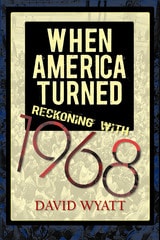
When America Turned
Reckoning with 1968David Wyatt
University of Massachusetts Press, 2013
Wyatt explores these questions as he retraces the decisive moments of 1968—the Tet Offensive, the McCarthy campaign, the assassinations of Martin Luther King Jr. and Robert Kennedy, the student revolt at Columbia, the "police riot" at the Democratic Convention in Chicago, Lyndon Johnson's capitulation, and Richard Nixon's ascendency to power. Seeking to recover the emotions surrounding these events as well as analyze their significance, Wyatt draws on the insights of what Michael Herr has called "straight" and "secret" histories. The first category consists of work by professional historians, traditional journalists, public figures, and political operatives, while the second includes the writings of novelists, poets, New Journalists, and memoirists.
The aim of this parallel approach is to uncover two kinds of truth: a "scholarly truth" grounded in the documented past and an "imaginative truth" that occupies the more ambiguous realm of meaning. Only by reckoning with both, Wyatt believes, can Americans come to understand the true legacy of the 1960s.
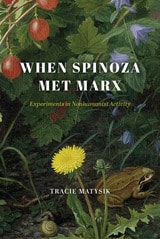
When Spinoza Met Marx
Experiments in Nonhumanist ActivityTracie Matysik
University of Chicago Press, 2022
Karl Marx was a fiery revolutionary theorist who heralded the imminent demise of capitalism, while Spinoza was a contemplative philosopher who preached rational understanding and voiced skepticism about open rebellion. Spinoza criticized all teleological ideas as anthropomorphic fantasies, while Marxism came to be associated expressly with teleological historical development. Why, then, were socialists of the German nineteenth century consistently drawn to Spinoza as their philosophical guide? Tracie Matysik shows how the metaphorical meeting of Spinoza and Marx arose out of an intellectual conundrum around the meaning of activity. How is it, exactly, that humans can be fully determined creatures but also able to change their world? To address this paradox, many revolutionary theorists came to think of activity in the sense of Spinoza—as relating. Matysik follows these Spinozist-socialist intellectual experiments as they unfolded across the nineteenth century, drawing lessons from them that will be meaningful for the contemporary world.
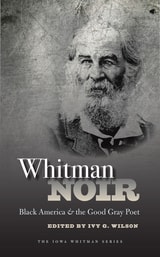
Whitman Noir
Black America and the Good Gray PoetIvy Wilson
University of Iowa Press, 2014
Whitman Noir: Black America and the Good Gray Poet explores the meaning of blacks and blackness in Whitman’s imagination and, equally significant, also illuminates the aura of Whitman in African American letters from Langston Hughes to June Jordan, Margaret Walker to Yusef Komunyakaa. The essays, which feature academic scholars and poets alike, address questions of literary history, the textual interplay between author and narrator, and race and poetic influence. The volume as a whole reveals the mutual engagement with a matrix of shared ideas, contradictions, and languages to expose how Whitman influenced African American literary production as well as how African American Studies brings to bear new questions and concerns for evaluating Whitman.
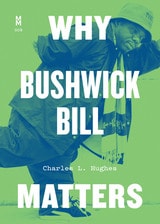
Why Bushwick Bill Matters
By Charles L. Hughes
University of Texas Press, 2021
In 1989 the Geto Boys released a blistering track, “Size Ain’t Shit,” that paid tribute to the group’s member Bushwick Bill. Born with dwarfism, Bill was one of the few visibly disabled musicians to achieve widespread fame and one of the even fewer to address disability in a direct, sustained manner. Initially hired as a dancer, Bill became central to the Geto Boys as the Houston crew became one of hip-hop’s most important groups.
Why Bushwick Bill Matters chronicles this crucial artist and explores what he reveals about the relationships among race, sex, and disability in pop music. Charles L. Hughes examines Bill's recordings and videos (both with the Geto Boys and solo), from the horror-comic persona of “Chuckie” to vulnerable verses in songs such as “Mind Playing Tricks On Me,” to discuss his portrayals of dwarfism, addiction, and mental illness. Hughes also explores Bill’s importance to his era and to the longer history of disability in music. A complex figure, Bill exposed the truths of a racist and ableist society even as his violent and provocative lyrics put him in the middle of debates over censorship and misogyny. Confrontational and controversial, Bushwick Bill left a massive legacy as he rhymed and swaggered through an often-inaccessible world.
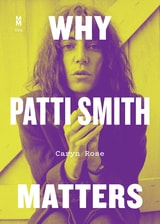
Why Patti Smith Matters
Caryn Rose
University of Texas Press, 2022
Patti Smith arrived in New York City at the end of the Age of Aquarius in search of work and purpose. What she found—what she fostered—was a cultural revolution. Through her poetry, her songs, her unapologetic vocal power, and her very presence as a woman fronting a rock band, she kicked open a door that countless others walked through. No other musician has better embodied the “nothing-to-hide” rawness of punk, nor has any other done more to nurture a place in society for misfits of every stripe.
Why Patti Smith Matters is the first book about the iconic artist written by a woman. The veteran music journalist Caryn Rose contextualizes Smith’s creative work, her influence, and her wide-ranging and still-evolving impact on rock and roll, visual art, and the written word. Rose goes deep into Smith’s oeuvre, from her first album, Horses, to acclaimed memoirs operating at a surprising remove from her music. The portrait of a ceaseless inventor, Why Patti Smith Matters rescues punk’s poet laureate from “strong woman” clichés. Of course Smith is strong. She is also a nuanced thinker. A maker of beautiful and challenging things. A transformative artist who has not simply entertained but also empowered millions.
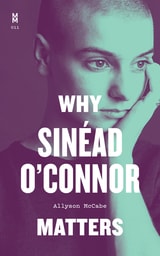
Why Sinéad O'Connor Matters
Allyson McCabe
University of Texas Press, 2023
A stirring defense of Sinéad O’Connor’s music and activism, and an indictment of the culture that cancelled her.
In 1990, Sinéad O’Connor’s video for “Nothing Compares 2 U” turned her into a superstar. Two years later, an appearance on Saturday Night Live turned her into a scandal. For many people—including, for years, the author—what they knew of O’Connor stopped there. Allyson McCabe believes it’s time to reassess our old judgments about Sinéad O’Connor and to expose the machinery that built her up and knocked her down.
Addressing triumph and struggle, sound and story, Why Sinéad O’Connor Matters argues that its subject has been repeatedly manipulated and misunderstood by a culture that is often hostile to women who speak their minds (in O’Connor’s case, by shaving her head, championing rappers, and tearing up a picture of the pope on live television). McCabe details O’Connor’s childhood abuse, her initial success, and the backlash against her radical politics without shying away from the difficult issues her career raises. She compares O’Connor to Madonna, another superstar who challenged the Catholic Church, and Prince, who wrote her biggest hit and allegedly assaulted her. A journalist herself, McCabe exposes how the media distorts not only how we see O’Connor but how we see ourselves, and she weighs the risks of telling a story that hits close to home.
In an era when popular understanding of mental health has improved and the public eagerly celebrates feminist struggles of the past, it can be easy to forget how O’Connor suffered for being herself. This is the book her admirers and defenders have been waiting for.
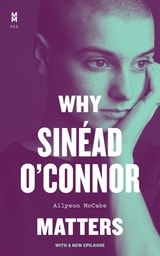
Why Sinéad O'Connor Matters
Allyson McCabe
University of Texas Press, 2023
A stirring defense of Sinéad O’Connor’s music and activism, and an indictment of the culture that cancelled her.
In 1990, Sinéad O’Connor’s video for “Nothing Compares 2 U” turned her into a superstar. Two years later, an appearance on Saturday Night Live turned her into a scandal. For many people—including, for years, the author—what they knew of O’Connor stopped there. Allyson McCabe believes it’s time to reassess our old judgments about Sinéad O’Connor and to expose the machinery that built her up and knocked her down.
Addressing triumph and struggle, sound and story, Why Sinéad O’Connor Matters argues that its subject has been repeatedly manipulated and misunderstood by a culture that is often hostile to women who speak their minds (in O’Connor’s case, by shaving her head, championing rappers, and tearing up a picture of the pope on live television). McCabe details O’Connor’s childhood abuse, her initial success, and the backlash against her radical politics without shying away from the difficult issues her career raises. She compares O’Connor to Madonna, another superstar who challenged the Catholic Church, and Prince, who wrote her biggest hit and allegedly assaulted her. A journalist herself, McCabe exposes how the media distorts not only how we see O’Connor but how we see ourselves, and she weighs the risks of telling a story that hits close to home.
In an era when popular understanding of mental health has improved and the public eagerly celebrates feminist struggles of the past, it can be easy to forget how O’Connor suffered for being herself. This is the book her admirers and defenders have been waiting for.

Why We Can't Have Nice Things
Social Media’s Influence on Fashion, Ethics, and PropertyMinh-Ha T. Pham
Duke University Press, 2022
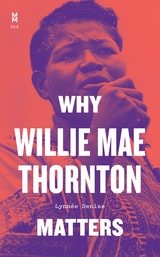
Why Willie Mae Thornton Matters
Lynnée Denise
University of Texas Press, 2023
Finalist, 2024 Lesbian Memoir/Biography, Lambda Literary Award for Arts and Culture
Winner — Walter & Lillian Lowenfels Criticism Award, 45th Annual American Book Awards, Before Columbus Foundation
A queer, Black “biography in essays” about the performer who gave us “Hound Dog,” “Ball and Chain,” and other songs that changed the course of American music.
Born in Alabama in 1926, raised in the church, appropriated by white performers, buried in an indigent’s grave—Willie Mae “Big Mama” Thornton's life events epitomize the blues—but Lynnée Denise pushes past the stereotypes to read Thornton’s life through a Black, queer, feminist lens and reveal an artist who was an innovator across her four-decade-long career.
Why Willie Mae Thornton Matters “samples” elements of Thornton’s art—and, occasionally, the author’s own story—to create “a biography in essays” that explores the life of its subject as a DJ might dig through a crate of records. Denise connects Thornton’s vaudevillesque performances in Sammy Green’s Hot Harlem Revue to the vocal improvisations that made “Hound Dog” a hit for Peacock Records (and later for Elvis Presley), injecting music criticism into what’s often framed as a cautionary tale of record-industry racism. She interprets Thornton’s performing in men’s suits as both a sly, Little Richard–like queering of the Chitlin Circuit and a simple preference for pants over dresses that didn’t have a pocket for her harmonica. Most radical of all, she refers to her subject by her given name rather than "Big Mama," a nickname bestowed upon her by a white man. It's a deliberate and crucial act of reclamation, because in the name of Willie Mae Thornton is the sound of Black musical resilience.
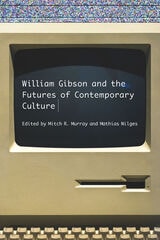
William Gibson and the Future of Contemporary Culture
Mitch R. Murray and Mathias Nilges
University of Iowa Press, 2021
In the 1970s and 80s, Gibson, the “Godfather of Cyberpunk,” rejuvenated science fiction. In groundbreaking works such as Neuromancer, which changed science fiction as we knew it, Gibson provided us with a language and imaginary through which it became possible to make sense of the newly emerging world of globalization and the digital and media age. Ever since, Gibson’s reformulation of science fiction has provided us not just with radically innovative visions of the future but indeed with trenchant analyses of our historical present and of the emergence and exhaustion of possible futures.
Contributors: Maria Alberto, Andrew M. Butler, Amy J. Elias, Christian Haines, Kylie Korsnack, Mathias Nilges, Malka Older, Aron Pease, Lisa Swanstrom, Takayuki Tatsumi, Sherryl Vint, Phillip E. Wegner, Roger Whitson, Charles Yu
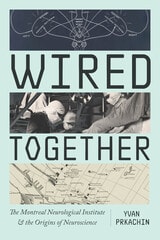
Wired Together
The Montreal Neurological Institute and the Origins of NeuroscienceYvan Prkachin
University of Chicago Press, 2026
Wired Together explains the rise of neuroscience by tracing the history of the Montreal Neurological Institute (MNI) and the men and women who transformed it into neuroscience’s most innovative and productive research site. Opened by neurosurgeon Wilder Penfield in 1934, the MNI pioneered the surgical treatment of epilepsy and transformed the operating theater into a new kind of scientific laboratory for investigating the functions of the brain. But more than that, the MNI became a crucial site for forming new interdisciplinary practices. These involved, as Yvan Prkachin puts it, wiring together new assemblies of physicians, surgeons, and scientists into a growing network that made possible the emergence of an interdisciplinary science of the brain.
Wired Together also traces how the MNI and its network of scientists spread this new interdisciplinary neuroscience to the rest of the world. Prkachin uncovers the surprising history of some of the most important neuroscientific organizations, discoveries, theories, and instruments from their beginnings in Montreal through the complex international networks of the post-war sciences. In doing so, he tells the stories of the most crucial and least understood characters from early neuroscience—such as Brenda Milner, Donald Hebb, Herbert Jasper, Molly Harrower, and David Hubel—as well as the surprising origins of scientific practices and ideas like sensory deprivation, multiple forms of memory, and artificial neural networks.
Within Reason
A Liberal Public Health for an Illiberal TimeSandro Galea
University of Chicago Press, 2023
A provocative chronicle of how US public health has strayed from its liberal roots.
The Covid-19 response was a crucible of politics and public health—a volatile combination that produced predictably bad results. As scientific expertise became entangled with political motivations, the public-health establishment found itself mired in political encampment.
It was, as Sandro Galea argues, a crisis of liberalism: a retreat from the principles of free speech, open debate, and the pursuit of knowledge through reasoned inquiry that should inform the work of public health.
Across fifty essays, Within Reason chronicles how public health became enmeshed in the insidious social trends that accelerated under Covid-19. Galea challenges this intellectual drift towards intolerance and absolutism while showing how similar regressions from reason undermined social progress during earlier eras. Within Reason builds an incisive case for a return to critical, open inquiry as a guiding principle for the future public health we want—and a future we must work to protect.
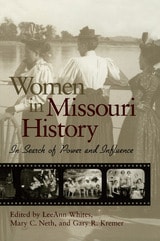
Women in Missouri History
In Search of Power and InfluenceEdited by LeeAnn Whites, Mary C. Neth, & Gary R. Kremer
University of Missouri Press, 2004
Women in Missouri History is an exceptional collection of essays surveying the history of women in the state of Missouri from the period of colonial settlement through the mid-twentieth century. The women featured in these essays come from various ethnic, economic, and racial groups, from both urban and rural areas, and from all over the state. The authors effectively tell these women’s stories through biographies and through techniques of social history, allowing the reader to learn not only about the women’s lives individually, but also about how groups of “ordinary” women shaped the history of the state.
The essays in this collection address questions that are at the center of current developments in the field of women’s history but are written in a manner that makes them accessible to general readers. Providing an excellent general overview of the history of women in Missouri, this collection makes a valuable contribution to a better understanding of the state’s past.
Word Toys
Poetry and TechnicsBrian Kim Stefans
University of Alabama Press, 2017
With the ascent of digital culture, new forms of literature and literary production are thriving that include multimedia, networked, conceptual, and other as-yet-unnamed genres while traditional genres and media—the lyric, the novel, the book—have been transformed. Word Toys: Poetry and Technics is an engaging and thought-provoking volume that speculates on a range of poetic, novelistic, and programmed works that lie beyond the language of the literary and which views them instead as technical objects.
Brian Kim Stefans considers the problems that arise when discussing these progressive texts in relation to more traditional print-based poetic texts. He questions the influence of game theory and digital humanities rhetoric on poetic production, and how non-digital works, such as contemporary works of lyric poetry, are influenced by the recent ubiquity of social media, the power of search engines, and the public perceptions of language in a time of nearly universal surveillance.
Word Toys offers new readings of canonical avant-garde writers such as Ezra Pound and Charles Olson, major successors such as Charles Bernstein, Alice Notley, and Wanda Coleman, mixed-genre artists including Caroline Bergvall, Tan Lin, and William Poundstone, and lyric poets such as Harryette Mullen and Ben Lerner. Writers that trouble the poetry/science divide such as Christian Bök, and novelists who have embraced digital technology such as Mark Z. Danielewski and the elusive Toadex Hobogrammathon, anchor reflections on the nature of creativity in a world where authors collaborate, even if unwittingly, with machines and networks. In addition, Stefans names provocative new genres—among them the nearly formless “undigest” and the transpacific “miscegenated script”—arguing by example that interdisciplinary discourse is crucial to the development of scholarship about experimental work.
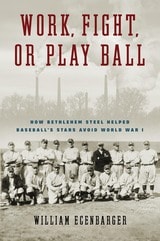
Work, Fight, or Play Ball
How Bethlehem Steel Helped Baseball's Stars Avoid World War IEcenbarger, William
Temple University Press, 2024
Some players used the steel mill and shipyard leagues to avoid wartime military duty, irking Major League owners, who saw their rosters dwindling. Bethlehem Steel President Charles Schwab (no relation to the financier) saw the league as a means to stave off employee and union organizing. Most fans loudly criticized the ballplayers, but nevertheless showed up to watch the action on the diamond.
Ecenbarger traces the 1918 Steel League’s season and compares the fates of the players who defected to industry or continued to play stateside with the travails of the Major Leaguers, such as Christy Mathewson, Ty Cobb, and Grover Cleveland Alexander, who served during the war.
Work, Fight, or Play Ball reveals the home field advantage brought on by the war, which allowed companies to profit from Major League players.
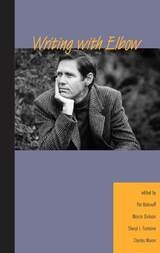
Writing With Elbow
edited by Pat Belanoff, Marcia Dickson, Sheryl I. Fontaine, & Charles Moran
Utah State University Press, 2002
Writing with Elbow is a must-read collection for composition scholars, teachers, English educationists, and graduate students.
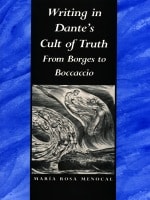
Writing in Dante's Cult of Truth
From Borges to BocaccioMaría Rosa Menocal
Duke University Press, 1991
Beginning with a reading of La vita nuova and the Commedia, this literary history of poetic literary histories explores the Dantean poetic experience as it has been limited and rewritten by later poets, particularly Petrarch, Boccaccio, Borges, Pound, Eliot, and the all but forgotten Silvio Pellico, author of Le mie prigioni. By blending discussions of Dante’s own marriage of literature and literary history with those investigations into the imitative qualities of later works, Writing in Dante’s Cult of Truth presents an intertextual literary history, one which seeks to maintain the uncanniness of literature, while imagining history to be neither linear nor clearly distinguishable from literature itself.