Results by title
58 books match the query 'Intellectual property' and 2 start with w
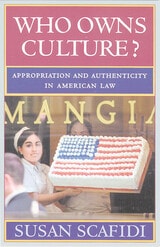
Who Owns Culture?
Appropriation and Authenticity in American LawScafidi, Susan
Rutgers University Press, 2005
It is not uncommon for white suburban youths to perform rap music, for New York fashion designers to ransack the world's closets for inspiration, or for Euro-American authors to adopt the voice of a geisha or shaman. But who really owns these art forms? Is it the community in which they were originally generated, or the culture that has absorbed them?
While claims of authenticity or quality may prompt some consumers to seek cultural products at their source, the communities of origin are generally unable to exclude copyists through legal action. Like other works of unincorporated group authorship, cultural products lack protection under our system of intellectual property law. But is this legal vacuum an injustice, the lifeblood of American culture, a historical oversight, a result of administrative incapacity, or all of the above?
Who Owns Culture? offers the first comprehensive analysis of cultural authorship and appropriation within American law. From indigenous art to Linux, Susan Scafidi takes the reader on a tour of the no-man's-land between law and culture, pausing to ask: What prompts us to offer legal protection to works of literature, but not folklore? What does it mean for a creation to belong to a community, especially a diffuse or fractured one? And is our national culture the product of Yankee ingenuity or cultural kleptomania?
Providing new insights to communal authorship, cultural appropriation, intellectual property law, and the formation of American culture, this innovative and accessible guide greatly enriches future legal understanding of cultural production.
[more]
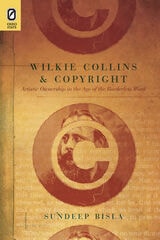
Wilkie Collins and Copyright
Sundeep Bisla
The Ohio State University Press, 2013
In the works and letters of his later years, Wilkie Collins continually expressed his displeasure over copyright violations. Wilkie Collins and Copyright: Artistic Ownership in the Age of the Borderless Word by Sundeep Bisla asks whether that discontent might not also have affected the composition of Collins’s major early works of the 1850s and 60s. Bisla’s investigation into this question, surprisingly, does not find an uncomplicated author uncomplicatedly launched on a defense of what he believes to be rightfully his. Instead, Bisla finds an author locked in fierce negotiation with the theoretical underpinnings of his medium, the written word, underpinnings best delineated by the twentieth-century deconstructionist Jacques Derrida. Collins’s discomfort with copyright violation comes to be in tension with his budding understanding of the paradoxical nature of the “iterability” of the word, a nature presenting itself as a conflict between the settling and breaking manifestations of linguistic repetition. In his efforts at resolving this paradox, Collins adopts a mechanism of recursive self-reflexivity through which each story reflects upon itself to a more fundamental extent than had its predecessor. This self-reflexive exploration has significant consequences for the author’s own iterability-menaced subjectivity, a striking example of which can be seen in the fact that the name being sought in Collins’s last masterpiece, The Moonstone, will end up being “MY OWN NAME” — in other words, “WILKIE COLLINS.”
[more]