Results by title
87 books match the query 'Iraq' and 7 start with w
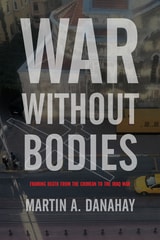
War without Bodies
Framing Death from the Crimean to the Iraq WarMartin Danahay
Rutgers University Press, 2022
Analyzing poetry, photographs, video and video games the book illustrates the ways in which war was framed in these different historical contexts. It examines the cultural assumptions that influenced the reception of images of war and discusses how death and damage to bodies was made acceptable to the public. War Without Bodies aims to heighten awareness of how acceptance of war is coded into texts and how active resistance to such hidden messages can help prevent future unnecessary wars.
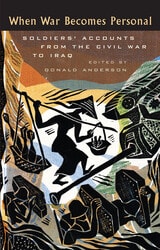
When War Becomes Personal
Soldiers' Accounts from the Civil War to IraqDonald Anderson
University of Iowa Press, 2008
The thirteen essays in When War Becomes Personal tell the enduring truths of battle, stripping away much of the romance, myth, and fantasy.
Soldiers more than anyone know what they are capable of destroying; when they write about war, they are trying to preserve the world.
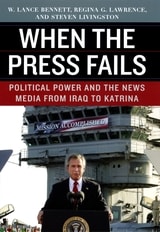
When the Press Fails
Political Power and the News Media from Iraq to KatrinaW. Lance Bennett, Regina G. Lawrence, and Steven Livingston
University of Chicago Press, 2007
“The hand-in-glove relationship of the U.S. media with the White House is mercilessly exposed in this determined and disheartening study that repeatedly reveals how the press has toed the official line at those moments when its independence was most needed.”—George Pendle, Financial Times
“Bennett, Lawrence, and Livingston are indisputably right about the news media’s dereliction in covering the administration’s campaign to take the nation to war against Iraq.”—Don Wycliff, Chicago Tribune
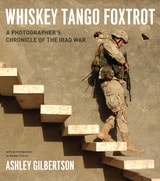
Whiskey Tango Foxtrot
A Photographer's Chronicle of the Iraq WarAshley Gilbertson
University of Chicago Press, 2007
Whiskey Tango Foxtrot gathers the best of Gilbertson’s photographs, chronicling America’s early battles in Iraq, the initial occupation of Baghdad, the insurgency that erupted shortly afterward, the dramatic battle to overtake Falluja, and ultimately, the country’s first national elections. No Western photojournalist has done as much sustained work in occupied Iraq as Gilbertson, and this wide-ranging treatment of the war from the viewpoint of a photographer is the first of its kind. Accompanying each section of the book is a personal account of Gilbertson’s experiences covering the conflict. Throughout, he conveys the exhilaration and terror of photographing war, as well as the challenges of photojournalism in our age of embedded reporting. But ultimately, and just as importantly, Whiskey Tango Foxtrot tells the story of Gilbertson’s own journey from hard-drinking bravado to the grave realism of a scarred survivor. Here he struggles with guilt over the death of a marine escort, tells candidly of his own experience with post-traumatic stress, and grapples with the reality that Iraq—despite the sacrifice in Iraqi and American lives—has descended into a civil war with no end in sight.
A searing account of the American experience in Iraq, Whiskey Tango Foxtrot is sure to become one of the classic war photography books of our time.
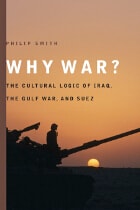
Why War?
The Cultural Logic of Iraq, the Gulf War, and SuezPhilip Smith
University of Chicago Press, 2005
Comprised of case studies of the War in Iraq, the Gulf War, and the Suez Crisis, Why War? decodes the cultural logic of the narratives that justify military action. Each nation, Smith argues, makes use of binary codes—good and evil, sacred and profane, rational and irrational, to name a few. These codes, in the hands of political leaders, activists, and the media, are deployed within four different types of narratives—mundane, tragic, romantic, or apocalyptic. With this cultural system, Smith is able to radically recast our "war stories" and show how nations can have vastly different understandings of crises as each identifies the relevant protagonists and antagonists, objects of struggle, and threats and dangers.
The large-scale sacrifice of human lives necessary in modern war, according to Smith, requires an apocalyptic vision of world events. In the case of the War in Iraq, for example, he argues that the United States and Britain replicated a narrative of impending global doom from the Gulf War. But in their apocalyptic account they mistakenly made the now seemingly toothless Saddam Hussein once again a symbol of evil by writing him into the story alongside al Qaeda, resulting in the war's contestation in the United States, Britain, and abroad.
Offering an innovative approach to understanding how major wars are packaged, sold, and understood, Why War? will be applauded by anyone with an interest in military history, political science, cultural studies, and communication.
Women of Assur and Kanesh
Texts from the Archives of Assyrian MerchantsCécile Michel
SBL Press, 2020
Vivid sources for reconstructing the lives of Assyrian women
In this collection Cécile Michel translates into English texts related to wives and daughters of merchants and to their activities in nineteenth-century BCE Aššur and Kaneš. Discovered in excavations of the Old Assyrian private archives at Kültepe (ancient Kaneš) in Central Anatolia, these letters sent from Aššur reflect the preeminent role of Assyrian women within the family and in the domestic economy, as well as their contribution to long-distance trade. Contracts and other legal texts excavated at Kültepe attest to Assyrian and Anatolian women as parties in marriage and divorce contracts, last wills, loans, and purchase contracts. These unique finds paint a vivid portrait of women who aspire to be socially respected and provide a rare opportunity to reconstruct their daily lives as both businesswomen and housewives.
Features
- More than three hundred letters and documents transliterated and translated with commentary
- An overview of the study of women and gender in Assyriology
- A reconstruction of women's roles as textile producers, investors, and creditors within a long-distance commercial network
Cécile Michel is Senior Researcher at the National Center for Scientific Research (CNRS, France) and Professor at Hamburg University (Germany). She is a member of the international group of scholars in charge of the decipherment of the 23,000 tablets found at Kültepe (ancient Kaneš) and of the Kültepe archaeological team. She is the coeditor of and contributor to The Role of Women in Work and Society in the Ancient Near East (2016), Textile Terminologies from the Orient to the Mediterranean and Europe, 1000 BC to 1000 AD (2017), and Mathematics, Administrative and Economic Activities in Ancient Worlds (2020).
Writing, Law, and Kingship in Old Babylonian Mesopotamia
Dominique Charpin
University of Chicago Press, 2010
Ancient Mesopotamia, the fertile crescent between the Tigris and Euphrates rivers in what is now western Iraq and eastern Syria, is considered to be the cradle of civilization—home of the Babylonian and Assyrian empires, as well as the great Code of Hammurabi. The Code was only part of a rich juridical culture from 2200–1600 BCE that saw the invention of writing and the development of its relationship to law, among other remarkable firsts.
Though ancient history offers inexhaustible riches, Dominique Charpin focuses here on the legal systems of Old Babylonian Mesopotamia and offers considerable insight into how writing and the law evolved together to forge the principles of authority, precedent, and documentation that dominate us to this day. As legal codes throughout the region evolved through advances in cuneiform writing, kings and governments were able to stabilize their control over distant realms and impose a common language—which gave rise to complex social systems overseen by magistrates, judges, and scribes that eventually became the vast empires of history books. Sure to attract any reader with an interest in the ancient Near East, as well as rhetoric, legal history, and classical studies, this book is an innovative account of the intertwined histories of law and language.