Results by title
496 books match the query 'Jewish' and 14 start with w
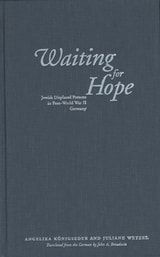
Waiting for Hope
Jewish Displaced Persons in Post-World War II GermanyAngelika Konigseder
Northwestern University Press, 2001
Starting with the discovery of death camps by Allied forces, Königseder and Wetzel describe the inadequate preparations made for the survivors. The soldiers were ill equipped to deal with the physical wreckage and mental anguish of their charges, but American rabbis soon arrived to perform invaluable work helping the survivors cope. The historians also devote attention to autonomous Jewish life in and near the camps: theater groups and orchestras prospered, schools were founded, a tuberculosis hospital and clinic for DPs was established, and underground organizations handled illegal immigration to Israel and trained soldiers to fight in Palestine.
Drawing on original documents and the work of other historians, Waiting for Hope sheds light on a largely unknown period in postwar Jewish history and shows that the suffering of the survivors did not end with the war.
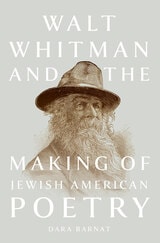
Walt Whitman and the Making of Jewish American Poetry
Dara Barnat
University of Iowa Press, 2023
Dara Barnat presents a genealogy of Jewish American poets in dialogue with Whitman, and with each other, and reveals how the lineage of Jewish American poets responding to Whitman extends far beyond the likes of Allen Ginsberg. From Emma Lazarus and Adah Isaacs Menken, through twentieth-century poets such as Charles Reznikoff, Karl Shapiro, Kenneth Koch, Muriel Rukeyser, Adrienne Rich, Marge Piercy, Alicia Suskin Ostriker, and Gerald Stern, this book demonstrates that Whitman has been adopted by Jewish American poets as a liberal symbol against exclusionary and anti-Semitic elements in high modernist literary culture. The turn to Whitman serves as a mode of exploring Jewish and American identity.
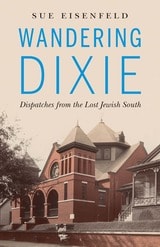
Wandering Dixie
Dispatches from the Lost Jewish SouthSue Eisenfeld
The Ohio State University Press, 2020
From South Carolina to Arkansas, she explores the small towns where Jewish people once lived and thrived. She visits the site of her distant cousin and civil rights activist Andrew Goodman’s murder during 1964’s Freedom Summer. She also talks with the only Jews remaining in some of the “lost” places, from Selma to the Mississippi Delta to Natchitoches, and visits areas with no Jewish community left—except for an old temple or overgrown cemetery. Eisenfeld follows her curiosity about Jewish Confederates and casts an unflinching eye on early southern Jews’ participation in slavery. Her travels become a journey of revelation about our nation’s fraught history and a personal reckoning with the true nature of America.
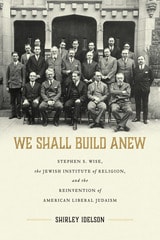
We Shall Build Anew
Stephen S. Wise, the Jewish Institute of Religion, and the Reinvention of American Liberal JudaismShirley Idelson
University of Alabama Press, 2022
Charting the reinvention of American Liberal Judaism through visionary leadership.
In 1922, Rabbi Stephen S. Wise, a leader of the Zionist movement, established the Jewish Institute of Religion (JIR), a nondenominational rabbinical seminary in New York City. Having already founded the thriving Free Synagogue movement and the American Jewish Congress, he intended to revolutionize American liberal Judaism. Wise believed mainstream American Jewish institutions had become outdated, and he championed a progressive Jewish nationalism that would fight alongside America’s leading proponents of social and economic justice.
We Shall Build Anew tells the little-known story of how Wise changed the trajectory of American Judaism for the next century. Through JIR, he trained a new cadre of young rabbis who shared his outlook, charged them with invigorating and reshaping Jewish life, and launched them into positions of leadership across the country. While Wise earned the ire of many mainstream Jewish leaders through his disregard for denominational distinctions, JIR became home to faculty and students of widely divergent religious and political viewpoints.
We Shall Build Anew is the first book dedicated exclusively to the history of the Jewish Institute of Religion. The story of Wise’s vision for American liberal Judaism is now more important than ever. As American Jewry becomes increasingly polarized around debates concerning religious doctrine as well as Zionism and Israel, the JIR model offers hope that progressives and conservatives, Zionists and non-Zionists, and Jews representing the full spectrum of religious life cannot only coexist but also work together in the name of a vibrant Judaism and a just and peaceful world.
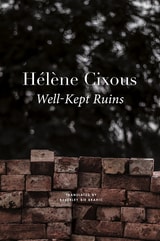
Well-Kept Ruins
Hélène Cixous
Seagull Books, 2022
In the Lower Saxony region of northwestern Germany sits the city of Osnabrück. This is where, in 1648, the Peace of Westphalia was signed, bringing the Thirty Years’ War and one of the most calamitous periods of European history to an end. But the city was later to witness another calamity.
Today, as one walks through Old Synagogue Street in a rich neighborhood of Osnabrück, one might miss noticing a pile of pale stones held together by chicken wire that sits between two fashionable homes. These are the well-kept ruins from behind which stares a gaping space—a place of memory and oblivion. Four polished plaques tell the tale of the horror-filled night of November 9, 1938—today known as Kristallnacht—when the synagogue that had stood on this spot was desecrated, looted, set on fire, and eventually demolished by Hitler’s forces. On the same day, ninety parishioners were imprisoned by the Gestapo and eventually sent to the Buchenwald concentration camp.
Osnabrück was also home to Eve Klein, a member of the city’s early-twentieth-century Jewish community and the mother of author Hélène Cixous. In Well-Kept Ruins, Cixous returns to the historic city in 2019 and reflects on the remains of the synagogue that “express the life lost, the life kept.” Walking the streets of the city, plumbing the depths of the past along with her own family’s history, looking deep into the future, and punctuating her poetic prose with haunting photographs, Cixous explores the ruins at the heart of humanity. Part memoir, part philosophical meditation, Well-Kept Ruins is a genre-defying and timely reflection of the contemporary human condition.
What History Tells
George L. Mosse and the Culture of Modern EuropeEdited by Stanley G. Payne, David J. Sorkin, and John S. Tortorice
University of Wisconsin Press, 2004
The contributors include Walter Laqueur, David Sabean, Johann Sommerville, Emilio Gentile, Roger Griffin, Saul Friedländer, Jay Winter, Rudy Koshar, Robert Nye, Janna Bourke, Shulamit Volkov, and Steven E. Aschheim.
What is Modern Israel?
Yakov M. Rabkin
Pluto Press, 2016
Drawing on many overlooked pages of history, including English, French, Hebrew, Yiddish and Russian sources, Yakov Rabkin shows that Zionism was conceived as a sharp break with Judaism and Jewish continuity. Israel’s past and present must be seen in the context of European ethnic nationalism, colonial expansion and geopolitical interests, rather than as an incarnation of Biblical prophecies or a culmination of Jewish history.
With Freedom in Our Ears
Histories of Jewish AnarchismEdited by Anna Elena Torres and Kenyon Zimmer
University of Illinois Press, 2023
Contributors bring to light the presence and persistence of Jewish anarchism throughout histories of radical labor, women’s studies, political theory, multilingual literature, and ethnic studies.
These essays reveal an ongoing engagement with non-Jewish radical cultures, including the translation practices of the Jewish anarchist press. Jewish anarchists drew from a matrix of secular, cultural, and religious influences, inventing new anarchist forms that ranged from mystical individualism to militantly atheist revolutionary cells.
With Freedom in Our Ears brings together more than a dozen scholars and translators to write the first collaborative history of international, multilingual, and transdisciplinary Jewish anarchism.
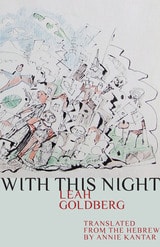
With This Night
By Leah Goldberg
University of Texas Press, 2011
When she arrived in Palestine in 1935 at the age of twenty-four, Leah Goldberg was already known as a significant emerging poet in contemporary Hebrew literature. Today, mention of her name is apt to evoke a nostalgic sigh among Israelis who have grown up hearing her poems read, quoted, recollected, and—having been set to some four hundred melodies—sung on the radio. In the wake of overwhelming new attention on Goldberg's work in Israel, With This Night makes available for the first time in English the final collection of poetry that Goldberg published during her lifetime.
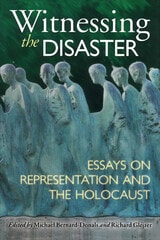
Witnessing the Disaster
Essays on Representation and the HolocaustEdited by Michael Bernard-Donals and Richard Glejzer
University of Wisconsin Press, 2003
These essayists aim to move past the notion that the Holocaust as an event defies representation. They look at specific cases of Holocaust representation and consider their effect, their structure, their authenticity, and the kind of knowledge they produce. Taken together they consider the tension between history and memory, the vexed problem of eyewitness testimony and its status as evidence, and the ethical imperatives of Holocaust representation.
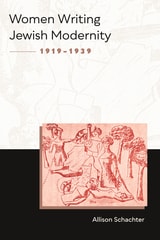
Women Writing Jewish Modernity, 1919–1939
Allison Schachter
Northwestern University Press, 2022
In Women Writing Jewish Modernity, 1919–1939, Allison Schachter rewrites Jewish literary modernity from the point of view of women. Focusing on works by interwar Hebrew and Yiddish writers, Schachter illuminates how women writers embraced the transgressive potential of prose fiction to challenge the patriarchal norms of Jewish textual authority and reconceptualize Jewish cultural belonging.
Born in the former Russian and Austro‑Hungarian Empires and writing from their homes in New York, Poland, and Mandatory Palestine, the authors central to this book—Fradl Shtok, Dvora Baron, Elisheva Bikhovsky, Leah Goldberg, and Debora Vogel—seized on the freedoms of social revolution to reimagine Jewish culture beyond the traditionally male world of Jewish letters. The societies they lived in devalued women’s labor and denied them support for their work. In response, their writing challenged the social hierarchies that excluded them as women and as Jews. As she reads these women, Schachter upends the idea that literary modernity was a conversation among men about women, with a few women writers listening in. Women writers revolutionized the very terms of Jewish fiction at a pivotal moment in Jewish history, transcending the boundaries of Jewish minority identities. Schachter tells their story and in so doing calls for a new way of thinking about Jewish cultural modernity.
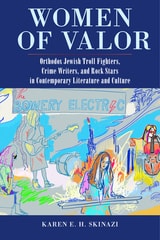
Women of Valor
Orthodox Jewish Troll Fighters, Crime Writers, and Rock Stars in Contemporary Literature and CultureKaren E. H. Skinazi
Rutgers University Press, 2018
Media portrayals of Orthodox Jewish women frequently depict powerless, silent individuals who are at best naive to live an Orthodox lifestyle, and who are at worst, coerced into it. Karen E. H. Skinazi delves beyond this stereotype in Women of Valor to identify a powerful tradition of feminist literary portrayals of Orthodox women, often created by Orthodox women themselves. She examines Orthodox women as they appear in memoirs, comics, novels, and movies, and speaks with the authors, filmmakers, and musicians who create these representations. Throughout the work, Skinazi threads lines from the poem “Eshes Chayil,” the Biblical description of an Orthodox “Woman of Valor.” This proverb unites Orthodoxy and feminism in a complex relationship, where Orthodox women continuously question, challenge, and negotiate Orthodox and feminist values. Ultimately, these women create paths that unite their work, passions, and families under the framework of an “Eshes Chayil,” a woman who situates religious conviction within her own power.
Writing on Water
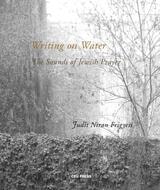
The Sounds of Jewish PrayerJudit Niran Frigyesi
Central European University Press, 2018
Writing on Water grasps the phenomenon of sound in prayer, that is, a meaning in sounds and soundscapes, and a musical essence in the act of praying.
The impetus for the book arose from the author’s fieldwork among traditional Jews during the era of communism in Budapest and Prague. In that period the Jewish religion and Jewishness in general were supressed and rituals became semi-secret and turned inward. The book is a witness to these communities and their rituals, but it goes beyond documentation. The uniqueness of the sounds of the rituals compelled the author to try to comprehend how melodies and soundscapes became the sustaining/protective environment, as well as the vehicle, for the expression of a world-orientation—in a situation where open discourse was inconceivable.
The book is based on extensive interviews, musical recordings, photographs and scholarly analyses. It is unique in its choice of communities, its wealth of original documents, and its novel interpretation of sound.
Writing on Water is creative non-fiction. The presentation is evocative and poetic, but at the same time it transmits knowledge. The book can aid research and serve in courses in philosophy, religion, music, ethnomusicology, anthropology, aesthetics, Jewish studies, folklore, oral history, and performance studies. It is also a work of art and literature.
Written for the Drawer
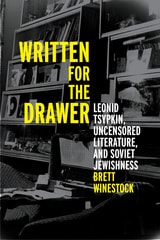
Leonid Tsypkin, Uncensored Literature, and Soviet JewishnessBrett Winestock
University of Wisconsin Press, 2024
Tsypkin’s autobiographical writing explored the impossibility of being both a Russian writer and a Soviet Jew, employing indirection and referentiality. In the first book-length appraisal of Tsypkin and his work, Brett Winestock considers Tsypkin’s fiction as part of a transnational literary response to the horrors of the twentieth century, a reception that helps explain his much-belated international readership. Through close readings of Tsypkin’s work in the context of late-Soviet cultural worlds, Winestock makes an important contribution to studies of Jewish Soviet writing and identity.