Results by title
169 books match the query 'Juvenile Nonfiction' and 10 start with w
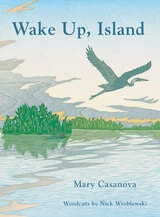
Wake Up, Island
Mary Casanova
University of Minnesota Press, 2016
Wake up, little one, a soft voice beckons, the world around you is already stirring. As Wake Up, Island gently rouses the sleepy child, it summons a world of nature coming to life on a summer island in the magical North Woods. Sunlit fingers touch the shores, pine trees stretch their limbs, and lichen warms on ancient rock. Doe and fawn rise from their grass bed and pearls of dew bead a spider’s finely woven web. Mallards skim the water’s surface. Ravens perch and gargle greetings, chickadees call dee, dee, dee, and a heron swoops—minnows flee! The moose and her calf wade, munching on plants. The red squirrel chatters. The black bear lazily scratches her back against a tree.
Conjuring the morning life around a cabin fragrant with berry pancakes, this timeless book wakens the child in every reader to the wonders of nature that greet every new day in the charmed world of a northern woodland island.
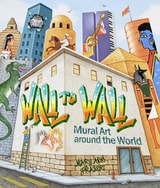
Wall to Wall
Mural Art around the WorldMary Ann Fraser
J. Paul Getty Trust, The, 2024
People have been drawing on walls since ancient times. They do it to create beauty, to tell a story, to make a statement, or just to say, “I was here.” You can find wall art in a remote cave in Patagonia and a desert castle in Jordan, a kingly palace in the Republic of Benin and the National Palace of Mexico, a miles-long flood channel in Los Angeles and a sky-high rooftop in Norway.
In Wall to Wall, award-winning author, illustrator, and muralist Mary Ann Fraser takes readers on a worldwide journey through time, stopping to see amazing mural art along the way. Stunning color illustrations and fascinating photographs illuminate both famous and little-known examples, and lighthearted text tells engaging stories about the people who inspired or created them. A glossary, selected bibliography, and section about the preservation of murals conclude the book. No reader will ever again pass by a mural—whether in a historic building, a museum, or out on the street—without stopping to take a closer look.
Ages ten to fourteen
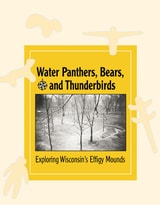
Water Panthers, Bears, and Thunderbirds
Exploring Wisconsin's Effigy MoundsBobbie Malone and Amy Rosebrough
Wisconsin Historical Society Press, 2003
Based on recent archaeological interpretation, this standards-based resource enriches material covered in Native People of Wisconsin. Water Panthers, Bears, and Thunderbirds introduces young readers to effigy mound sites in five southern Wisconsin counties. Suggested activities encourage students to graph, compare, contrast, and analyze the ways these mound groups vary from county to county.
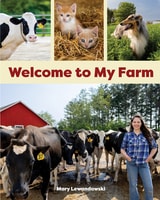
Welcome to My Farm
Mary Lewandowski
Wisconsin Historical Society Press, 2026
Mary Lewandowski helps her family at their dairy farm in Wisconsin. Her great-great-great-grandparents founded the farm more than a hundred years ago. Today, the farm has some fifty cows that must be fed, milked, and kept happy and healthy. Corn and alfalfa need to be planted and harvested for their feed. It’s all a lot of work for Mary, but she loves her cows, and they provide us with milk to drink, cheese and ice cream to eat, and many other delicious dairy treats.
Welcome to My Farm is a fun and illuminating look at farm life in the heart of America’s Dairyland. Aimed at young readers age four and up, the book shares fascinating facts about dairy cows and the crops that farmers grow. Presenting a day in the life of a small dairy farm, Welcome to My Farm reveals the many ways that Mary takes care of her cows and how farms help feed our communities. Readers will also meet cuddly kittens and Mary’s two collies, Buffy and Buddy!
Young readers will find the answers to many common dairy-farm questions, such as:
- How do you milk a cow?
- What types of food are made from cow’s milk?
- How much does a cow eat and drink in a day?
- How much does a calf weigh when it’s born?
- What types of crops do dairy farmers grow?
- What do farmers use tractors for?
- What happens in a silo?
Illustrated with dozens of color photos, Welcome to My Farm helps young readers understand and appreciate how dairy farms work and the central role that agriculture plays in the food we eat.
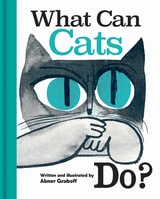
What Can Cats Do?
Abner Graboff
Bodleian Library Publishing, 2018
Abner Graboff combines the voice of childhood innocence with a wonderful sense of fun in his quirky book about the mysteries of cats and their secret lives, inspired by the Graboff family’s own beloved cat Tarzan. Told from the point of view of a young child, this whimsical tale is complemented by Graboff’s characteristically playful and bold illustrations.
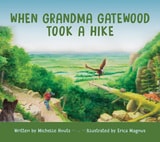
When Grandma Gatewood Took a Hike
Michelle Houts
Ohio University Press, 2016
It took her two tries, but in 1955, sixty-seven-year-old Emma “Grandma” Gatewood became the first woman to solo hike the entire length of the Appalachian Trail in one thru-hike. Gatewood, who left an abusive marriage after raising eleven children, has become a legend for those who hike the trail, and in her home state of Ohio, where she helped found the Buckeye Trail. In recent years, she has been the subject of a bestselling biography and a documentary film.
In When Grandma Gatewood Took a Hike, Michelle Houts brings us the first children’s book about her feat, which she accomplished without professional gear or even a tent. Houts chronicles the spirit of a seasoned outdoorswoman and mother of eleven whose grit and determination helped her to hike over two thousand miles. Erica Magnus’s vibrant illustrations capture the wild animals, people from all walks of life, and unexpected challenges that this strong-willed woman encountered on the journey she initially called a “lark.”
Children ages 4–10 will delight in this narrative nonfiction work as they accompany Emma Gatewood on the adventure of a lifetime and witness her transformation from grandmother to hiking legend, becoming “Grandma” to all.
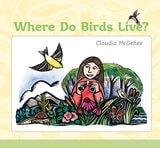
Where Do Birds Live?
Claudia McGehee
University of Iowa Press, 2010
Claudia McGehee brought the glory of the prairie to life in A Tallgrass Prairie Alphabet and explored the wonders of the woodlands in A Woodland Counting Book. Now this award-winning artist focuses on the birds of the United States, bringing children and their parents closer to the habitats and lives of birds from the Pacific coast to open rangeland to the cityscape of Manhattan.
McGehee introduces us to fourteen representative habitats, giving each its own double-page spread that features a signature bird. She devotes one page of each spread to depicting the bird in the full complexity of its complete habitat—at home in its environment with other animal companions—and the other page describes and illustrates its nesting, feeding, soaring, and paddling lifeways. Highlighting ideas for preserving and protecting each habitat and its inhabitants, McGehee also provides ways that children can make their own backyards safe havens for birdlife while they learn to enjoy the magic of birdwatching.
Claudia’s birds include bobolinks on the tallgrass prairie, common ravens in the Pacific rainforest, brown pelicans on barrier islands in the Gulf of Mexico, scarlet tanagers in the northwoods, red-cockaded woodpeckers in longleaf pine forests, greater roadrunners in the southwestern desert, and roseate spoonbills in red mangrove forests. Her energizing, engaging illustrations create worlds of vibrant color that ring with the calls and songs of birds across the panorama of American landscapes.
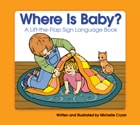
Where Is Baby?
A Lift-the-Flap Sign Language BookMichelle Cryan
Gallaudet University Press, 2007
Here’s a fun, interactive way to teach youngsters ages 1- 4 basic American Sign Language signs. Where Is Baby? A Lift-the-Flap Sign Language Book features 12 basic questions in ASL with English translations. Little ones can find the answer for each question by lifting the flap on the opposite page to reveal a charming, full-color illustration. The questions and answers engage children with everyday subjects of high interest to them: Where is the airplane, train, bug, cat, elephant, shoe, pizza, Mama, Daddy, sister, and of course, Baby.
By introducing young children to sign language, Where Is Baby? can help them strengthen their vocabulary, grammar, and other language skills while also allowing them to communicate their needs and feelings at an earlier age. This sturdy book offers an enjoyable, instructive way for parents, teachers, and other caregivers to begin reading and signing together with children at a wonderful age for learning.
Wittgenstein's Rhinoceros
Françoise Armengaud
Diaphanes, 2016
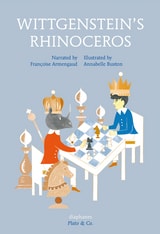
“Mister Wittgenstein! Stop looking for a horned beast in the middle of a Cambridge classroom!,” an exasperated Bertrand Russell commands his pupil. But the young Ludwig Wittgenstein knows that, just because we don’t see a rhinoceros, doesn’t mean one may not be hiding where we least expect it. When war breaks out in Europe, Ludwig is recruited for a top-secret mission. Alas, no one is able to make sense of rhino-loving philosopher’s notebooks. What could he possibly mean by so many seemingly nonsensical statements?
Plato & Co.’s clear approach and charming illustrations make this series the perfect addition to any little library.
Writing From The Heart
Young People Share Their WisdomPeggy Veljkovic
Templeton Press, 2000
Writing from the Heart offers us a unique window into what young people have learned about life. This collection of essays captures the values that matter most to teens—values such as love, perseverance, family, and helping others—in their own words. As the young writers reflect on their own experience, readers of all ages will be inspired by their wisdom and hope.