Results by title
100 books match the query 'Kings and rulers' and 3 start with w

Warriors Without War
Seminole Leadership in the Late Twentieth CenturyPatricia Riles Wickman
University of Alabama Press, 2012
Warriors Without War takes readers beneath the placid waters of the Seminole’s public image and into the fascinating depths of Seminole society and politics.

Water and Ritual
The Rise and Fall of Classic Maya RulersBy Lisa J. Lucero
University of Texas Press, 2006
In the southern Maya lowlands, rainfall provided the primary and, in some areas, the only source of water for people and crops. Classic Maya kings sponsored elaborate public rituals that affirmed their close ties to the supernatural world and their ability to intercede with deities and ancestors to ensure an adequate amount of rain, which was then stored to provide water during the four-to-five-month dry season. As long as the rains came, Maya kings supplied their subjects with water and exacted tribute in labor and goods in return. But when the rains failed at the end of the Classic period (AD 850-950), the Maya rulers lost both their claim to supernatural power and their temporal authority. Maya commoners continued to supplicate gods and ancestors for rain in household rituals, but they stopped paying tribute to rulers whom the gods had forsaken.
In this paradigm-shifting book, Lisa Lucero investigates the central role of water and ritual in the rise, dominance, and fall of Classic Maya rulers. She documents commoner, elite, and royal ritual histories in the southern Maya lowlands from the Late Preclassic through the Terminal Classic periods to show how elites and rulers gained political power through the public replication and elaboration of household-level rituals. At the same time, Lucero demonstrates that political power rested equally on material conditions that the Maya rulers could only partially control. Offering a new, more nuanced understanding of these dual bases of power, Lucero makes a compelling case for spiritual and material factors intermingling in the development and demise of Maya political complexity.
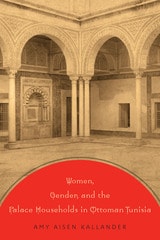
Women, Gender, and the Palace Households in Ottoman Tunisia
By Amy Aisen Kallander
University of Texas Press, 2013
In this first in-depth study of the ruling family of Tunisia in the eighteenth and nineteenth centuries, Kallander investigates the palace as a site of familial and political significance. Through extensive archival research, she elucidates the domestic economy of the palace as well as the changing relationship between the ruling family of Tunis and the government, thus revealing how the private space of the palace mirrored the public political space.
“Instead of viewing the period as merely a precursor to colonial occupation and the nation-state as emphasized in precolonial or nationalist histories, this narrative moves away from images of stagnation and dependency to insist upon dynamism,” Kallander explains. She delves deep into palace dynamics, comparing them to those of monarchies outside of the Ottoman Empire to find persuasive evidence of a global modernity. She demonstrates how upper-class Muslim women were active political players, exerting their power through displays of wealth such as consumerism and philanthropy. Ultimately, she creates a rich view of the Husaynid dynastic culture that will surprise many, and stimulate debate and further research among scholars of Ottoman Tunisia.