Results by title
135 books match the query 'Landscape' and 6 start with w

Walls
Enclosure and Ethics in the Modern LandscapeThomas Oles
University of Chicago Press, 2014
In Walls, Oles shows how our minds and our politics are shaped by–and shape–our divisions in the landscape. He traces the rich array of practices and meanings connected to the making and marking of boundaries across history and prehistory, and he describes how these practices have declined in recent centuries. The consequence, he argues, is all around us in the contemporary landscape, riven by walls shoddy in material and mean in spirit. Yet even today, Oles demonstrates, every wall remains potentially an opening, a stage, that critical place in the landscape where people present themselves and define their obligations to one another. In an evocative epilogue, Oles brings to life a society of productive, intentional, and ethical enclosure—one that will leave readers more hopeful about the divided landscapes of the future.
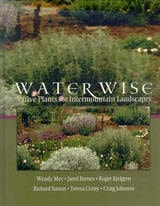
Water Wise
Native Plants for Intermountain LandscapesWendy Mee, Jared Barnes, Roger Kjelgren, Richard Sutton, Teresa Cerny, and Craig Johnson
Utah State University Press, 2003
Today, native plants and water conservation are subjects of vital interest to cities, offices, homeowners, and agriculture alike, as all are affected by the growing shortage of water in the Intermountain region.
This comprehensive volume provides specific information about shrubs, trees, grasses, forbs, and cacti that are native to most states in the Intermountain West, and that can be used in landscaping to conserve water, reflect and preserve the region's landscape character, and help protect its ecological integrity. The book is an invaluable guide for the professional landscaper, horticulturist, and others in the Intermountain nursery industry, as well as for the student, general reader, gardener, and homeowner.
Water Wise is both convenient and comprehensive. The heart of the book presents hundreds of species, devoting a full page to each, with a description of appearance, habitat, landscape use, and other comments. Color photographs illustrate each plant described. A reader-friendly introduction provides important background on the ecology of the Intermountain West, along with full descriptions of native plant habitats and associations.
An accessible resource of accurate native plant information for all readers, Water Wise will be indispensable to professional landscapers and amateurs alike.
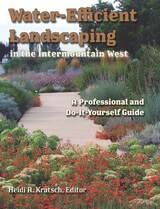
Water-Efficient Landscaping in the Intermountain West
A Professional and Do-It-Yourself GuideHeidi Kratsch
Utah State University Press, 2011
This working manual provides complete information on the technical aspects of designing, building, and maintaining waterwise landscapes in the Mountain West. Written particularly for professionals, including landscape designers, architects, contractors, and maintenance and irrigation specialists, it has an attractive, well-illustrated, user-friendly format that will make it useful as well to DIY homeowners and to educators, plant retailers, extension agents, and many others.
The manual is organized according to landscape principles that are adapted to the climate of the intermountain region. Beginning with planning and design, the topical principles proceed through soil preparation, appropriate plant selection, practicalities of turfgrass, use of mulch, and irrigation planning, winding up with landscape maintenance. Designed for onsite, handy use, the book is illustrated with color images of landscapes, plants, and materials. Tables, charts, diagrams, landscape plans, plant lists, checklists, and other graphic resources are scattered throughout the manual, which is written in an accessible but information-rich style. Water-Efficient Landscaping in the Intermountain West answers, more comprehensively than any other single book, the need for professional information that addresses both growing awareness of the necessity for water conservation and the desire for beautiful, healthy yards and properties.
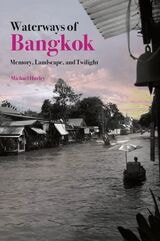
Waterways of Bangkok
Memory, Landscape and TwilightMichael Hurley
National University of Singapore Press, 2025
This ethnographic study explores memory along the waterways, a realm of boats and hovels, merchants and war captives, temples and ghosts. The river also flows into the dissonant realities of Thailand, a country of deep conflicts over power and national ideology. Based on research in a time of political turmoil, centered on the late years of the long-reigning monarch, Rama IX, this book invites readers to look beyond established images of Thai society. More broadly, this work will speak to readers interested in water, cities, and the bonds of memory and landscape.
What Is Art History?
Mark Roskill
University of Massachusetts Press, 1989
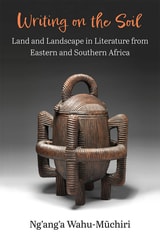
Writing on the Soil
Land and Landscape in Literature from Eastern and Southern AfricaNg’ang’a Wahu-Muchiri
University of Michigan Press, 2023
Across contiguous nation-states in Eastern Africa, the geographic proximity disguises an ideological complexity. Land has meant something fundamental in the sociocultural history of each country. Those concerns, however, have manifested into varied political events, and the range of struggles over land has spawned a multiplicity of literary interventions. While Kenya and Uganda were both British colonies, Kenya's experience of settler land alienation made for a much more violent response against efforts at political independence. Uganda's relatively calm unyoking from the colonial burden, however, led to a tumultuous post-independence. Tanzania, too, like Kenya and Uganda, resisted British colonial administration—after Germany's defeat in World War 1.
In Writing on the Soil, author Ng’ang’a Wahu-Mũchiriargues that representations of land and landscape perform significant metaphorical labor in African literatures, and this argument evolves across several geographical spaces. Each chapter's analysis is grounded in a particular locale: western Kenya, colonial Tanganyika, post-independence Tanzania, Zimbabwe, Nairobi, Dar es Salaam, Anam Ka'alakol (Lake Turkana), Kampala, and Kitgum in Northern Uganda. Moreover, each section contributes to a deeper understanding of the aesthetic choices that authors make when deploying tropes revolving around land, landscape, and the environment. Mũchiri disentangles the numerous connections between geography and geopolitical space on the one hand, and ideology and cultural analysis on the other. This book embodies a multi-layered argument in the sphere of African critical scholarship, while adding to the growing field of African land rights scholarship—an approach that foregrounds the close reading of Africa’s literary canon.