Results by title
108 books match the query 'Landscapes' and 4 start with w
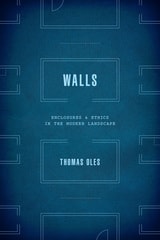
Walls
Enclosure and Ethics in the Modern LandscapeThomas Oles
University of Chicago Press, 2014
Stone walls, concrete walls, chain-link walls, border walls: we live in a world of walls. Walls mark sacred space and embody earthly power. They maintain peace and cause war. They enforce separation and create unity. They express identity and build community. Yard to nation, city to self, walls define and dissect our lives. And, for Thomas Oles, it is time to broaden our ideas of what they can—and must—do.
In Walls, Oles shows how our minds and our politics are shaped by–and shape–our divisions in the landscape. He traces the rich array of practices and meanings connected to the making and marking of boundaries across history and prehistory, and he describes how these practices have declined in recent centuries. The consequence, he argues, is all around us in the contemporary landscape, riven by walls shoddy in material and mean in spirit. Yet even today, Oles demonstrates, every wall remains potentially an opening, a stage, that critical place in the landscape where people present themselves and define their obligations to one another. In an evocative epilogue, Oles brings to life a society of productive, intentional, and ethical enclosure—one that will leave readers more hopeful about the divided landscapes of the future.
In Walls, Oles shows how our minds and our politics are shaped by–and shape–our divisions in the landscape. He traces the rich array of practices and meanings connected to the making and marking of boundaries across history and prehistory, and he describes how these practices have declined in recent centuries. The consequence, he argues, is all around us in the contemporary landscape, riven by walls shoddy in material and mean in spirit. Yet even today, Oles demonstrates, every wall remains potentially an opening, a stage, that critical place in the landscape where people present themselves and define their obligations to one another. In an evocative epilogue, Oles brings to life a society of productive, intentional, and ethical enclosure—one that will leave readers more hopeful about the divided landscapes of the future.
[more]
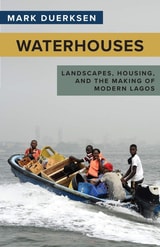
Waterhouses
Landscapes, Housing, and the Making of Modern LagosMark Duerksen
Ohio University Press, 2024
Waterhouses is about the places the people of Lagos have inhabited, imagined, and made home for the past two centuries. It asks what a house in Lagos is and explores how the answer to that question has been historically constructed and reconstructed in turn with the city’s changing landscapes. Written for historians of African and Atlantic history, scholars and practitioners of urbanism, and anyone looking to make sense of Africa’s most populous metropolis today, the book is an approachable history of how houses and water have formed modern Lagos. The book argues that in the coastlands from which Lagos rose, housing architectures were the single most important social, material, and political instruments for people hoping to contour the city’s landscapes—both its ecology and its image—and its historical course. The forms and meanings of houses in Lagos have shifted dramatically over time and in ways that reveal how power, house making, visual perception, and the environment are entangled in modern cities. The book’s chapters encompass six eras and six waterscapes: sandbars, canals, swamps, lagoons, oceans, and floods. These spaces guide the book’s exploration of how people saw and attempted to remake Lagos’s environs in a process that invariably involved housing architectures. At its core, Lagos is a city built through the materials, relations, and powers contained in the dry, solid, and hospitable spaces of homes, which have long been scarce and culturally celebrated resources in the city’s water-constricted setting. While shelter is integral to any city’s development, houses have been particularly important and sought after in Lagos because of the city’s land shortages and because of the societal influence and physical footprint of traditional Yoruba ilé (family compounds), in which activities were historically organized and centered. Through dozens of maps, photographs, and housing plans found in British and Nigerian archives, this book traces the relationship between Lagos’s residential spaces and its urban landscapes across the rise, fall, and aftermath of British colonization. By showing how Yoruba visions of home—though often forgotten or misunderstood today—coexisted with European notions, Waterhouses offers urban planners, policy makers, and architects ideas for how the definingly human act of inhabiting a place might be grounded in practices of continuous custodianship rather than extractive possession.
[more]
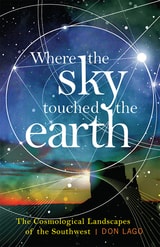
Where the Sky Touched the Earth
The Cosmological Landscapes of the SouthwestDon Lago
University of Nevada Press, 2017
The landscapes of the American Southwest—the Grand Canyon, Monument Valley, the Sedona red rocks—have long filled humans with wonder about nature. This is the home of Lowell Observatory, where astronomers first discovered evidence that the universe is expanding; Meteor Crater, where Apollo astronauts trained for the moon; and Native American tribes with their own ancient, rich ways of relating to the cosmos. With the personal, poetic style of the very best literary nature writing, Don Lago explores how these landscapes have offered humans a deeper sense of connection with the universe. While most nature writing never leaves the ground, Lago is one of the few writers who has applied it to the universe, seeking ties between humans and the astronomical forces that gave us birth.
Nowhere else in the world is the link between earth and sky so powerful. Lago witnesses a solar eclipse over the Grand Canyon, climbs primeval volcanos, and sees the universe in tree rings. Through ageless Native American ceremonies, modern telescopes, and even dreams of flying saucers, Lago, who is not only a poet but a true philosopher of science, strives to find order and meaning in the world and brings out the Southwest’s beauty and mystery.
Nowhere else in the world is the link between earth and sky so powerful. Lago witnesses a solar eclipse over the Grand Canyon, climbs primeval volcanos, and sees the universe in tree rings. Through ageless Native American ceremonies, modern telescopes, and even dreams of flying saucers, Lago, who is not only a poet but a true philosopher of science, strives to find order and meaning in the world and brings out the Southwest’s beauty and mystery.
[more]
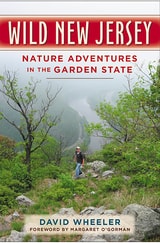
Wild New Jersey
Nature Adventures in the Garden StateDavid Wheeler
Rutgers University Press, 2011
The fastest animal on earth dive-bombs him from the skies. A young black bear bounds up a mountain trail a few yards away. Poisonous snakes swirl at his feet. A thousand bats careen past his head in a pitch-black roost. Pods of dolphins swim right past him by the scores. Who? Experienced naturalist David Wheeler. Where? In Wild New Jersey, of course.
Wild New Jersey invites readers along Wheeler’s whirlwind year-long tour of the most ecologically diverse state for its size in America. Along with the expert guidance of charismatic wildlife biologists and local conservationists, he explores mountains, valleys, beaches, pine barrens, caves, rivers, marshlands, and more—breathtaking landscapes and the state’s Noah’s Ark of fascinating creatures.
This isn’t your ordinary ride on the Jersey Turnpike. Fasten your seatbelts and join Wheeler as he . . .
- Kayaks through the Meadowlands under the watchful eye of the Empire State Building,
- Pans for cretaceous fossils in a hidden brook once home to mastodons and giant sloths,
- Rides a fishing boat in the frigid snows of winter on a high-seas quest for Atlantic puffins,
- Trudges through the eerie darkness of a bog on a mysterious night hike,
- Dogsleds across the windswept alpine slopes in the haunts of the porcupine and bobcat.
With Wheeler’s compelling narrative, in-depth background details, and eye for revealing the offbeat, you can count this as the first nature book to paint the extraordinary picture of New Jersey’s unlikely wilderness in all its glory. Come along for all the adventure and insight in Wild New Jersey!
[more]