Results by title
112 books match the query 'Languages' and 9 start with w
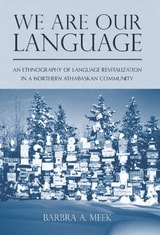
We Are Our Language
An Ethnography of Language Revitalization in a Northern Athabaskan CommunityBarbra A. Meek
University of Arizona Press, 2012
In presenting the case of Kaska, an endangered language in an Athabascan community in the Yukon, Barbra A. Meek asserts that language revitalization requires more than just linguistic rehabilitation; it demands a social transformation. The process must mend rips and tears in the social fabric of the language community that result from an enduring colonial history focused on termination. These “disjunctures” include government policies conflicting with community goals, widely varying teaching methods and generational viewpoints, and even clashing ideologies within the language community.
This book provides a detailed investigation of language revitalization based on more than two years of active participation in local language renewal efforts. Each chapter focuses on a different dimension, such as spelling and expertise, conversation and social status, family practices, and bureaucratic involvement in local language choices. Each situation illustrates the balance between the desire for linguistic continuity and the reality of disruption.
We Are Our Language reveals the subtle ways in which different conceptions and practices—historical, material, and interactional—can variably affect the state of an indigenous language, and it offers a critical step toward redefining success and achieving revitalization.
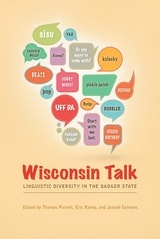
Wisconsin Talk
Linguistic Diversity in the Badger StateEdited by Thomas Purnell, Eric Raimy, and Joseph Salmons
University of Wisconsin Press, 2013
An engaging survey for both general readers and language scholars, Wisconsin Talk brings together perspectives from linguistics, history, cultural studies, and geography to illuminate why language matters in our everyday lives. The authors highlight such topics as:
• words distinctive to the state
• how recent and earlier immigrants have negotiated cultural and linguistic challenges
• the diversity of bilingual speakers that enriches our communities
• how maps can convey the stories of language
• the relation of Wisconsin's Indian languages to language loss worldwide.
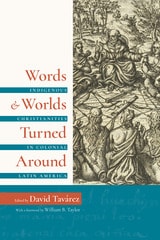
Words and Worlds Turned Around
Indigenous Christianities in Colonial Latin AmericaDavid Tavárez
University Press of Colorado, 2017
A sophisticated, state-of-the-art study of the remaking of Christianity by indigenous societies, Words and Worlds Turned Around reveals the manifold transformations of Christian discourses in the colonial Americas. The book surveys how Christian messages were rendered in indigenous languages; explores what was added, transformed, or glossed over; and ends with an epilogue about contemporary Nahuatl Christianities.
In eleven case studies drawn from eight Amerindian languages—Nahuatl, Northern and Valley Zapotec, Quechua, Yucatec Maya, K'iche' Maya, Q'eqchi' Maya, and Tupi—the authors address Christian texts and traditions that were repeatedly changed through translation—a process of “turning around” as conveyed in Classical Nahuatl. Through an examination of how Christian terms and practices were made, remade, and negotiated by both missionaries and native authors and audiences, the volume shows the conversion of indigenous peoples as an ongoing process influenced by what native societies sought, understood, or accepted.
The volume features a rapprochement of methodologies and assumptions employed in history, anthropology, and religion and combines the acuity of of methodologies drawn from philology and historical linguistics with the contextualizing force of the ethnohistory and social history of Spanish and Portuguese America.
Contributors: Claudia Brosseder, Louise M. Burkhart, Mark Christensen, John F. Chuchiak IV, Abelardo de la Cruz, Gregory Haimovich, Kittiya Lee, Ben Leeming, Julia Madajczak, Justyna Olko, Frauke Sachse, Garry Sparks
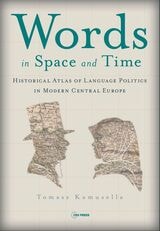
Words in Space and Time
A Historical Atlas of Language Politics in Modern Central EuropeTomasz Kamusella
Central European University Press, 2022
With forty-two extensively annotated maps, this atlas offers novel insights into the history and mechanics of how Central Europe’s languages have been made, unmade, and deployed for political action. The innovative combination of linguistics, history, and cartography makes a wealth of hard-to-reach knowledge readily available to both specialist and general readers. It combines information on languages, dialects, alphabets, religions, mass violence, or migrations over an extended period of time.
The story first focuses on Central Europe’s dialect continua, the emergence of states, and the spread of writing technology from the tenth century onward. Most maps concentrate on the last two centuries. The main storyline opens with the emergence of the Western European concept of the nation, in accord with which the ethnolinguistic nation-states of Italy and Germany were founded. In the Central European view, a “proper” nation is none other than the speech community of a single language. The Atlas aspires to help users make the intellectual leap of perceiving languages as products of human history and part of culture. Like states, nations, universities, towns, associations, art, beauty, religions, injustice, or atheism—languages are artefacts invented and shaped by individuals and their groups.
Words of the True Peoples/Palabras de los Seres Verdaderos
Anthology of Contemporary Mexican Indigenous-Language Writers/Antología de Escritores Actuales en Lenguas Indígenas de México: Volume One/Tomo Uno: Prose/ProsaEdited by Carlos Montemayor and Donald Frischmann
University of Texas Press, 2005
As part of the larger, ongoing movement throughout Latin America to reclaim non-Hispanic cultural heritages and identities, indigenous writers in Mexico are reappropriating the written word in their ancestral tongues and in Spanish. As a result, the long-marginalized, innermost feelings, needs, and worldviews of Mexico's ten to twenty million indigenous peoples are now being widely revealed to the Western societies with which these peoples coexist. To contribute to this process and serve as a bridge of intercultural communication and understanding, this groundbreaking, three-volume anthology gathers works by the leading generation of writers in thirteen Mexican indigenous languages: Nahuatl, Maya, Tzotzil, Tzeltal, Tojolabal, Tabasco Chontal, Purepecha, Sierra Zapoteco, Isthmus Zapoteco, Mazateco, Ñahñu, Totonaco, and Huichol.
Volume 1 contains narratives and essays by Mexican indigenous writers. Their texts appear first in their native language, followed by English and Spanish translations. Frischmann and Montemayor have abundantly annotated the English, Spanish, and indigenous-language texts and added glossaries and essays that trace the development of indigenous texts, literacy, and writing. These supporting materials make the anthology especially accessible and interesting for nonspecialist readers seeking a greater understanding of Mexico's indigenous peoples.
The other volumes of this work will be Volume 2: Poetry/Poesía and Volume 3: Theater/Teatro.
Words of the True Peoples/Palabras de los Seres Verdaderos
Anthology of Contemporary Mexican Indigenous-Language Writers/Antología de Escritores Actuales en Lenguas Indígenas de México: Volume Two/Tomo Dos: Poetry/PoesíaEdited by Carlos Montemayor and Donald Frischmann
University of Texas Press, 2005
As part of the larger, ongoing movement throughout Latin America to reclaim non-Hispanic cultural heritages and identities, indigenous writers in Mexico are reappropriating the written word in their ancestral tongues and in Spanish. As a result, the long-marginalized, innermost feelings, needs, and worldviews of Mexico's ten to twenty million indigenous peoples are now being widely revealed to the Western societies with which these peoples coexist. To contribute to this process and serve as a bridge of intercultural communication and understanding, this groundbreaking, three-volume anthology gathers works by the leading generation of writers in thirteen Mexican indigenous languages: Nahuatl, Maya, Tzotzil, Tzeltal, Tojolabal, Tabasco Chontal, Purepecha, Sierra Zapoteco, Isthmus Zapoteco, Mazateco, Ñahñu, Totonaco, and Huichol.
Volume Two contains poetry by Mexican indigenous writers. Their poems appear first in their native language, followed by English and Spanish translations. Montemayor and Frischmann have abundantly annotated the Spanish, English, and indigenous-language texts and added glossaries and essays that discuss the formal and linguistic qualities of the poems, as well as their place within contemporary poetry. These supporting materials make the anthology especially accessible and interesting for nonspecialist readers seeking a greater understanding of Mexico's indigenous peoples.

Words on Words
Quotations about Language and LanguagesEdited by David Crystal and Hilary Crystal
University of Chicago Press, 2000
The quotations are grouped thematically under 65 different headings, from "The Nature of Language" through the "Language of Politics" to "Quoting and Misquoting." This arrangement enables the reader to explore a topic through a variety of lenses, ancient and modern, domestic and foreign, scientific and casual, ironic and playful. Three thorough indexes—to authors, sources, and key words—provide different entry points into the collection. A valuable resource for professional writers and scholars, Words on Words is for anyone who loves language and all things linguistic.
Writing Without Words
Alternative Literacies in Mesoamerica and the AndesElizabeth Hill Boone and Walter D. Mignolo, eds.
Duke University Press, 1994
The contributors--who include art historians, anthropologists, and literary theorists--examine the ways in which ancient Mesoamerican and Andean peoples conveyed meaning through hieroglyphic, pictorial, and coded systems, systems inseparable from the ideologies they were developed to serve. We see, then, how these systems changed with the European invasion, and how uniquely colonial writing systems came to embody the post-conquest American ideologies. The authors also explore the role of these early systems in religious discourse and their relation to later colonial writing.
Bringing the insights from Mesoamerica and the Andes to bear on a fundamental exchange among art history, literary theory, semiotics, and anthropology, the volume reveals the power contained in the medium of writing.
Contributors. Elizabeth Hill Boone, Tom Cummins, Stephen Houston, Mark B. King, Dana Leibsohn, Walter D. Mignolo, John Monaghan, John M. D. Pohl, Joanne Rappaport, Peter van der Loo
Writing and Literacy in the World of Ancient Israel
Epigraphic Evidence from the Iron AgeChristopher A. Rollston
SBL Press, 2010