98 books match the query 'Law enforcement' and 7 start with w

cover of What is to Be Done About Law and Order?: Crisis in the Nineties

What is to Be Done About Law and Order?

Crisis in the Nineties

John Lea and Jock Young

Pluto Press, 1993

The authors look at the connection between democracy and efficiency as they investigate the meaning of law and order. The authors argue that only through a democratically accountable police service can we hope to build up relationships within the inner city.
[more]
cover of When Lambs Become Wolves: The Chilling Case of Sheila von Wiese-Mack

When Lambs Become Wolves

The Chilling Case of Sheila von Wiese-Mack

Sgt. Rasul T. Freelain (Ret.)

Southern Illinois University Press, 2026

A bold firsthand account of the circumstances surrounding the notorious Bali “Suitcase Murder” and the human cost of overlooking child-to-parent violence and abuse

On August 12, 2014, the body of 62-year-old Sheila von Wiese-Mack—the wealthy Oak Park, Illinois, widow of famed composer James L. Mack—was found stuffed inside a suitcase in the trunk of a taxi in Bali. Back in the Midwest, listening to the radio, Sgt. Rasul Freelain of the Oak Park Police Department pulled his car over to absorb the unthinkable news. Amid his shock, one coherent thought surfaced: “Heather did this.” 

Freelain had met the Macks more than three years earlier, when Sheila first reached out to the police for help with her increasingly volatile daughter. Although Heather Mack was just a teenager, she had already displayed a disturbing pattern of escalating violence. Freelain did everything he could to intervene. But as the abuse worsened, he found himself sidelined by a justice system unprepared to deal with child-to-parent violence and abuse (CPVA).

In this gripping and empathetic memoir, Freelain traces the Mack family’s descent from privilege to tragedy, bringing overdue attention to CPVA as a critical yet overlooked public health crisis. He recounts the glamorous but troubled world of the Macks—the parties, the talent, the dysfunction—and his efforts to support both mother and daughter. With rare insight into the web of trauma, race, wealth, and grief that surrounded them, he shows how the system failed them both—and how, even after Sheila’s death, he remained committed to seeking justice and change.

When Lambs Become Wolves moves beyond sensational headlines to examine the roots of one of America’s most hidden forms of domestic violence. While media coverage fixated on the exotic setting and shocking brutality of the crime, along with the growing notoriety of the teenage killer, Freelain urges readers—and institutions in law enforcement, child welfare, and mental health—to focus instead on those harmed. Sheila was more than a victim; she was a sharp, compassionate, creative woman who loved her daughter to the very end. Through meticulous research and raw personal reflection, Freelain explores how abuse cycles form, how institutions look away, and what it means to try—and fail—to protect someone in crisis.

This memoir, with a foreword by Sheila’s brother William Wiese, is a call to action, offering a rare blend of true crime, compassion, and advocacy. This deeply human account of a police officer caught in an impossible situation shows the price of ignoring the violence that starts at home.
[more]
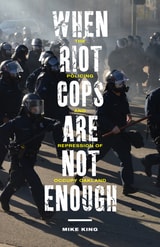
cover of When Riot Cops Are Not Enough: The Policing and Repression of Occupy Oakland

When Riot Cops Are Not Enough

The Policing and Repression of Occupy Oakland

King, Mike

Rutgers University Press, 2017

In When Riot Cops Are Not Enough, sociologist and activist Mike King examines the policing, and broader political repression, of the Occupy Oakland movement during the fall of 2011 through the spring of 2012. King’s active and daily participation in that movement, from its inception through its demise, provides a unique insider perspective to illustrate how the Oakland police and city administrators lost the ability to effectively control the movement.
 
Drawn from King’s intensive field work, the book focuses on the physical, legal, political, and ideological dimensions of repression—in the streets, in courtrooms, in the media, in city hall, and within the movement itself—When Riot Cops Are Not Enough highlights the central role of political legitimacy, both for mass movements seeking to create social change, as well as for governmental forces seeking to control such movements. Although Occupy Oakland was different from other Occupy sites in many respects, King shows how the contradictions it illuminated within both social movement and police strategies provide deep insights into the nature of protest policing generally, and a clear map to understanding the full range of social control techniques used in North America in the twenty-first century.

 
[more]
cover of Whiskey River Ranger: The Old West Life of Baz Outlaw

Whiskey River Ranger

The Old West Life of Baz Outlaw

Bob Alexander

University of North Texas Press, 2016

[more]
cover of Whose Rights?: Counterterrorism and the Dark Side of American Public Opinion

Whose Rights?

Counterterrorism and the Dark Side of American Public Opinion

Clem Brooks

Russell Sage Foundation, 2013

In the wake of the September 11 attacks, the U.S. government adopted a series of counterterrorism policies that radically altered the prevailing balance between civil liberties and security. These changes allowed for warrantless domestic surveillance, military commissions at Guantanamo Bay and even extralegal assassinations. Now, more than a decade after 9/11, these sharply contested measures appear poised to become lasting features of American government. What do Americans think about these policies? Where do they draw the line on what the government is allowed to do in the name of fighting terrorism? Drawing from a wealth of survey and experimental data, Whose Rights? explores the underlying sources of public attitudes toward the war on terror in a more detailed and comprehensive manner than has ever been attempted. In an analysis that deftly deploys the tools of political science and psychology, Whose Rights? addresses a vexing puzzle: Why does the counterterrorism agenda persist even as 9/11 recedes in time and the threat from Al Qaeda wanes? Authors Clem Brooks and Jeff Manza provocatively argue that American opinion, despite traditionally showing strong support for civil liberties, exhibits a “dark side” that tolerates illiberal policies in the face of a threat. Surveillance of American citizens, heightened airport security, the Patriot Act and targeted assassinations enjoy broad support among Americans, and these preferences have remained largely stable over the past decade. There are, however, important variations: Waterboarding and torture receive notably low levels of support, and counterterrorism activities sanctioned by formal legislation, as opposed to covert operations, tend to draw more favor. To better evaluate these trends, Whose Rights? examines the concept of “threat-priming” and finds that getting people to think about the specter of terrorism bolsters anew their willingness to support coercive measures. A series of experimental surveys also yields fascinating insight into the impact of national identity cues. When respondents are primed to think that American citizens would be targeted by harsh counterterrorism policies, support declines significantly. On the other hand, groups such as Muslims, foreigners, and people of Middle Eastern background elicit particularly negative attitudes and increase support for counterterrorism measures. Under the right conditions, Brooks and Manza show, American support for counterterrorism activities can be propelled upward by simple reminders of past terrorism plots and communication about disliked external groups. Whose Rights? convincingly argues that mass opinion plays a central role in the politics of contemporary counterterrorism policy. With their clarity and compelling evidence, Brooks and Manza offer much-needed insight into the policy responses to the defining conflict of our age and the psychological impact of terrorism.
[more]
cover of Winchester Warriors: Texas Rangers of Company D, 1874-1901

Winchester Warriors

Texas Rangers of Company D, 1874-1901

Bob Alexander

University of North Texas Press, 2009

[more]
cover of Writing the World of Policing: The Difference Ethnography Makes

Writing the World of Policing

The Difference Ethnography Makes

Edited by Didier Fassin

University of Chicago Press, 2017

As policing has recently become a major topic of public debate, it was also a growing area of ethnographic research. Writing the World of Policing brings together an international roster of scholars who have conducted fieldwork studies of law enforcement in disadvantaged urban neighborhoods on five continents. How, they ask, can ethnography illuminate the role of the police in society? Are there important aspects of policing that are not captured through interviews and statistics? And how can the study of law enforcement shed light on the practice of ethnography? What might studying policing teach us about the epistemological and ethical challenges of participant observation? Beyond these questions of crucial interest for criminology and, more generally, the social sciences, Writing the World of Policing provides a timely discussion of one of the most problematic institutions in contemporary society.
[more]