Results by title
124 books match the query 'Learning' and 4 start with w
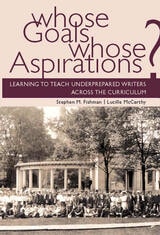
Whose Goals Whose Aspirations
Learning to Teach Underprepared Writers across the CurriculumStephen M. Fishman and Lucille McCarthy
Utah State University Press, 2002
Ever since Horace Mann promoted state supported schooling in the 1850s, the aims of U.S. public education have been the subject of heated national debate. Whose Goals? Whose Aspirations? joins this debate by exploring clashing educational aims in a discipline-based university classroom and the consequences of these clashes for "underprepared" writers.
In this close-up look at a White middle-class teacher and his ethnically diverse students, Fishman and McCarthy examine not only the role of Standard English in college writing instruction but also the underlying and highly charged issues of multiculturalism, race cognizance, and social class.
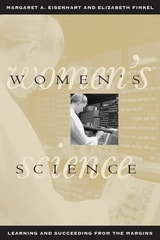
Women's Science
Learning and Succeeding from the MarginsMargaret A. Eisenhart and Elizabeth Finkel
University of Chicago Press, 1998
Women's Science offers a dramatic counterpoint not only to these findings but also to the related, narrow assumption that "real science" only occurs in research and laboratory investigation. This book describes women engaged with science or engineering at the margins: an innovative high school genetics class; a school-to-work internship for prospective engineers, an environmental action group, and a nonprofit conservation agency. In these places—where people use or rely on science for public, social, or community purposes—the authors found a remarkably high proportion of women. Moreover, these women were successful at learning and using technical knowledge, they advanced in roughly equal percentages to men, and they generally enjoyed their work.
Yet, even in these more marginal workplaces, women had to pay a price. Working outside traditional laboratories, they enjoy little public prestige and receive significantly less financial compensation. Although most employers claimed to treat men and women equally, women in fact only achieved success when they acted like male professionals.
Women's Science is an original and provocative contribution that expands our conception of scientific practice as it reconfigures both women's role in science and the meaning of science in contemporary society.
Work of Teaching Writing
Learning from Fiction, Film, and DramaJoseph Harris
Utah State University Press, 2020
Each chapter examines a fictional representation of writing classes—as portrayed in Dead Poets Society, Up the Down Staircase, Educating Rita, Push, and more—and shifts the conversation from how these works portray teachers to how they dramatize the actual work of teaching. Harris considers scenes of instruction from different stages of the writing process and depictions of students and teachers at work together to highlight the everyday aspects of teaching writing.
In the writing classroom the ideas of teachers come to life in the work of their students. The Work of Teaching Writing shows what fiction, film, and drama can convey about the moment of exchange between teacher and student as they work together to create new insights into writing. It will interest both high school and undergraduate English teachers, as well as graduate students and scholars in composition and rhetoric, literary studies, and film studies.
Writing Opportunities
Writing, Learning, and Rightful Presence in College TransitionsBrad Jacobson
Utah State University Press, 2026
Writing Opportunities presents in-depth text histories illustrating the interrelationship of writing, identities, and belonging in college writing transitions. Drawing on more than two years of research with three Latinx/a/o students transitioning from the same high school class to the local university, Brad Jacobson brings together analyses of interview transcripts, student writing, classroom genres, and institutional policies to foreground a sense of belonging as central to writing development and learning.
Including interviews with students and their instructors, Jacobson traces writing opportunities that Hercules, Jain, and Lucy were afforded as they transitioned from high school to college writing, particularly in general education courses. Chapters attend to multiple levels of interaction to show how policies, practices, and social histories can impact opportunities for learning. With attention to dominant discourses of writing that narrow what counts as good writing as well as positive opportunity structures that extend possibilities for identification, engagement, and deep learning, Jacobson also posits writing as an opportunity for writers to explore possibilities for who we are and who we may become.
Jacobson’s humanizing research invites readers to consider opportunity from multiple perspectives and shows how subtle shifts in relationships among students, instructors, and institutions can increase meaningful learning and provide a sense of belonging in educational contexts.