Results by title
642 books match the query 'Linguistics' and 16 start with w
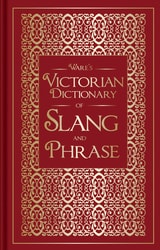
Ware's Victorian Dictionary of Slang and Phrase
J. Redding Ware
Bodleian Library Publishing, 2013
First published in 1909 and reproduced here with a new introduction by Oxford English Dictionary editor John Simpson, Ware’s Victorian Dictionary of Slang and Phrase reflects the rich history of unofficial English. Many of the expressions are obsolete; one is not likely to have the misfortune of encountering a “parlour jumper.” Order a “shant of bivvy” at the pub and you’ll be met with a blank stare. But some of the entries reveal the origins of expressions still in use today, such as calling someone a “bad egg” to indicate that they are dishonest or of ill-repute. While showing the significant influence of American English on Victorian slang, the Dictionary also demonstrates how impressively innovative its speakers were.
A treasure trove of everyday language of the nineteenth century, this book has much to offer in terms of insight into the intriguing history of English and will be of interest to anyone with a passion for words.
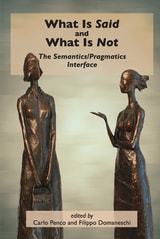
What Is Said and What Is Not
The Semantics/Pragmatics InterfaceEdited by Carlo Penco and Filippo Domaneschi
CSLI, 2013
What Makes Sound Patterns Expressive?
The Poetic Mode of Speech PerceptionReuven Tsur
Duke University Press, 1992
Research in recent decades has established two distinct types of aural perception: a nonspeech mode, in which the acoustic signals are received in the manner of musical sounds or natural noises; and a speech mode, in which acoustic signals are excluded from awareness and only an abstract phonetic category is perceived. Here, Tsur proposes a third type of speech perception, a poetic mode in which some part of the acoustic signal becomes accessible, however faintly, to consciousness.
Using Roman Jakobson’s model of childhood acquisition of the phonological system, Tsur shows how the nonreferential babbling sounds made by infants form a basis for aesthetic valuation of language. He tests the intersubjective and intercultural validity of various spatial and tactile metaphors for certain sounds. Illustrating his insights with reference to particular literary texts, Tsur considers the relative merits of cognitive and psychoanalytic approaches to the emotional symbolism of speech sounds.
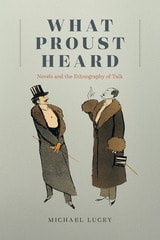
What Proust Heard
Novels and the Ethnography of TalkMichael Lucey
University of Chicago Press, 2022
What happens when we talk? This deceptively simple question is central to Marcel Proust’s monumental novel In Search of Lost Time. Both Proust’s narrator and the novel that houses him devote considerable energy to investigating not just what people are saying or doing when they talk, but also what happens socioculturally through their use of language. Proust, in other words, is interested in what linguistic anthropologists call language-in-use.
Michael Lucey elucidates Proust’s approach to language-in-use in a number of ways: principally in relation to linguistic anthropology, but also in relation to speech act theory, and to Pierre Bourdieu’s sociology. The book also includes an interlude after each of its chapters that contextualizes Proust’s social-scientific practice of novel writing in relation to that of a number of other novelists, earlier and later, and from several different traditions, including Honoré de Balzac, George Eliot, Virginia Woolf, Nathalie Sarraute, and Rachel Cusk. Lucey is thus able to show how, in the hands of quite different novelists, various aspects of the novel form become instruments of linguistic anthropological analysis. The result introduces a different way of understanding language to literary and cultural critics and explores the consequences of this new understanding for the practice of literary criticism more generally.
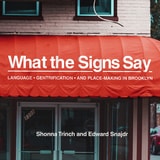
What the Signs Say
Language, Gentrification, and Place-Making in BrooklynShonna Trinch
Vanderbilt University Press, 2020
Shonna Trinch and Edward Snajdr, a sociolinguist and an anthropologist respectively, show how the beliefs and ideas that people take as truths about language and its speakers are deployed in these different sign types. They also present in-depth ethnographic case studies that reveal how gentrification and corporate redevelopment in Brooklyn are intimately connected to public communication, literacy practices, the transformation of motherhood and gender roles, notions of historical preservation, urban planning, and systems of privilege. Far from peripheral or irrelevant, shop signs say loud and clear that language displayed in public always matters.
This book is the recipient of the 2021 Norman L. and Roselea J. Goldberg Prize from Vanderbilt University Press for the best book in the area of art or medicine.
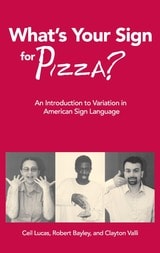
What's Your Sign for Pizza?
An Introduction to Variation in American Sign LanguageCeil Lucas
Gallaudet University Press, 2019
What’s Your Sign for Pizza? derives from an extensive seven-year research project in which more than 200 Deaf ASL users representing different ages, genders, and ethnic groups from seven different regions were filmed sharing their signs for everyday vocabulary. The film clips form a supplemental resource to the text and are referenced in their relevant chapters. The text begins with an explanation of the basic concepts of language and the structure of sign language. Each part of the text concludes with questions for discussion, and the final section offers three supplemental readings that provide further information on variation in both spoken and signed languages. What’s Your Sign for Pizza also briefly sketches the development of ASL, which explains the relationships between language varieties throughout the country.
The videos are available online at www.youtube.com/GallaudetUniversityPress.
When Words Lose Their Meaning
Constitutions and Reconstitutions of Language, Character, and CommunityJames Boyd White
University of Chicago Press, 1984
"In this ambitious and demanding work of literary criticism, James Boyd White seeks to communicate 'a sense of reading in a new and different way.' . . . [White's] marriage of lawyerly acumen and classically trained literary sensibility—equally evident in his earlier work, The Legal Imagination—gives the best parts of When Words Lose Their Meaning a gravity and moral earnestness rare in the pages of contemporary literary criticism."—Roger Kimball, American Scholar
"James Boyd White makes a state-of-the-art attempt to enrich legal theory with the insights of modern literary theory. Of its kind, it is a singular and standout achievement. . . . [White's] selections span the whole range of legal, literary, and political offerings, and his writing evidences a sustained and intimate experience with these texts. Writing with natural elegance, White manages to be insightful and inciteful. Throughout, his timely book is energized by an urgent love of literature and law and their liberating potential. His passion and sincerity are palpable."—Allan C. Hutchinson, Yale Law Journal
"Undeniably a unique and significant work. . . . When Words Lose Their Meaning is a rewarding book by a distinguished legal scholar. It is a showcase for the most interesting sort of inter-disciplinary work: the kind that brings together from traditionally separate fields not so much information as ideas and approaches."—R. B. Kershner, Jr., Georgia Review
Whose Goals Whose Aspirations
Learning to Teach Underprepared Writers across the CurriculumStephen M. Fishman and Lucille McCarthy
Utah State University Press, 2002
Ever since Horace Mann promoted state supported schooling in the 1850s, the aims of U.S. public education have been the subject of heated national debate. Whose Goals? Whose Aspirations? joins this debate by exploring clashing educational aims in a discipline-based university classroom and the consequences of these clashes for "underprepared" writers.
In this close-up look at a White middle-class teacher and his ethnically diverse students, Fishman and McCarthy examine not only the role of Standard English in college writing instruction but also the underlying and highly charged issues of multiculturalism, race cognizance, and social class.
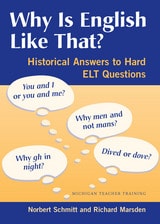
Why Is English Like That?
Historical Answers to Hard ELT QuestionsNorbert Schmitt and Richard Marsden
University of Michigan Press, 2006
The book outlines the historical events that shaped English; describes how its grammar, vocabulary, spelling, and pronunciation developed over time; and highlights the "quirks" and "exceptions" in English that can be explained on a historical basis. By understanding how the English of today evolved from the English of past times, both teachers and students will be more comfortable with the many conventions of the English language.
Why Is English Like That? also contains reproducible grammar and vocabulary exercises that will help teachers incorporate some of this historical knowledge into classroom activities. This book was written with English language teachers in mind, and the exercises are designed for ESL/EFL students, but it may also be used by teachers in training (L1 and L2).
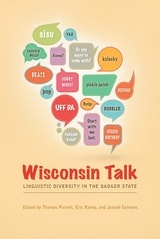
Wisconsin Talk
Linguistic Diversity in the Badger StateEdited by Thomas Purnell, Eric Raimy, and Joseph Salmons
University of Wisconsin Press, 2013
An engaging survey for both general readers and language scholars, Wisconsin Talk brings together perspectives from linguistics, history, cultural studies, and geography to illuminate why language matters in our everyday lives. The authors highlight such topics as:
• words distinctive to the state
• how recent and earlier immigrants have negotiated cultural and linguistic challenges
• the diversity of bilingual speakers that enriches our communities
• how maps can convey the stories of language
• the relation of Wisconsin's Indian languages to language loss worldwide.
Women, Fire, and Dangerous Things
What Categories Reveal about the MindGeorge Lakoff
University of Chicago Press, 1987
In Women, Fire, and Dangerous Things, George M. Lakoff takes on the classical theory of categorization, which argues that the classes into which our minds and language group things and people are clearly defined and have strict boundaries. Lakoff argues instead that the mind and language build categories around protoypical examples, and that categories then radiate out from those central types. The book argues for embodied cognition and makes a powerful case that meaning cannot be reduced to abstract symbols or removed from the physical experiences of human perception.
Word Structure in Ngalakgan
Brett Baker
CSLI, 2008
Words and Contents
Richard Vallée
CSLI, 2018
Words and the Grammar of Context
Paul Kay
CSLI, 1997
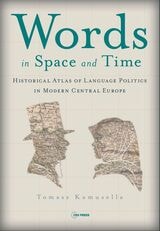
Words in Space and Time
A Historical Atlas of Language Politics in Modern Central EuropeTomasz Kamusella
Central European University Press, 2022
With forty-two extensively annotated maps, this atlas offers novel insights into the history and mechanics of how Central Europe’s languages have been made, unmade, and deployed for political action. The innovative combination of linguistics, history, and cartography makes a wealth of hard-to-reach knowledge readily available to both specialist and general readers. It combines information on languages, dialects, alphabets, religions, mass violence, or migrations over an extended period of time.
The story first focuses on Central Europe’s dialect continua, the emergence of states, and the spread of writing technology from the tenth century onward. Most maps concentrate on the last two centuries. The main storyline opens with the emergence of the Western European concept of the nation, in accord with which the ethnolinguistic nation-states of Italy and Germany were founded. In the Central European view, a “proper” nation is none other than the speech community of a single language. The Atlas aspires to help users make the intellectual leap of perceiving languages as products of human history and part of culture. Like states, nations, universities, towns, associations, art, beauty, religions, injustice, or atheism—languages are artefacts invented and shaped by individuals and their groups.

Words on Words
Quotations about Language and LanguagesEdited by David Crystal and Hilary Crystal
University of Chicago Press, 2000
The quotations are grouped thematically under 65 different headings, from "The Nature of Language" through the "Language of Politics" to "Quoting and Misquoting." This arrangement enables the reader to explore a topic through a variety of lenses, ancient and modern, domestic and foreign, scientific and casual, ironic and playful. Three thorough indexes—to authors, sources, and key words—provide different entry points into the collection. A valuable resource for professional writers and scholars, Words on Words is for anyone who loves language and all things linguistic.