Results by title
121 books match the query 'Literacy' and 7 start with w
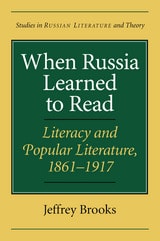
When Russia Learned to Read
Literacy and Popular Literature, 1861-1917Jeffrey Brooks
Northwestern University Press, 2003
With a new introduction that underscores its relevance to a post-Soviet Russia, When Russia Learned to Read addresses the question of Russia's common heritage with the liberal democratic market societies of Western Europe and the United States. This prize-winning book also exposes the unsuspected complexities of a mass culture little known and less understood in the West. Jeffrey Brooks brings out the characteristically Russian aspect of the nation's popular writing as he ranges through chapbooks, detective stories, newspaper serials, and women's fiction, tracing the emergence of secular, rational, and cosmopolitan values along with newly minted notions of individual initiative and talent. He shows how crude popular tales and serials of the era find their echoes in the literary themes of Dostoevsky, Tolstoy, and other great Russian writers, as well as in the current renaissance of Russian detective stories and thrillers.
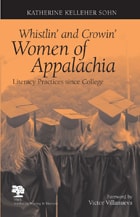
Whistlin' and Crowin' Women of Appalachia
Literacy Practices Since CollegeKatherine Kelleher Sohn. Foreword by Victor Villanueva
Southern Illinois University Press, 2006
Even some enlightened academicians automatically—and incorrectly—connect illiteracy to Appalachia, contends Katherine Kelleher Sohn. After overhearing two education professionals refer to the southern accent of a waiter and then launch into a few redneck jokes, Sohn wondered why rural, working-class white people are not considered part of the multicultural community. Whistlin’ and Crowin’ Women of Appalachia: Literacy Practices since College examines the power of women to rise above cultural constraints, complete their college degrees, assume positions of responsibility, and ultimately come to voice.
Sohn, a born southerner and assimilated Appalachian who moved from the city more than thirty years ago, argues that an underclass of rural whites is being left out of multicultural conversations. She shares how her own search for identity in the academic world (after enrolling in a doctoral program at age fifty) parallels the journeys of eight nontraditional, working-class women. Through interviews and case studies, Sohn illustrates how academic literacy empowers women in their homes, jobs, and communities, effectively disproving the Appalachian adage: “Whistlin’ women and crowin’ hens, always come to no good ends.”
Sohn situates the women’s stories within the context of theory, self confidence, and place. She weaves the women’s words with her own, relating voice to language, identity, and power. As the women move from silence to voice throughout and after college—by maintaining their dialect, discovering the power of expressivist writing, gaining economic and social power, and remaining in their communities—they discover their identity as strong women of Appalachia.
Sohn focuses on the power of place, which figures predominantly in the identity of these women, and colorfully describes the region. These Appalachian women who move from silence to voice are the purveyors of literacy and the keepers of community, says Sohn. Serving as the foundation of Appalachian culture in spite of a patriarchal society, the women shape the region even as it shapes them.
Geared to scholars of literacy studies, women’s studies, and regional studies, Whistlin’ and Crowin’ Women of Appalachia will also resonate with those working with other marginalized populations who are isolated economically, geographically, or culturally.
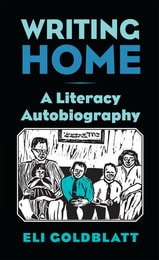
Writing Home
A Literacy AutobiographyEli Goldblatt
Southern Illinois University Press, 2012
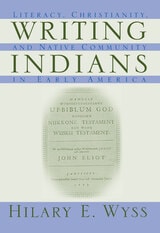
Writing Indians
Literacy, Christianity, and Native Community in Early AmericaHilary E. Wyss
University of Massachusetts Press, 2000
A study of cultural encounter, this book takes a fresh look at the much ignored and often misunderstood experience of Christian Indians in early America. Focusing on New England missionary settlements from the mid-seventeenth to the early nineteenth centuries, Hilary E. Wyss examines the ways in which Native American converts to Christianity developed their own distinct identity within the context of a colonial culture.
With an approach that weaves together literature, religious studies, and ethno-history, Wyss grounds her work in the analysis of a rarely read body of “autobiographical” writings by Christian Indians, including letters, journal entries, and religious confessions. She then juxtaposes these documents to the writings of better known Native Americans like Samson Occom as well as to the published works of Anglo-Americans, such as Mary Rowlandson's famous captivity narrative and Eleazor Wheelock's accounts of his charity schools.
In their search for ostensibly “authentic” Native voices, scholars have tended to overlook the writings of Christian Indians. Yet, Wyss argues, these texts reveal the emergence of a dynamic Native American identity through Christianity. More specifically, they show how the active appropriation of New England Protestantism contributed to the formation of a particular Indian identity that resisted colonialism by using its language against itself.
Writing Studies Research in Practice
Methods and MethodologiesEdited by Lee Nickoson and Mary P. Sheridan, Foreword by Gesa E. Kirsch
Southern Illinois University Press, 2012
An essential reference for students and scholars exploring the methods and methodologies of writing research.
What does it mean to research writing today? What are the practical and theoretical issues researchers face when approaching writing as they do? What are the gains or limitations of applying particular methods, and what might researchers be overlooking? These questions and more are answered by the writing research field’s leading scholars in Writing Studies Research in Practice: Methods and Methodologies.
Editors Nickoson and Sheridan gather twenty chapters from leaders in writing research, spanning topics from ethical considerations for researchers, quantitative methods, and activity analysis to interviewing and communitybased and Internet research. While each chapter addresses a different subject, the volume as a whole covers the range of methodologies, technologies, and approaches—both old and new—that writing researchers use, and examines the ways in which contemporary writing research is understood, practiced, and represented.
An essential reference for experienced researchers and an invaluable tool to help novices understand research methods and methodologies, Writing Studies Research in Practice includes established methods and knowledge while addressing the contemporary issues, interests, and concerns faced by writing researchers today.
Writing and Literacy in the World of Ancient Israel
Epigraphic Evidence from the Iron AgeChristopher A. Rollston
SBL Press, 2010
Writing as Punishment in Schools, Courts, and Everyday Life
Spencer Schaffner
University of Alabama Press, 2019
Writing tends to be characterized as a positive aspect of literacy that helps us to express our thoughts, to foster interpersonal communication, and to archive ideas. However, there is a vast array of evidence that emphasizes the counterbelief that writing has the power to punish, shame, humiliate, control, dehumanize, fetishize, and transform those who are subjected to it. In Writing as Punishment in Schools, Courts, and Everyday Life, Spencer Schaffner looks at many instances of writing as punishment, including forced tattooing, drunk shaming, court-ordered letters of apology, and social media shaming, with the aim of bringing understanding and recognition to the coupling of literacy and subjection.
Writing as Punishment in Schools, Courts, and Everyday Life is a fascinating inquiry into how sinister writing can truly be and directly questions the educational ideal that powerful writing is invariably a public good. While Schaffner does look at the darker side of writing, he neither vilifies nor supports the practice of writing as punishment. Rather, he investigates the question with humanistic inquiry and focuses on what can be learned from understanding the many strange ways that writing as punishment is used to accomplish fundamental objectives in everyday life.
Through five succinct case studies, we meet teachers, judges, parents, sex traffickers, and drunken partiers who have turned to writing because of its presumed power over writers and readers. Schaffner provides careful analysis of familiar punishments, such as schoolchildren copying lines, and more bizarre public rituals that result in ink-covered bodies and individuals forced to hold signs in public.
Schaffner argues that writing-based punishment should not be dismissed as benign or condemned as a misguided perversion of writing, but instead should be understood as an instrument capable of furthering both the aims of justice and degradation.