Results by title
65 books match the query 'Literature and the war' and 2 start with w
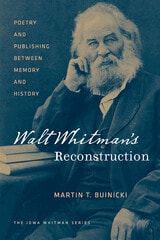
Walt Whitman's Reconstruction
Poetry and Publishing between Memory and HistoryMartin T. Buinicki
University of Iowa Press, 2012
For Walt Whitman, living and working in Washington, D.C., after the Civil War, Reconstruction meant not only navigating these tumultuous years alongside his fellow citizens but also coming to terms with his own memories of the war. Just as the work of national reconstruction would continue long past its official end in 1877, Whitman’s own reconstruction would continue throughout the remainder of his life as he worked to revise his poetic project—and his public image—to incorporate the disasters that had befallen the Union. In this innovative and insightful analysis of the considerable poetic and personal reimagining that is the hallmark of these postwar years, Martin Buinicki reveals the ways that Whitman reconstructed and read the war.
Writing Vietnam, Writing Life
Caputo, Heinemann, O'Brien, ButlerTobey C. Herzog
University of Iowa Press, 2008
Philip Caputo, Larry Heinemann, Tim O'Brien, and Robert Olen Butler: four young midwestern Americans coming of age during the 1960s who faced a difficult personal decision—whether or not to fight in Vietnam. Each chose to participate. After coming home, these four veterans became prizewinning authors telling the war stories and life stories of soldiers and civilians. The four extended conversations included in Writing Vietnam, Writing Life feature revealing personal stories alongside candid assessments of each author's distinct roles as son, soldier, writer, and teacher of creative writing.
As Tobey Herzog's thoughtful interviews reveal, these soldier-authors have diverse upbringings, values, interests, writing careers, life experiences, and literary voices. They hold wide-ranging views on, among other things, fatherhood, war, the military, religion, the creative process, the current state of the world, and the nature of both physical and moral courage. For each author, the conversation and richly annotated chronology provide an overview of the writer's life, the intersection of memory and imagination in his writing, and the path of his literary career. Together, these four life stories also offer mini-tableaux of the fascinating and troubling time of 1960s and 1970s America. Above all, the conversations reveal that each author is linked forever to the Vietnam War, the country of Vietnam, and its people.