163 books match the query 'Living' and 4 start with w
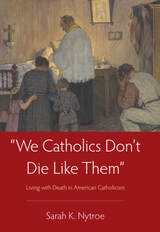
cover of We Catholics Don't Die Like Them: Living with Death Before Vatican II

We Catholics Don't Die Like Them

Living with Death Before Vatican II

Sarah Nytroe

Catholic University of America Press, 2026
We Catholics Don’t Die Like Them is the study of a minimally explored topic in American religious history, that of the Catholic approach to death and dying in the first half of the 20th century. Moreover, it advances scholarly understanding of three interrelated themes: cultural and social views of death and practices of dying; the Catholic religious culture and experience before the Second Vatican Council; and the relationship between Catholicism and modernity. While historians and scholars have explored these themes independently, this study seeks to draw them together in a manner that has yet to be fully considered. Finally, the study is grounded in a rich body of primary sources, the everyday religious literature produced to sustain the good death among Catholics. First, scholars from various disciplinary backgrounds, including history, have studied sociocultural attitudes about death and experiences of dying, those of both the past and the present. Those historical studies that examine death and dying do so through the lens of the Protestant religious culture and experience, giving limited to no attention to American Catholicism. Studies that have examined the Catholic approach to death and dying primarily focus on beliefs and practices in the medieval to early modern Church. Rarely have scholars extended the narrative into the modern period, especially the 20th century United States. This scholarly silence is surprising considering that historians have increasingly examined multiple dimensions of American Catholicism and the dynamic relationship between the institution and the "people in the pews." This study seeks to draw attention to this feature of the American Catholic religious culture and how it paralleled other aspects of the pre-Vatican II Catholic culture. Lastly, historians have long studied the relationship between Catholicism and modernity. Numerous studies have examined the ambivalence that existed in the Church towards the ideas, values, and structures of modernity in the pre-conciliar American context. Institutional anxiousness about the influence of modernity permeated the religious culture and the everyday lives of practicing Catholics. Church authorities remained apprehensive about how modern ideas influenced the faithful’s thoughts about death, how they died, how the living supported the dying in their last hour, and how they remembered the dead. This sense of anxiousness emerges in the content and tone of the religious literature produced for Catholics, and yet, historians have yet to fully explore this feature of the relationship.
[more]
cover of West of 98: Living and Writing the New American West

West of 98

Living and Writing the New American West

Edited by Lynn Stegner and Russell Rowland

University of Texas Press, 2011

What does it mean to be a westerner? With all the mythology that has grown up about the American West, is it even possible to describe "how it was, how it is, here, in the West—just that," in the words of Lynn Stegner? Starting with that challenge, Stegner and Russell Rowland invited several dozen members of the western literary tribe to write about living in the West and being a western writer in particular. West of 98 gathers sixty-six literary testimonies, in essays and poetry, from a stellar collection of writers who represent every state west of the 98th parallel—a kind of Greek chorus of the most prominent voices in western literature today, who seek to "characterize the West as each of us grew to know it, and, equally important, the West that is still becoming."

In West of 98, western writers speak to the ways in which the West imprints itself on the people who live there, as well as how the people of the West create the personality of the region. The writers explore the western landscape—how it has been revered and abused across centuries—and the inescapable limitations its aridity puts on all dreams of conquest and development. They dismantle the boosterism of manifest destiny and the cowboy and mountain man ethos of every-man-for-himself, and show instead how we must create new narratives of cooperation if we are to survive in this spare and beautiful country. The writers seek to define the essence of both actual and metaphoric wilderness as they journey toward a West that might honestly be called home.

A collective declaration not of our independence but of our interdependence with the land and with each other, West of 98 opens up a whole new panorama of the western experience.
[more]
cover of Wheeling and Dealing: Living with Spinal Cord Injury

Wheeling and Dealing

Living with Spinal Cord Injury

Esther Isabelle Wilder

Vanderbilt University Press, 2006

Before his motorcycle accident, Travis saw himself becoming a pro football player. Now, paralyzed from the nipple down, he says, "At times it's a pain in the ass-literally and figuratively. But it allows me to not be as threatening to some people [the way I was when] I was still an athlete. Because a lot of times male interaction is done on the basis of pissing contests: I'm bigger, I'm tougher, I'm stronger, I'm smarter. When you're in a chair, they don't look at you like that." At the same time, Travis complains that many people are uncomfortable interacting with him because of his disability. "I would rather you make a mistake and deal with me than not deal with me at all."<>

Meghan is a high-level quadriplegic, living alone, who uses a power wheelchair and requires daily attendant care. She laments, "There are so many people who think we're asexual, we're not pretty, and we're creeps and weirdoes." To dispel this myth, she envisions a fashion show of women in wheelchairs parading down a runway. Meghan has been involved in a number of sexual relationships since sustaining her injury. While she doesn't think her disability has diminished her sexual pleasure, she feels that it has affected her sexual performance: "Well, you can't move it. You can't, like, bump and grind."


In 32 unusually frank in-depth interviews like these, the men and women in this book freely discuss their sex lives, their beliefs about God, how they want others to treat them, and whether they want to walk again. In each chapter the author presents their complex voices and comprehensive research about different facets of spinal cord injury (SCI).


Wheeling and Dealing explores the extent to which people with spinal cord injury locate their challenges in their physical impairments or in the social environment. Some disagree with those disability activists who focus almost exclusively on the latter, but the author examines this issue in depth.


Topics include:

--Physical health from degrees of loss of function to problems like pressure sores, temperature regulation, and bladder control.

--The stages of psychological adjustment and rehabilitation.

--Obstacles to sexual intimacy, treatment of erectile dysfunction, and new sources of sexual pleasure and emotional intimacy.

--Religion and spirituality.

--Social and political beliefs, with those with SCI weighing in on everything from welfare services to embryonic stem cell research.

--Dating, marriage, and parenting.

--Friendship networks and social supports; concerns about transportation and accessibility; stigma.

--Education, employment, and economic consequences.


This book is the recipient of the 2004 Norman L. and Roselea J. Goldberg Prize from Vanderbilt University Press for the best project in the area of medicine.
[more]
cover of When the Bones Speak: The Living, the Dead, and the Sacrifice of Contemporary Okinawa

When the Bones Speak

The Living, the Dead, and the Sacrifice of Contemporary Okinawa

Christopher T. Nelson

Duke University Press, 2025

Haunted by the past, ordinary Okinawans struggle to live with the unbearable legacies of war, Japanese nationalism, and American imperialism. They are caught up in a web of people and practices—living and dead, visible and immaterial—that exert powerful forces often beyond their control. In When the Bones Speak, Christopher T. Nelson examines the myriad ways contemporary Okinawans experience, remember, and contest sacrifice. He attends to the voices of those who find their vocation in service to others, from shamans, fortune tellers, laborers, and artists to dead soldiers, war survivors, antiwar activists, and Christian missionaries. Nelson shows how the memories of past sacrifices, atrocities, and exploitation as well as residual trauma shape modern life in Okinawa and the possibility and hope for creative action grounded in the everyday. Offering new understandings of colonial transformation, wartime violence, and military occupation, Nelson writes from the intersection of temporalities and possibilities, where the hard finality of the past may be broken open to reveal a “not yet” that has always remained just beyond reach.
[more]