Results by title
156 books match the query 'Los Angeles' and 5 start with w

Wallbangin'
Graffiti and Gangs in L.A.Susan A. Phillips
University of Chicago Press, 1999
Graffiti is as ubiquitous as telephone poles in America's cities; it is as old as the earliest civilizations. The most public medium in the country today, graffiti can signal territory, love, or liberation. Ironically, graffiti is understood by only a fraction of those who encounter it. Usually read as a sign of urban decay and as a loss of control over the physical environment, graffiti has become one of the most potent cultural languages of our age. Wallbangin' is an unprecedented, in-depth look at this phenomenon as it is embodied in the neighborhoods of one of its epicenters, Los Angeles.
Anthropologist Susan Phillips enters the lives of the African-American and Chicano gang members to write a comprehensive guide to their symbolic and visual expression. She not only decodes the graffiti—explaining how, for instance, gang boundaries are visually delimited and how "memorial" graffiti functions—but she also places it in the context of the changing urban landscapes within the city. Graffiti, she argues, is inextricably linked to political change, to race, and to art, and she demonstrates how those connections are played out in contemporary L.A. Wallbangin' is, on this level, an iconography of street imagery. But it is also a very personal narrative about entering the world of L.A. street gangs—a world of pride, enemies, affirmation, and humanity where gang members use graffiti to redefine their social and political position in society.
To many outsiders, graffiti is cryptic, senseless scribbling. But Phillips explains it as an ingenious and creative solution to the disenfranchisement felt by those who produce it. With personal narratives, provocative photography, and contemporary voices, Wallbangin' unlocks the mysteries behind street-level ideologies and their visual manifestations.
[more]

Weimar Under the Palms
Pacific Palisades, German Exiles, and the Invention of HollywoodThomas Blubacher
Brandeis University Press, 2025
The story of the German exiles—and cultural titans—who settled in Pacific Palisades and influenced American culture.
In the early twentieth century, Pacific Palisades was home to America’s most modern film studio of the time as well as the proposed site of the world’s largest Christian center. But by the end of the 1920s, the Los Angeles neighborhood had become the refuge of the rich and beautiful as German and Austrian filmmakers, among them Salka and Berthold Viertel, settled there. They were soon followed by cultural and intellectual giants of the Weimar Republic who were fleeing Europe, such as Max Reinhardt, Hanns Eisler, or Max Horkheimer. These great minds turned Pacific Palisades into a “Weimar under the palm trees.” Though many were successful in exile—including Vicki Baum, Thomas Mann, and Lion Feuchtwanger—others felt as if they were in a “sun prison” far from home.
Recounting a story of glamor and great minds, Thomas Blubacher tells of the history of German-speaking exiles that is still alive there today, going on a foray through the film industry, taking us on a journey to this special place that was so recently devastated by fire. Many of the homes in this book have now gone, but Marta Feuchtwanger’s Villa Aurora and the Thomas Mann house still stand as a testament to luck, resilience, and history.
[more]
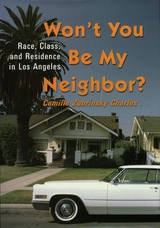
Won't You be My Neighbor
Race, Class, and Residence in Los AngelesCamille Zubrinksy Charles
Russell Sage Foundation, 2006
Los Angeles is a city of delicate racial and ethnic balance. As evidenced by the 1965 Watts violence, the 1992 Rodney King riots, and this year's award-winning film Crash, the city's myriad racial groups coexist uneasily together, often on the brink of confrontation. In fact, Los Angeles is highly segregated, with racial and ethnic groups clustered in homogeneous neighborhoods. These residential groupings have profound effects on the economic well-being and quality of life of residents, dictating which jobs they can access, which social networks they can tap in to, and which schools they attend. In Won't You Be My Neighbor?, sociologist Camille Zubrinsky Charles explores how modern racial attitudes shape and are shaped by the places in which people live. Using in-depth survey data and information from focus groups with members of L.A.'s largest racial and ethnic groups, Won't You Be My Neighbor? explores why Los Angeles remains a segregated city. Charles finds that people of all backgrounds prefer both racial integration and a critical mass of same-race neighbors. When asked to reveal their preferred level of racial integration, people of all races show a clear and consistent order of preference, with whites considered the most highly desired neighbors and blacks the least desirable. This is even true among recent immigrants who have little experience with American race relations. Charles finds that these preferences, which are driven primarily by racial prejudice and minority-group fears of white hostility, taken together with financial considerations, strongly affect people's decisions about where they live. Still, Charles offers reasons for optimism: over time and with increased exposure to other racial and ethnic groups, people show an increased willingness to live with neighbors of other races. In a racially and ethnically diverse city, segregated neighborhoods can foster distrust, reinforce stereotypes, and agitate inter-group tensions. Won't You Be My Neighbor? zeroes in on segregated neighborhoods to provide a compelling examination of the way contemporary racial attitudes shape, and are shaped by, the places where we live.
[more]

World Film Locations
Los AngelesEdited by Gabriel Solomons
Intellect Books, 2011
The heart of Hollywood’s star-studded film industry for more than a century, Los Angeles and its abundant and ever-changing locales—from the Santa Monica Pier to the infamous and now-defunct Ambassador Hotel—have set the scene for a wide variety of cinematic treasures, from Chinatown to Forrest Gump, Falling Down to the coming-of-age classic Boyz n The Hood. This volume marks an engaging citywide tour of the many films shot on location in this birthplace of cinema and the screen spectacle.
World Film Locations: Los Angeles pairs fifty incisive synopses of carefully chosen film scenes—both famous and lesser-known—with an accompanying array of evocative full-color film stills, demonstrating how motion pictures have contributed to the multifarious role of the city in our collective consciousness, as well as how key cinematic moments reveal aspects of its life and culture that are otherwise largely hidden from view. Insightful essays throughout turn the spotlight on the important directors, thematic elements, and historical periods that provide insight into Los Angeles and its vibrant cinematic culture. Rounding out this information are city maps with information on how to locate key features, as well as photographs showing featured locations as they appear now.
A guided tour of the City of Angels conducted by the likes of Robert Altman, Nicholas Ray, Michael Mann, and Roman Polanski, World Film Locations: Los Angeles is moreover a concise and user-friendly guide to how Los Angeles has captured the imaginations of both filmmakers and those of us sitting transfixed in theatres worldwide.
[more]
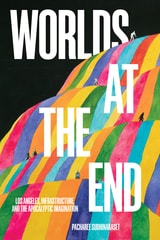
Worlds at the End
Los Angeles, Infrastructure, and the Apocalyptic ImaginationPacharee Sudhinaraset
Temple University Press, 2024
Worlds at the End attends to a body of literature that renders Los Angeles’s infrastructure, or its material foundations, as central to the rise and consolidation of colonial life. Pacharee Sudhinaraset employs a women-of-color feminist methodology to examine Indigenous, Black, Asian American, and Latinx literary works about apocalypse and the end times.
Worlds at the End analyzes destruction, rupture, and continuance through texts ranging from Karen Tei Yamashita’s Tropic of Orange, which considers racial colonial infrastructure, to the work of Diné poet Esther Belin, which illuminates how the separation between the Indian reservation and LA is part of a broader infrastructural network of termination. And she unpacks Octavia Butler’s post-apocalyptic novel, Parable of the Sower, where LA’s freeways and roadways are routes of forced migration, colonization, and flight.
Tearing down existing institutions that marginalize people of color and moving past them, Worlds at the End highlights the imaginaries of those subjugated, racialized, and made other, for whom modernity, freedom, and progress meant violence, brutality, and relegation to the status of devalued surplus populations. As Sudhinaraset deftly shows, the apocalypse marks moments of historical and spatial transition, offering stories of doomsdays that will give rise to resurgence and regeneration.
[more]